
Developers love the phrase "visa eligible", and agents often say that any property above AED 2 million will do. In practice, the Golden Visa is decided by how the property is classified and registered, not by how it is marketed. Two units with the same price can be treated very differently.
If you are buying with residency in mind, it pays to know the categories before you sign anything. This guide walks through the main property types, what each needs in order to count, and which ones tend to cause trouble.
01The starting point: AED 2 million, registered in your name
The property route asks for UAE property worth AED 2 million or more. That can be a single home or several deeds added together. The ownership has to be recorded with the land department, so a verbal agreement, a reservation form or a developer's email is not enough on its own.
Everything below is a variation on that idea: is the asset a genuine, registered residential holding that belongs to you?
02Property types that usually work
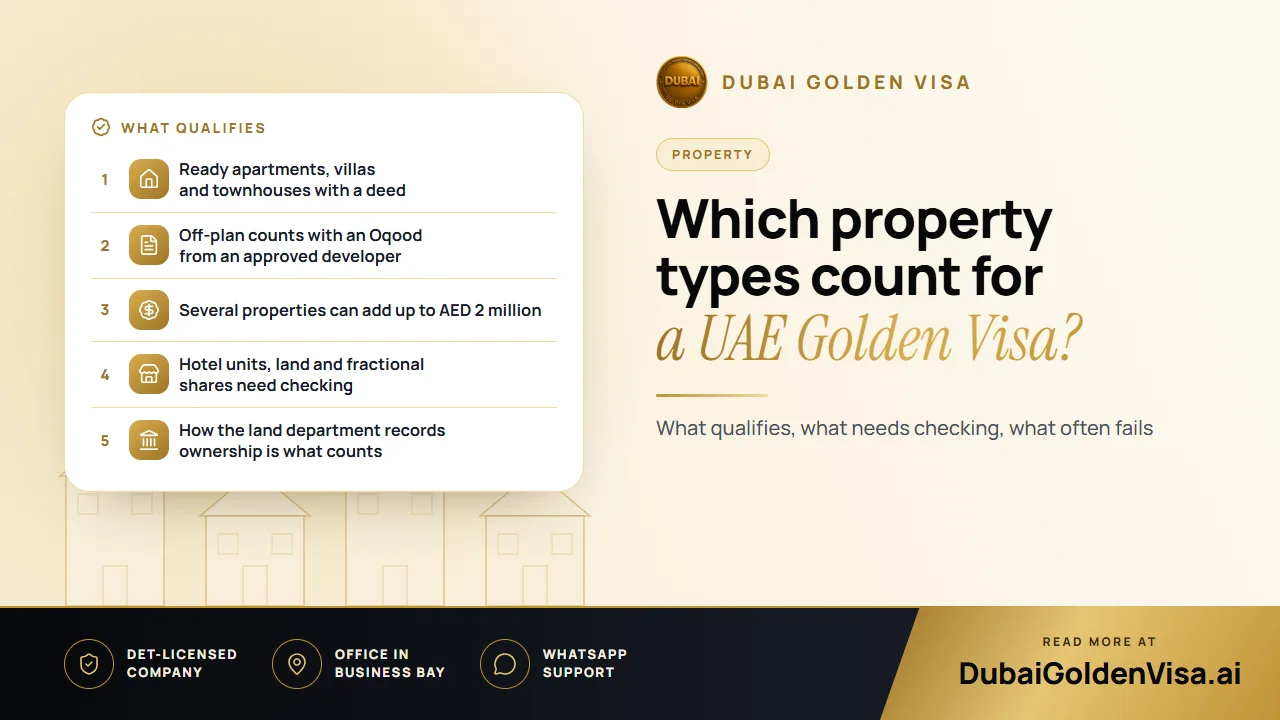
Completed apartments in freehold areas are the most common basis for an approval. If the unit has a title deed in your name and its recorded value reaches the threshold, the file is simple to check and usually moves smoothly.
Villas and townhouses are treated in exactly the same way. Whether it is a waterfront community, a family suburb or a city-centre tower, the deciding points are residential use, proper registration and the value on record. The style of home makes no difference to immigration.
Off-plan homes can also count. The project must be registered and the unit must appear under your name through an Oqood. With an approved developer, the unit qualifies whatever you have paid so far, but the paperwork has to be complete. A booking form on its own carries no weight, which is why off-plan files are the ones most likely to be delayed by missing documents.
A mortgaged home can qualify too. It counts on its full value, and you will need a no-objection letter from the bank. Many buyers wrongly assume that only the part they have already repaid is counted.
03Combining properties
You do not have to put everything into one asset. An apartment plus a villa, two apartments, or a finished unit plus an off-plan one can be added together, as long as the total reaches AED 2 million. Each unit still has to be properly registered, and each one must meet the ownership rules on its own.
This is useful for owners who bought modestly over several years and never realised their combined holdings were enough.
Tip
Joint owners, take note
If you share a deed with someone else, it is your registered share that counts, not the whole price. Check the percentage on the title deed before you assume you qualify.
04Property types that need a closer look
- Hotel apartments: some are plain freehold residential units with a deed in your name, others are structured as hospitality investments with guaranteed returns. The first kind may work; the second often does not.
- Commercial offices and shops: these are not residential and are generally not accepted for this route.
- Warehouses and industrial units: same position as commercial space.
- Empty land: without a qualifying building, it is unlikely to support a visa.
- Timeshare or fractional shares: ownership is split in a way that rarely satisfies the rules.
- Property held through a company: the applicant is not the direct owner, so the structure needs separate review.
05How to check before you buy
- 1
Ask for the classification
Confirm the unit is residential and freehold, and ask how the land department lists it.
- 2
Confirm who will hold the title
Decide whether it will be in your own name, a joint name or a company, and what share you will hold.
- 3
Check the registration
For a finished home, look for the deed. For off-plan, look for the Oqood and the developer's approval.
- 4
Work out the value on record
Make sure the recorded figure, or a current valuation where that applies, reaches AED 2 million.
- 5
Send us the documents
We review the file against the current rules before you commit, so surprises come out early.
Government checks between immigration and the land department are increasingly digital, so inconsistencies are noticed quickly. The rules themselves have not become harsher; they are simply applied more consistently. Most delays we see come from structure and paperwork, not from the type of property chosen.
Thinking of buying, or not sure whether the property you already own counts? Message us on WhatsApp and we will check it for free before you commit any money.
Questions about this topic
Yes. Immigration looks at residential use, registration and recorded value, so the type of home does not change the outcome.
Questions about your own case?
Send us a message and an advisor will tell you which route fits and what you'll need.