
Most people think of Dubai first when they picture a property-backed Golden Visa, but the UAE has seven emirates and the route is not limited to one of them. A home in Ras Al Khaimah or Sharjah can, in principle, support a ten-year residence just as a Dubai apartment can, provided it is registered in your name and reaches the required value.
The catch is that every emirate runs its own property registry and has its own rules on who may buy where. This guide explains what is the same everywhere, what differs, and how to avoid the mistakes that send files back.
01The rules that apply everywhere
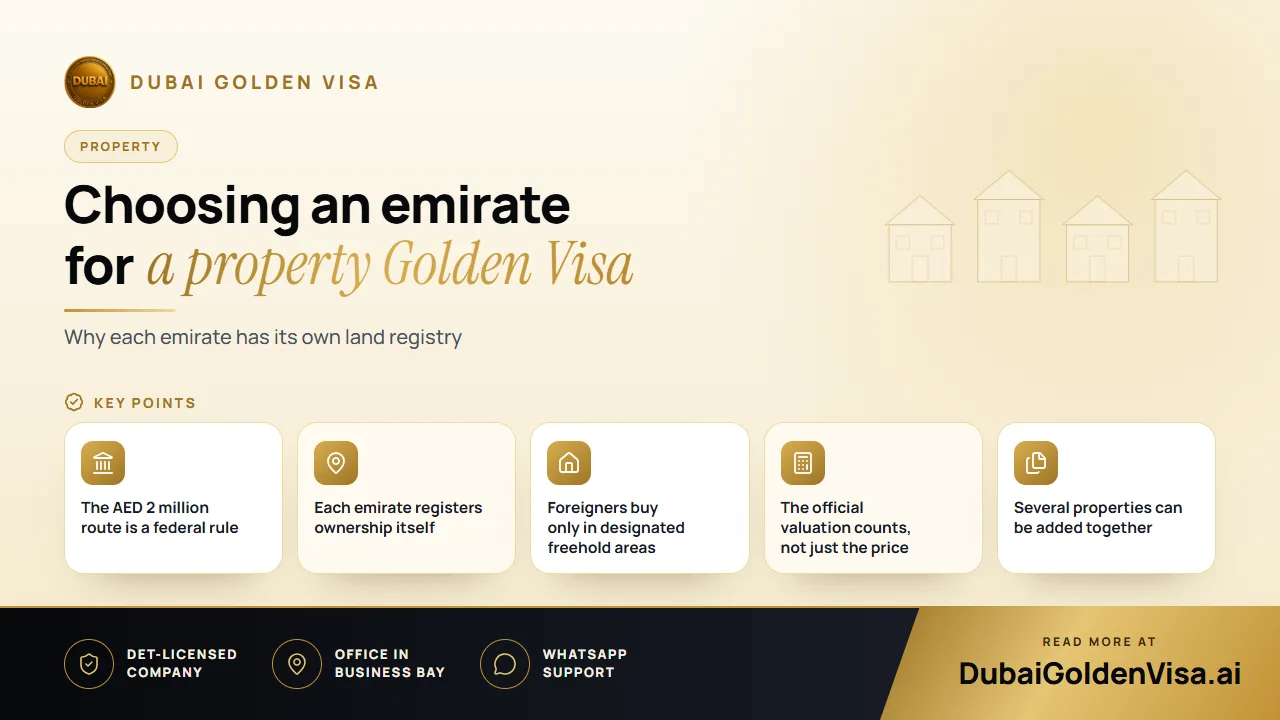
The headline requirement is the same across the country: you need registered property worth AED 2 million or more. That can be a single home or several, as long as they are all in your name. A pair of flats valued at 1.2 million and 800,000 dirhams would reach the threshold together.
Off-plan purchases can count when the unit comes from an approved developer and is registered with the land authority, whatever you have paid so far. A mortgaged home can count on its full value, with a no-objection letter from your bank. You and any family members you add will also need valid health cover in the UAE.
Tip
Value means the official valuation
The authorities look at the value they recognise for the property, which is not always the price in your sale contract. If the recognised figure comes in below AED 2 million, the file will not qualify, so ask for a current valuation before you commit to a purchase near the line.
02How the emirates compare for a buyer
Dubai has the deepest market, the widest choice of ready and off-plan homes and the easiest resale. Applications for Dubai property start with the Dubai Land Department and are completed with the General Directorate of Residency and Foreigners Affairs, which is the route we use for most clients.
Abu Dhabi suits buyers who want a home to live in, with island and waterfront communities and a calmer market. Its authorities handle their own applications, and they can look closely at financing, so settle your mortgage figures with your adviser before filing.
Sharjah is more affordable and close enough to Dubai for a daily commute. Foreign buyers are limited to approved projects, so the first question for any Sharjah listing is whether it can legally be registered to you.
Ajman has some of the lowest prices in the country. Because of that, buyers often assemble the AED 2 million from two or three apartments. Each deed must be fully registered, and the recognised values must add up, which is easier to check before purchase than after.
Ras Al Khaimah is attracting attention for larger, newer waterfront homes at lower prices per square foot than Dubai. Fujairah and Umm Al Quwain are smaller markets with limited stock and fewer projects near the threshold, so they suit patient buyers or second-home seekers rather than people who need a quick resale.
03How the application usually runs
The details differ by emirate, but the sequence is broadly similar. Dubai files follow the Dubai route above; elsewhere, the federal identity authority's smart services are normally the starting point.
- 1
Buy and register
Complete the purchase and have the title deed or off-plan registration issued by the local land authority.
- 2
Collect proof of value
Gather the deed, a letter or valuation confirming the AED 2 million figure and, if you have a mortgage, the bank's no-objection letter.
- 3
Prepare personal papers
Have a passport with several months of validity, a recent photo and proof of UAE health cover for everyone on the file.
- 4
Submit and pay
File through the correct channel for your emirate, pay the government fees and respond quickly to any request for more information.
- 5
Medical test and biometrics
Attend the medical and Emirates ID appointments when you are asked, then receive your residence and card.
Once your documents are complete, property files typically move in about five to seven working days. Applying for your spouse and children at the same time saves repeat visits.
04Mistakes that get files rejected
- Filing with the wrong authority. Each emirate has its own process, and a misdirected file costs time.
- Counting the purchase price instead of the recognised valuation.
- Buying outside a freehold zone, where foreigners cannot hold title.
- Assuming that properties in different emirates will be added up without checking that each authority accepts the other's documents.
- Leaving health insurance until last.
None of these is hard to avoid with a little checking up front. Most of the expensive problems we see were visible before the purchase was made.
If you would like us to check a property against the Golden Visa rules before you pay a deposit, message us on WhatsApp and we will give you a free assessment.
Questions about this topic
In principle yes, provided it is registered in your name in an area where foreigners may own and its recognised value meets the AED 2 million rule. Always confirm the local rules before paying a deposit.
Questions about your own case?
Send us a message and an advisor will tell you which route fits and what you'll need.