
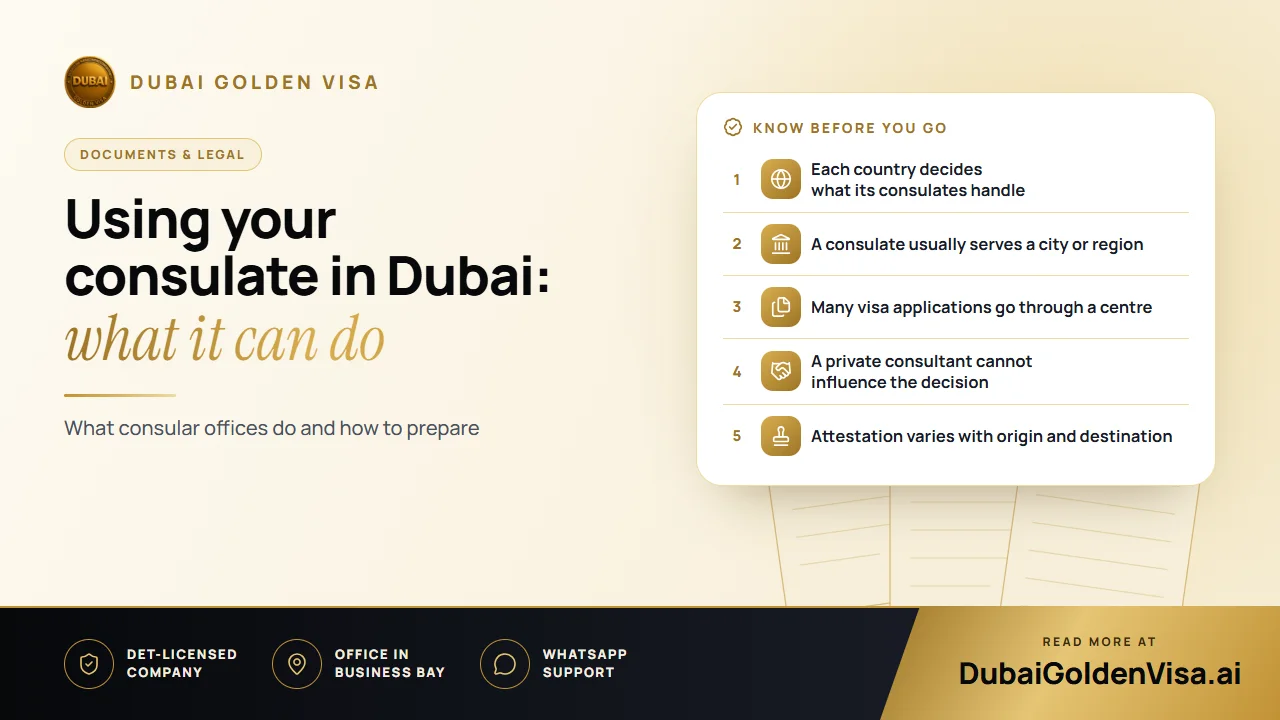
Some matters cannot be settled with UAE authorities alone. A passport that is nearly expired, a certificate needed back home, a newborn who must be recorded with their parents' country: these are consular jobs, handled by the office of your own nationality.
The tricky part is that every country organises its consular work differently. This guide gives you a general picture, so you arrive at the right office with the right papers.
01Embassy or consulate?
An embassy is a country's main diplomatic office in another state, normally in the capital, where it deals with the host government. A consulate, or consulate general in a larger city, typically looks after people in a particular area. For many nationalities living in Dubai, the embassy is in Abu Dhabi while the consulate in Dubai handles passports, visas or documents, but this varies, so the official website is the final word.
02What consular offices may offer
No office does everything. Depending on the country, you might find some or all of the following.
- Passport renewals, replacements and guidance for children's passports
- Visa and travel information, or a referral to an approved application centre
- Certification of copies and signatures, and some notarial work
- Registration of births, marriages and deaths
- Help for citizens in an emergency
- Trade and business support in some cases
For passports, ask what form to use, which papers to bring and whether you need an appointment. For visas, remember that the consulate or centre receives your application but the immigration authority decides it. For civil events, registering with your consulate does not always replace what UAE authorities require, so do both properly.
In an emergency, such as a lost passport, tell your consulate quickly. Staff can point you towards the right local service, but their power is limited by local law. They cannot overturn a court decision or settle a private dispute.
Tip
A real-world example
Some European countries run their Dubai consulate general for passports and visa matters while the embassy sits in Abu Dhabi, and send Schengen and residence permit applicants to an external application centre. It is a good reminder to check which door is correct before you travel.
03Documents that cross borders
A UAE degree, marriage certificate or power of attorney often needs checking before another country will accept it. Attestation lets the receiving body confirm that signatures and seals are genuine. The chain of steps varies with the paper's country of issue and the country that will receive it, so look at the UAE Ministry of Foreign Affairs guidance and at the receiving country's own rules before you pay for anything. Ask the office whether it wants originals or will accept an eligible digital document.
04How to prepare, step by step
- 1
Find the responsible office
Work out whether an embassy, consulate, or an approved centre handles your service.
- 2
Read the current instructions
Note forms, photo sizes, fees, formats and booking rules. If the website is unclear, ask before you spend money.
- 3
Prepare documents carefully
Check names, dates and spellings against the originals, and ask what translation or certification is accepted for foreign-language papers.
- 4
Book through the official channel
Passport, visa and document appointments are often listed separately, so choose the right one. Ignore links from people you do not know.
- 5
Submit and keep proof
Follow the stated route, read payment details before paying and keep the receipt and reference number.
- 6
Follow up
Check the email and account you used, answer any request promptly and contact the office if the published processing time passes.
05Where private help fits
A consultant is not a consulate. What they can do is explain which office you need, review your papers for blanks or mismatched names, put them in the order requested and help you understand booking systems and attestation sequences. They cannot issue a passport, approve a visa or give an official stamp unless a government has specifically authorised them to. The authority alone confirms status and decides.
- Ask what the work includes, and what you must do yourself.
- Get the full fee in writing and ask whether government charges, translation or delivery are extra.
- Be wary of anyone promising approval or inside contacts.
- Ask who will handle your personal documents and how they will be returned.
06Mistakes that cost time
The usual culprits are visiting the wrong office, relying on a checklist saved months ago, submitting an incomplete set, booking the wrong appointment type, assuming all documents need the same attestation, and missing a follow-up email. A quick re-read of the current instructions on the day you go prevents most of them.
If you are unsure which attestation or translation your paperwork needs before it reaches a consulate, message us on WhatsApp for a free check and we will point you to the right next step.
Questions about this topic
No. Some handle passports directly, while others use an online portal or an approved centre. Check your own country's official site.
Questions about your own case?
Send us a message and an advisor will tell you which route fits and what you'll need.