

In the first days of March 2026, regional disruption forced widespread flight cancellations across the Gulf. On 3 March, UAE officials used a government media briefing to describe the first steps back towards normal air travel. This article sets out what was said, in plain terms, for residents, visitors and anyone planning to fly.
It is a summary of reported statements at that date and does not attempt to describe events beyond travel.
01What was announced
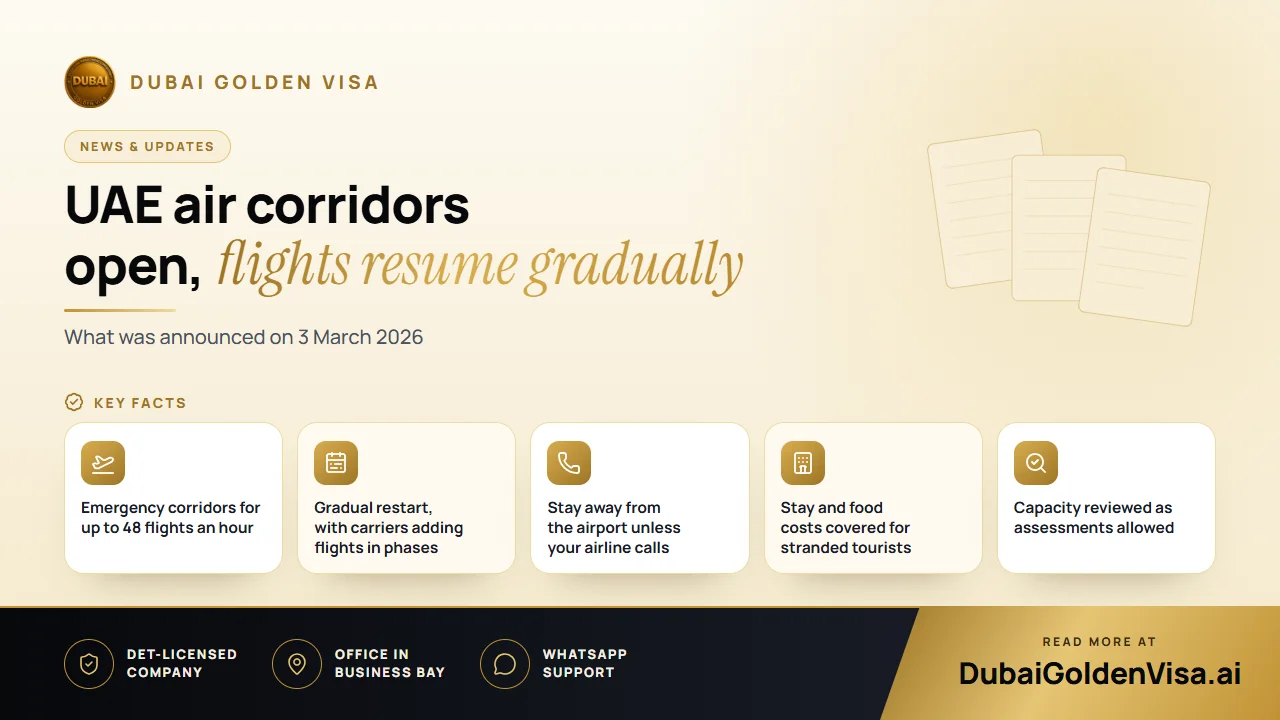
Officials said emergency air corridors had been opened, allowing a handling capacity of up to 48 flights an hour. That works out to roughly one aircraft movement every 75 seconds, a significant step for a country that serves as a global connecting hub, though far below ordinary volumes.
The corridors were set up in coordination with neighbouring Gulf states and with the international civil aviation body, using pre-approved regional emergency plans. Officials stressed that capacity could rise later, but only as safety and security assessments allowed.
02The restart in numbers
- From 1 to 3 March 2026, around 17,500 passengers travelled on 60 flights.
- The next phase was to include 80 additional flights with national carriers, with seats for about 27,000 passengers.
- Regular operations of the largest UAE airlines had not fully resumed, while a low-cost carrier had begun limited services.
In other words, flights were moving again, but selectively. Priority went to stranded travellers and essential journeys rather than to normal timetables.
03Advice for passengers
The clearest message from the briefing was practical: do not go to the airport unless your airline has contacted you directly. Crowds at terminals would slow down a system already working at reduced capacity.
- 1
Keep your contact details up to date
Make sure your airline has your current phone number and email.
- 2
Wait for a confirmed instruction
Travel to the airport only after your airline confirms your flight.
- 3
Save your booking references
You may need them for rebooking and for your hotel.
- 4
Expect changes
Schedules could move quickly in either direction, so check updates regularly.
Why does a corridor matter? Normally, aircraft follow a dense network of routes across several countries. When parts of that network close, the remaining safe paths have to be agreed between states and managed carefully, so that each movement is separated and monitored. A fixed hourly limit keeps controllers and airports from being overwhelmed while the situation is assessed.
For people planning travel in the following weeks, the practical effect was a shortage of seats and a lot of rebooking. Airlines worked first through passengers who were already stranded, and new bookings had to wait their turn.
04Support while flights were limited
During the same briefing, the minister said the government would cover accommodation and food for stranded tourists while operations remained limited. This followed instructions to hotels in Abu Dhabi and Dubai to extend guests' stays where needed.
05Reassurance on supplies and tourism
Officials added that national stockpiles and strategic reserves were sufficient for around four to six months of domestic needs, with daily monitoring and alternative sources if required. They also described the tourism sector as ready to host visitors, citing about 1,260 hotels and around 40,000 businesses linked to tourism.
Tip
Visa timing during delays
If a delay means your visit visa or residence status may expire before you can fly, contact us early. Residence visas usually have a 30-day grace period after they end, but visit visas do not, so act before the expiry date and we can talk through your situation.
06What came next
The path forward depended on ongoing monitoring by aviation authorities and partner states. A return to normal navigation was to follow only when conditions were judged safe. For travellers, the safest approach was to stay in direct contact with the airline and treat any plan as provisional until it was confirmed.
Have questions about your visa while your travel plans are uncertain? Message us on WhatsApp and we will give you a free, clear answer.
Questions about this topic
It was the stated handling capacity of the emergency corridors, about one movement every 75 seconds, and well below normal traffic.
Questions about your own case?
Send us a message and an advisor will tell you which route fits and what you'll need.