
Buying a home in Dubai does not, on its own, give you residency. The two-year property investor visa is a separate application, and it can be turned down. If you have just seen the word refused next to your file, take a breath: in our experience the cause is usually something specific and correctable.
This guide walks through the reasons we see most often, in roughly the order we would check them, and then explains what to do once you know which one applies to you.
01A quick reminder of how the visa works
The two-year visa is a renewable residence permit for owners of a completed property in Dubai. The application starts with the Dubai Land Department and the permit itself is issued by GDRFA Dubai after security checks. Since 1 May 2026, a sole owner of a finished home does not need any minimum property value. Where two or more people own the home together, each person needs a registered share worth at least AED 400,000.
Those two rules explain a surprising number of refusals, so start with your title deed.
02Problems with the property itself
- Your share is too small. The AED 400,000 test applies to each owner’s share, not the price of the whole unit. A flat worth AED 760,000 split equally leaves each of you at AED 380,000, so neither of you passes. With a 70/30 split of a AED 1 million unit, only the 70 per cent owner does.
- The home is still off-plan. An Oqood registration is not a title deed, however much you have paid. This route opens once the building is handed over and the deed is issued.
- The deed is not from the Dubai Land Department. Property in other emirates, and property registered in the financial free zone, cannot support a Dubai application.
- The mortgage paperwork is weak. A mortgaged home can qualify, but you need a current bank letter showing what you have paid and what is outstanding. A developer-financed home needs an up-to-date payment statement. Expired letters are a common reason for delay.
03Problems with your documents
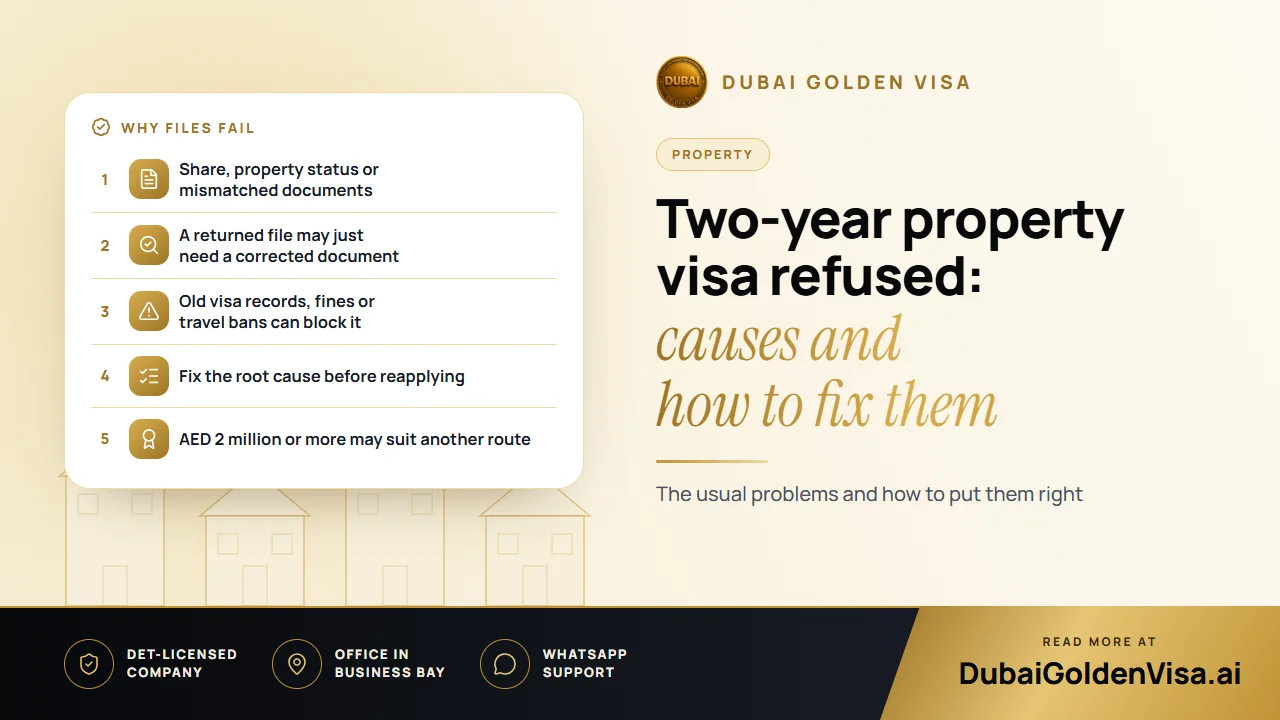
Names are the classic trap. If your passport says Muhammad and the deed says Mohammed, or you renewed your passport and the land department still holds the old number, the system sees two different people. Compare every spelling and number across your passport, deed and application, and correct the records at the source before you resubmit.
The police certificate is another stumbling block. For this route it has to be a Dubai Police certificate addressed to the Dubai Land Department. A clearance from your home country, or a Dubai certificate addressed to someone else, will not be accepted. Residents can usually request it through the police app, while non-residents may need to attend a police station in person.
Check the basics too. Your passport should have more than six months left, your photo must meet the immigration photo specification, your health insurance must be active and issued by a UAE insurer, and if you have held UAE residency before you should bring a copy of the old Emirates ID. Extra paperwork will not rescue a file whose core documents are out of date.
04Problems with you, not the property
Every file goes through security clearance. An old residence visa that was never cancelled, overstay fines you have not paid, a travel ban or an open police or court case can all lead to a refusal, and the notice does not always explain why. If anything like this applies, settle it formally first. Fines must be paid, old visas cancelled and legal matters properly closed before a new application stands a chance.
Finally, make sure you applied under the right category. The two-year visa suits completed Dubai property of any value for a sole owner. The ten-year Golden Visa needs property worth AED 2 million or more, and the five-year retirement visa needs AED 1 million or more in property and an owner aged 55 or over. A file that does not fit the route you picked can be refused.
Tip
Refused or returned?
A returned file usually only needs a document added or corrected, and you can often fix it quickly. A refusal needs the reason understood first. Ask GDRFA Dubai for the exact status, or send us a screenshot and we will read it with you.
05What to do next
- 1
Confirm the status
Find out whether the file was returned for amendment or truly refused, and note any reason given.
- 2
Match the cause to a fix
Resubmitting an identical file almost always produces an identical answer, so change something real.
- 3
Clear the root cause
Renew expired papers, correct name mismatches, pay outstanding fines and cancel old visa records.
- 4
Reapply, or ask for a review
Once the issue is fixed, file again. If you believe the decision was a mistake, you can raise it through GDRFA Dubai’s official channels, including Amer centres.
- 5
Finish the residence steps
After approval, complete the medical test and Emirates ID biometrics. Usually the whole process takes a couple of weeks once the file is complete.
If your home is worth AED 2 million or more, it is also worth looking at the Golden Visa. It lasts ten years, does not carry the six-month absence rule and can count off-plan property from an approved developer, so some refusals disappear when the route changes.
Not sure why your file was turned down? Message us on WhatsApp and we will review your deed and documents for free, then tell you honestly whether to correct and reapply or switch route.
Questions about this topic
Document-based refusals normally carry no waiting period, so you can reapply once the problem is fixed. Security, overstay or legal issues must be resolved first.
Questions about your own case?
Send us a message and an advisor will tell you which route fits and what you'll need.