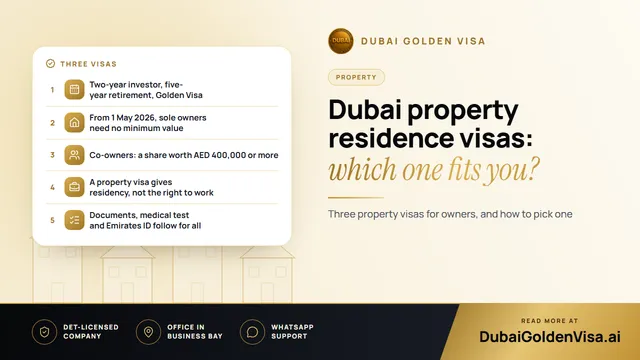

Not every property owner holds AED 2 million of real estate, and many do not need to. The two-year property investor visa gives owners of more modest homes a way to live in the UAE on the strength of what they own, without an employer or a trade licence.
The rules loosened on 1 May 2026, so older guidance you may have read is probably out of date. Here is where things stand and how to get ready.
01What the visa gives you
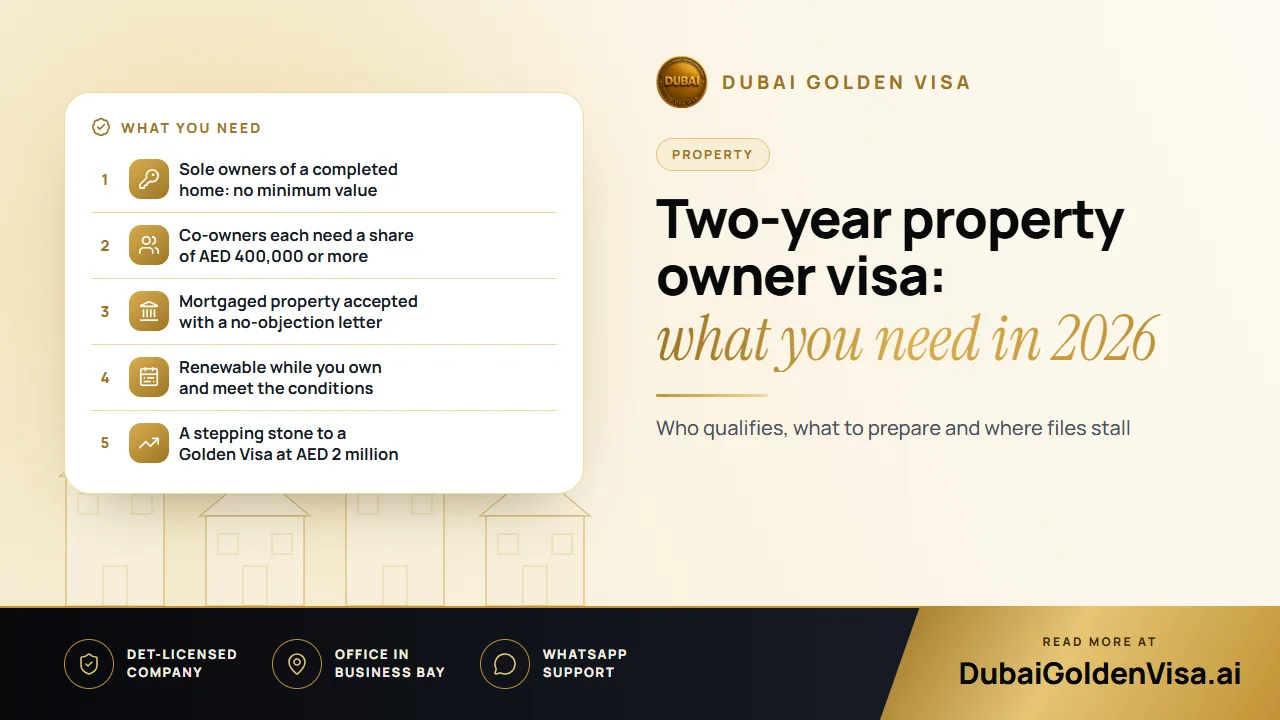
The visa is a two-year residence permit linked to your ownership of Dubai property. It comes with an Emirates ID, can be renewed while you still qualify and allows you to sponsor family members. It is not a Golden Visa, which lasts ten years and needs property worth AED 2 million or more.
With residence, you can open bank accounts more easily, get a UAE driving licence, access health care and place children in schools. It also lets you build a case for the Golden Visa later, if your holdings grow.
02Who qualifies since 1 May 2026
If you are the sole owner of a completed home, there is no minimum property value. A studio qualifies on the same basis as a villa.
If you co-own, each person applying needs a registered share worth at least AED 400,000. Two unrelated owners of a AED 800,000 flat, each holding half, could each apply. Married couples can hold a property together, and one spouse can apply as the investor while sponsoring the other.
Tip
Completed homes first
The simplest case is a completed, handed-over home with a title deed registered in your own name. Off-plan units and unusual ownership structures need checking case by case, so send us the details before you apply.
03Checking the property
- It is in Dubai, in an area where foreign ownership is allowed.
- The title deed is issued and the name matches your passport exactly.
- It is a residential unit, such as an apartment, villa or townhouse.
- If mortgaged, your bank provides a no-objection letter.
- If financed by the developer, you hold a payment statement.
04Documents to prepare
- Title deed
- Passport with at least six months' validity
- Passport-style photo on a white background
- Bank no-objection letter or a developer payment statement, where relevant
- Health insurance valid in the UAE
- A police good conduct certificate where the process asks for one
- Medical fitness test result
- Attested marriage and birth certificates if you are sponsoring family
05How the process runs
- 1
Confirm eligibility
Check your ownership structure and registered share against the rules.
- 2
Collect documents
Order the bank letter early, since it is often the slowest item.
- 3
File the application
The application is submitted through the land department and immigration channels, and fees are paid.
- 4
Medical test and biometrics
You attend an approved clinic, then give biometrics for your Emirates ID.
- 5
Residence issued
Your two-year visa is linked to your Emirates ID.
Overseas owners can often begin the process remotely, but you will need to be in Dubai in person for the medical test and biometrics.
06Why applications get held up
Most delays are avoidable. We see missing or expired papers, a passport that no longer has six months' validity, no valid health insurance, a deed name that differs slightly from the passport and unpaid fees. A quick check of each of these before you file saves days.
If you later add property and your combined holdings reach AED 2 million, the ten-year Golden Visa becomes an option. We can compare both visas for your situation.
Not sure whether your property qualifies? Message us on WhatsApp for a free check. Tell us how the property is owned and we will confirm the best route and today's government costs.
Questions about this topic
The simplest case is a completed home with a title deed. Off-plan units may be treated differently, so send us the details and we will confirm.
Questions about your own case?
Send us a message and an advisor will tell you which route fits and what you'll need.