
For years the two-year property investor visa came with a floor: your property had to be worth at least AED 750,000. That left owners of smaller apartments in outlying areas outside the scheme, even if they were long-term owners.
In spring 2026 the Dubai Land Department changed the model. In this article we compare the old position with the new one, give examples of who now qualifies, and explain what has stayed the same.
01Old rules versus new rules
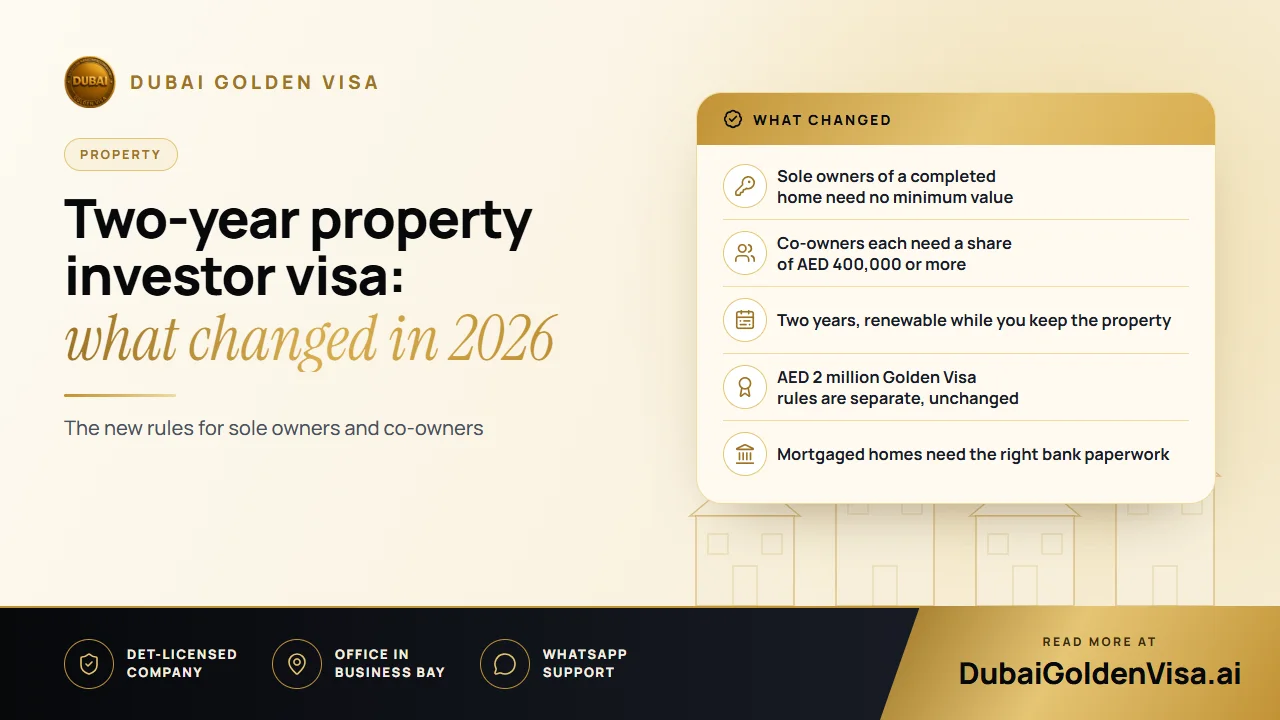
- Sole owners: previously a property worth at least AED 750,000. Now, since 1 May 2026, no minimum value applies to the owner of a completed home.
- Co-owners: previously a combined value test. Now each co-owner needs a registered share worth AED 400,000 or more.
- Property type: a completed property is required, as before.
- Duration: still two years, renewable.
The practical effect is that the visa is now linked to being a genuine owner rather than to a price tag. A studio in one of Dubai's more affordable communities can now sit alongside a waterfront apartment as the basis of a residence visa.
02Examples
A buyer who owns a completed one-bedroom flat worth AED 600,000 alone had no route before. Under the new model, that owner can apply.
Two friends who own a property worth AED 900,000 equally each hold a AED 450,000 share, so both clear the AED 400,000 mark. Two co-owners with a share of AED 350,000 each would not. This is why the deed split matters: it is each person's registered share, not the property total, that is checked.
Tip
Not the same as the Golden Visa
The Golden Visa still asks for AED 2 million in property, alone or combined, and lasts ten years. The two-year visa is a lighter, shorter option, and it can be a stepping stone if you later build up a larger holding.
03What still applies
- The property must be completed. Off-plan units do not qualify for the two-year visa, although they can support a Golden Visa from an approved developer.
- The title must be registered with the Dubai Land Department.
- A mortgaged home can be accepted with a bank no-objection letter and the lender's statement.
- Health insurance valid in the UAE is needed, along with the usual passport, photo and conduct documents.
Names must match exactly across the passport, title deed and application. A single spelling difference is one of the commonest reasons for delay.
04Who benefits most
The change is most useful to three groups. First, owners of smaller or more affordable completed units, who were previously below the line. Second, long-term landlords who have lived abroad and now want to base themselves here. Third, couples and families who bought together and can now check whether each person's share is enough.
It also suits buyers who want to try life in Dubai before deciding on a larger commitment. Because the visa is renewable and tied to ownership, it can become a long-term base, or a stepping stone to the Golden Visa if your holding grows.
05How the process runs
- 1
Check your deed
Confirm the unit is completed, registered in Dubai and shows your share.
- 2
Gather documents
Deed, passport, photo, insurance and any bank letter.
- 3
File the application
Submit through the land department process, with an entry permit first if you are abroad.
- 4
Medical and biometrics
Take the medical test and register your Emirates ID details.
- 5
Visa issued
Your residence is issued, and eligible family members can be added.
Typical timing and government charges depend on your situation, so we confirm today's cost when we check your file. If the visa is a step towards the Golden Visa, we can also map out how your holding could grow to the AED 2 million level.
Own a home in Dubai and wondering if the new rules work for you? Message us on WhatsApp for a free check. Send a photo of your deed and we will tell you where you stand.
Questions about this topic
For this land department scheme, yes. Title deeds from other emirates or from DIFC are not accepted.
Questions about your own case?
Send us a message and an advisor will tell you which route fits and what you'll need.