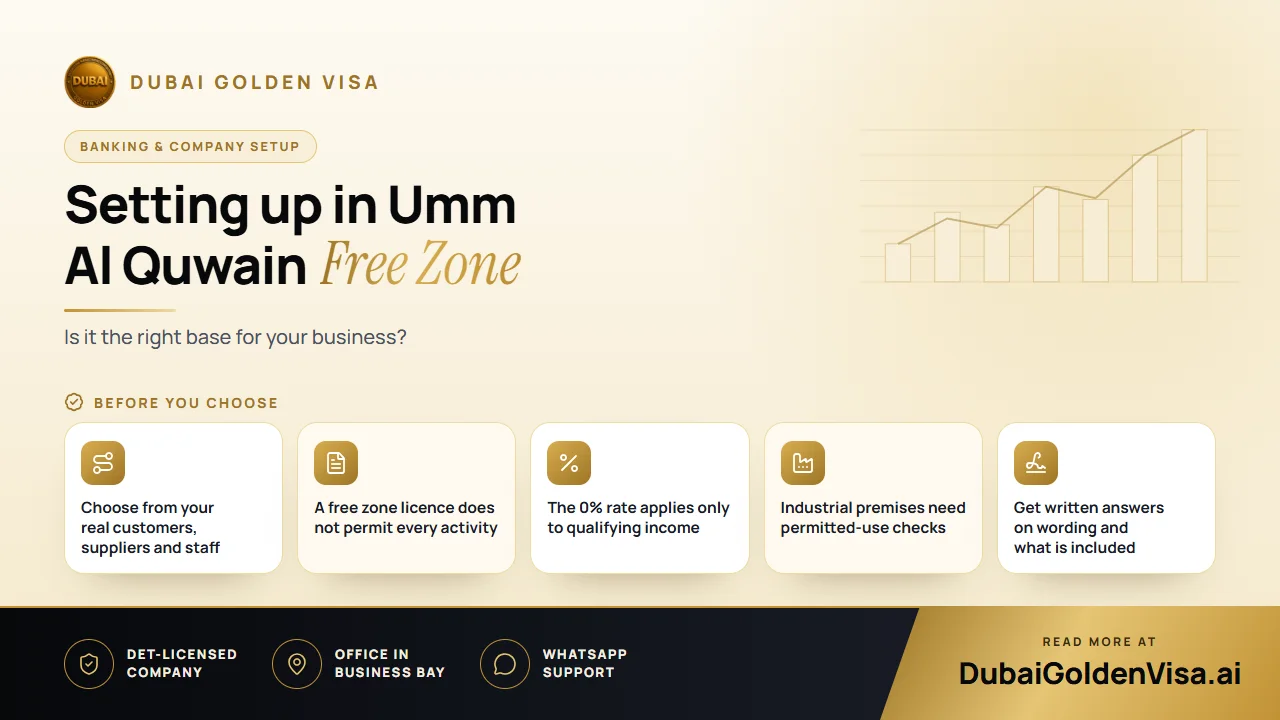
Many first-time founders look at Dubai and Abu Dhabi first, then discover that a quieter emirate can suit them better. Umm Al Quwain is one of those options, and its free trade zone offers a way to hold a UAE company outside the biggest commercial centres.
Whether it fits depends on the business, not the brochure. This guide covers how to judge the zone, how the setup works and the tax points owners often misunderstand.
01What the free zone is
UAQ Free Trade Zone is the business jurisdiction in the emirate of Umm Al Quwain that registers companies, lists permitted activities and arranges facilities such as offices or space for storage and light industry, subject to availability. A company there operates under the rules of its own licensing authority, which is a different system from a mainland company licensed by an emirate's mainland authority.
That difference becomes important when you want to sell in the UAE. A free zone licence does not give unrestricted permission to trade with the mainland. Depending on the activity, you might need a distribution arrangement, an extra permit, a mainland presence or another approved route. Confirm this for your exact activity before you incorporate.
02When Umm Al Quwain makes sense
It can suit owners who do not need an office in a major city and want a UAE base for international trading, services or some industrial work. The test is practical: where are your customers and suppliers, how will staff get to work, and how often will goods move? A glossy package is no help if the licence does not cover what you actually do.
Before committing, ask the authority to spell out the activity wording, the type of facility, visa eligibility and any limits attached to your package. Ask what is included and what you must arrange separately, and get the answers in writing.
03Matching the licence to the work
The licence defines what the company may do. Activity categories can cover trading, professional and consultancy services and some industrial operations, but the live list and its conditions should come directly from the authority. A trading company buying and selling approved goods needs a different set-up from a consultancy selling expertise. Industrial activity is another matter: making things or running a workshop can require fitting premises, machinery, safety arrangements and permissions on top of the basic licence.
Describe your operation in plain terms: what you sell, to whom, where the work happens and whether you will store, import, export or make anything. That helps the authority place you in the right activity from day one.
04Setup, step by step
- 1
Describe the business
Products or services, customers, how you earn revenue, and any plans to import, export, store or manufacture.
- 2
Pick a structure
Decide who owns the company. If a corporate shareholder is involved, expect requests for company records and proof that the signatory is authorised.
- 3
Check name and activity
The name must meet the authority's rules, and regulated or technical sectors may need another regulator's approval.
- 4
Choose the workspace
A consultant, a stock-holding trader and a manufacturer have different needs. Check permitted use and what the package includes.
- 5
Apply
Submit shareholder, identity and business documents in the requested format and answer any queries.
- 6
Finish and operate
After approval you receive the licence, then arrange immigration and establishment records, staff visas, banking, accounting and any sector approvals.
05Documents commonly requested
- Passport copies for each shareholder, director or signatory, and photographs if asked
- Contact details and residential address for those individuals
- Proposed company name, with alternatives if required
- A description of the intended activity and completed application forms
- For a corporate shareholder: certificate of incorporation, constitutional documents and a board resolution
- Business plans, technical specifications or sector approvals if the work is industrial or regulated
- Overseas documents that have been attested, legalised or translated, where the rules ask for it
Not everyone needs every item, so work from the authority's current checklist.
06Tax: free zone is not tax free
Tip
Do not assume an exemption
UAE corporate tax applies to free zone companies too. A company can pay 0% on income that qualifies, but only once it satisfies the tests for a Qualifying Free Zone Person. Income outside that category can be taxed under the standard rules.
Conditions can include real UAE substance, qualifying income, transfer pricing compliance, audited accounts where required and proper registration and filing. Your activities, customers, contracts and records decide the outcome, not the licence alone. VAT is a separate regime: you may need to register once you meet the conditions, and special treatment applies only in defined situations, not to every transaction in a free zone. Keep contracts, invoices, bank statements and accounts organised from the start.
07Premises and the industrial area
Umm Al Quwain is not one uniform business district. If you are considering the New Industrial Area, remember that an industrial label does not mean every kind of production or storage is permitted in every unit. Confirm what the unit may be used for, its zoning, utilities, how vehicles reach it, how waste is handled and what environmental or safety permits apply. Visit in person and check loading space and whether the building can carry your equipment.
08Free zone or mainland?
A free zone often fits international trade, cross-border services and activities that sit well within its licence framework. Mainland may be better if you serve the local market directly, work at customer sites or carry out activities that need mainland licensing. Neither is always better, so decide on customers, goods, premises and regulation.
If you are weighing up a free zone, a mainland licence or residency as a company owner, message us on WhatsApp for a free chat and we will help you compare the options.
Questions about this topic
It can be. A small consultancy and a stock-holding trader have different needs, so check the permitted activity, facility and visa conditions first.
Questions about your own case?
Send us a message and an advisor will tell you which route fits and what you'll need.