
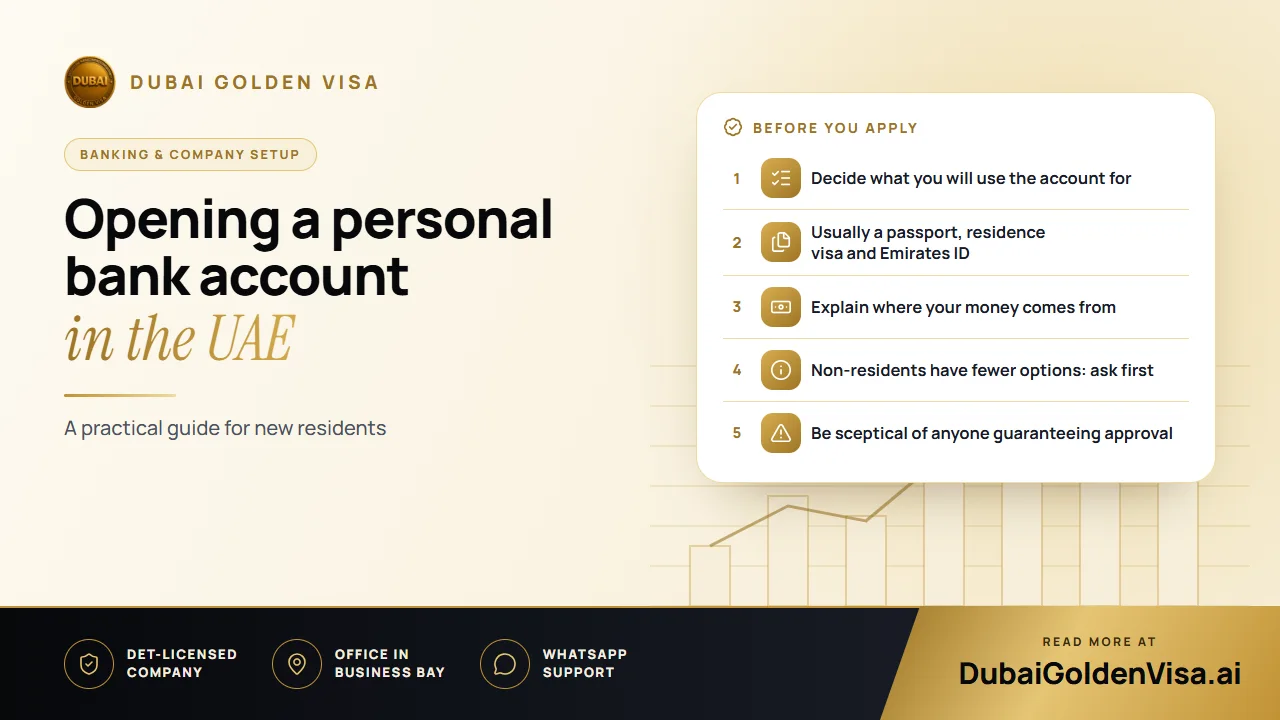
A bank account is one of the first practical things a newcomer needs. Employers pay salaries into it, landlords expect transfers and many utilities and shops prefer card or app payments. Walk along any busy street in Dubai or Abu Dhabi and you will see a number of bank branches, and there are also app-based banks with no branch at all.
This guide covers personal accounts only. Company accounts follow a separate process, with registration papers and ownership records.
01Who can open one
UAE nationals and many foreign residents can open personal accounts. Banks must identify the customer and understand how the account will be used, so expect questions about your job, address and the source of your money. That is normal and applies to everyone.
- Residents: usually a passport, residence visa and Emirates ID.
- Salaried staff: often a salary certificate or payslip, and some salary accounts have minimum-salary or approved-employer rules.
- Self-employed people and investors: a trade licence, company papers or statements to show how income arrives.
- Non-residents: a narrower choice of savings or deposit products, with detailed information requested.
02Account types
- Current account: for daily life, with cards, transfers and bill payments. Features such as cheque books vary.
- Savings account: for money you do not spend regularly. Compare how the return is worked out and whether withdrawals affect it.
- Salary account: built around monthly pay. Benefits may change if you change jobs or move your salary elsewhere.
- Islamic account: structured on Sharia principles, with profit-based rather than interest-based terms.
- Digital account: managed on your phone. Check where you can deposit cash and how you reach support.
03Documents to prepare
The government's banking guidance points to identity papers (passport or family book), your Emirates ID and your residence visa, and banks may add more depending on the product. Have these ready:
- Passport, with a clear copy of the details page
- UAE residence visa
- Emirates ID
- Salary certificate or employment letter, where relevant
- Recent payslip or bank statement
- Proof of address such as a tenancy document or utility bill
- Trade licence and company papers for the self-employed
- Evidence of the source of your funds, if asked
Check whether the bank expects original papers, plain copies or certified ones, and how recent your statements need to be. If a paper is in another language, find out about translation before paying for it.
04The steps
- 1
Decide what it is for
Will your salary arrive here, do you pay rent by transfer, do you send money abroad? The answers narrow your choice.
- 2
Compare conditions
Look beyond the headline offer to the opening deposit, minimum balance, card charges, transfer fees and closure terms.
- 3
Check eligibility
Confirm age and residency rules, and ask whether salary transfer is compulsory if you are between jobs.
- 4
Apply
Use the bank's own website, app or branch. Take care that names and numbers match your ID, and open every uploaded file to check it is legible.
- 5
Identity checks
These may happen in an app, through UAE PASS, on a video call or in a branch. Answer questions about your work and expected deposits plainly.
- 6
Wait for the decision
The bank may approve, ask a question or request another paper. A complete form does not guarantee approval.
- 7
Activate and review
Activate the card and online banking, note the account number and IBAN, switch on alerts and learn how to report a lost card.
05Common questions
Can a spouse who stays at home open an account? Often yes. Lacking an employer is not by itself a barrier, though the bank will want identity and residence papers and may ask how the account is funded. Be clear whether you want an individual account or a joint one, which has its own signing arrangements.
What is a zero-balance account? It usually means no minimum balance is required. It does not mean no fees. Check for opening deposits, monthly charges, card and withdrawal fees, transfer costs and where you can pay in cash.
Can you open one without a salary? Some savings and digital accounts do not rely on salary transfer, but you must still prove your identity and, if asked, explain your income. Describe your situation honestly. Wrong employment details cause far bigger problems later.
06Non-residents, timing and rejections
If you live abroad, contact the bank before travelling and confirm that it takes non-resident customers, which product is open to you and whether you must attend in person. Do not plan a trip around a general article.
Timing varies. A digital account with complete information can be decided quickly, while an application needing extra checks takes longer. Central Bank standards mention a three-business-day period for certain low-risk cases with full documents, but that is not a promise for every applicant.
Tip
Why applications are declined
The usual causes are choosing an account whose salary or balance rule you cannot meet, blurry or incomplete documents, and details that differ between forms and IDs, such as an old address or a different name spelling.
If you need to set up banking alongside your visa or company, message us on WhatsApp for a free check of which documents to prepare and what to ask the bank.
Questions about this topic
Residents normally show one, together with an Emirates ID. Non-residents have a smaller range of products and should ask each bank directly.
Questions about your own case?
Send us a message and an advisor will tell you which route fits and what you'll need.