

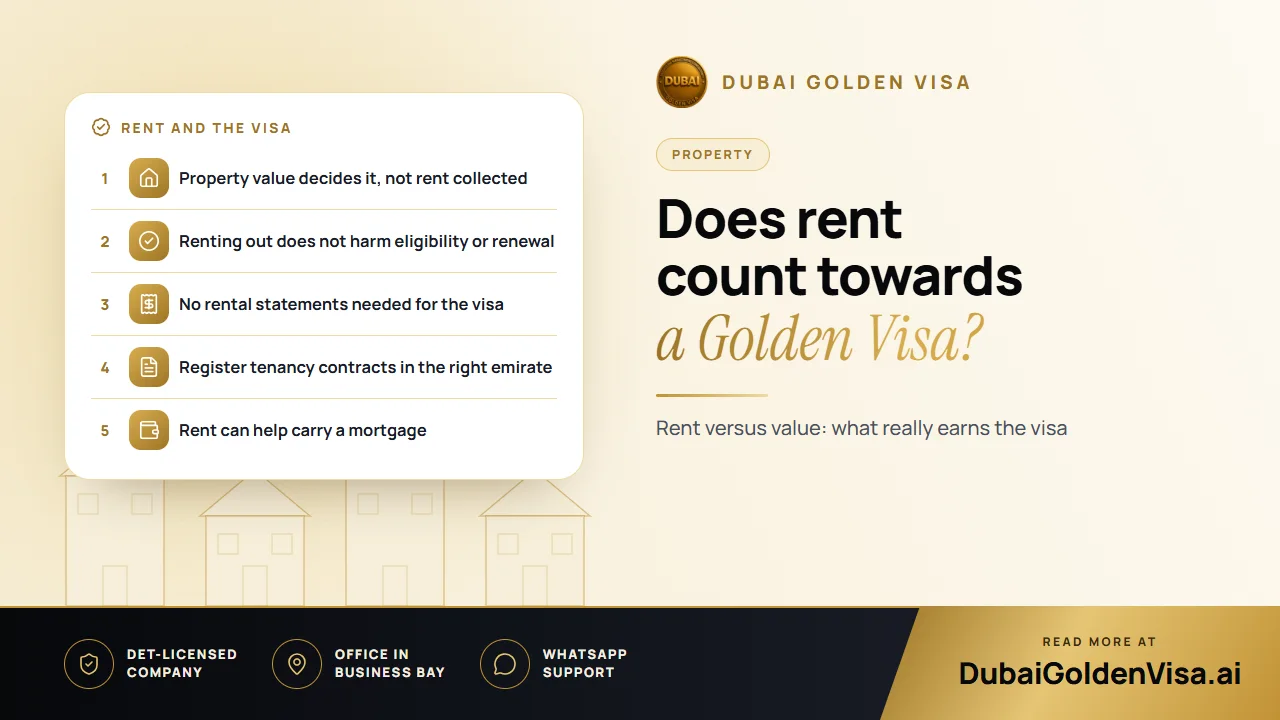
Listings often say something like a strong return plus a Golden Visa, and it is easy to read that as one benefit. The two are connected only because they come from the same property. The visa does not look at your rent at all.
That is worth being clear about before you buy, because it changes what you should look for in a property.
01What the property route is based on
The property route asks for UAE property worth AED 2 million or more, registered in your name. One deed or several can be combined. Off-plan homes from approved developers can count, and a mortgaged home counts on its full value with the bank's no-objection letter. If your deed shows an older, lower price, a current valuation from the land department can replace it.
If you own jointly, it is your own share that has to reach the figure. None of this involves income. A flat that earns very little can qualify, and a high-earning studio worth far less than the threshold cannot.
02Does renting the property affect the visa?
No. It does not matter whether the home is let on a long lease, used as a holiday rental, lived in by family or left empty. The visa rests on ownership and value. You do not provide rental statements with the application, and a very high rental income earns no extra weight.
What you should do is keep any tenancy properly registered. In Dubai that means registering the contract through Ejari, and other emirates have their own municipal systems. A registered tenancy protects you and your tenant and keeps your records clean if a bank or authority ever asks.
Tip
Do not confuse the salary route
Income does appear in one route: skilled professionals need a basic salary of AED 30,000 or more. That is employment pay, not rent, and it counts only through that specific route.
03Why rent still matters to investors
- It can cover or reduce mortgage payments, lowering the net cost of holding the property.
- UAE residents do not pay personal income tax on rent, although your home country might tax it, so check with a tax adviser.
- It can fund the purchase of further units over time.
- It helps if you live abroad for much of the year. Golden Visa holders are exempt from the six-month absence rule, so a managed let can work well for you.
- Combined with long-term value growth, it gives you two sources of return.
04Choosing between value and yield
If your main goal is the visa, buy for qualifying value and a home you would be happy to own. If your main goal is cash flow, weigh yields, service charges and tenant demand, and then check that the property also reaches the visa threshold. It is possible to get both, but it is wise to rank them.
A useful habit is to keep two separate files in your head. One holds the papers that prove your visa basis: deed, valuation, bank letter. The other holds your landlord records: tenancy contracts, receipts, service charge statements. Mixing them up leads to the wrong documents being sent to the wrong office, and slows both.
If you ever sell and replace the property, plan the order carefully. Buying the new qualifying home before you sell the old one keeps your basis continuous, and we are happy to map that out with you.
- 1
Confirm the value on the deed
Check the registered value or the Oqood, and your share if the property is jointly held.
- 2
Decide how you will use the home
Live in it, let it, or both over time. The visa does not mind.
- 3
Register any tenancy
Use the correct system for the emirate where the property sits.
- 4
Keep the property
Selling it, or dropping below the threshold, can affect the visa.
Wondering whether your property would qualify, and how renting it out fits in? Send us a message on WhatsApp for a free check, and we will give you a straight answer.
Questions about this topic
No. The property route looks at ownership and value, so rental documents are not part of the application.
Questions about your own case?
Send us a message and an advisor will tell you which route fits and what you'll need.