Customers rarely think about who owns a brand. They just look for the name they trust or the symbol they remember. For the business behind it, that recognition is among its most valuable assets, and it is surprisingly easy to lose when someone else starts using something close.
Many founders assume their trade licence has them covered. It does not. This guide explains what trademark registration in the UAE does, how to prepare for it and what to watch for if you own a brand overseas.
01What a trademark actually protects
A trademark is a sign that tells customers who stands behind particular goods or services. It might be a name, a logo, a mix of the two, a slogan people connect with your business, or in some cases a distinctive shape, pack design or colour.
The sign has to be distinctive. A phrase that merely describes the product, its quality or its purpose is hard to register, and some signs are excluded under UAE law. Ask yourself whether the mark says who you are, not just what you sell.
Tip
Licence, name, domain: not the same thing
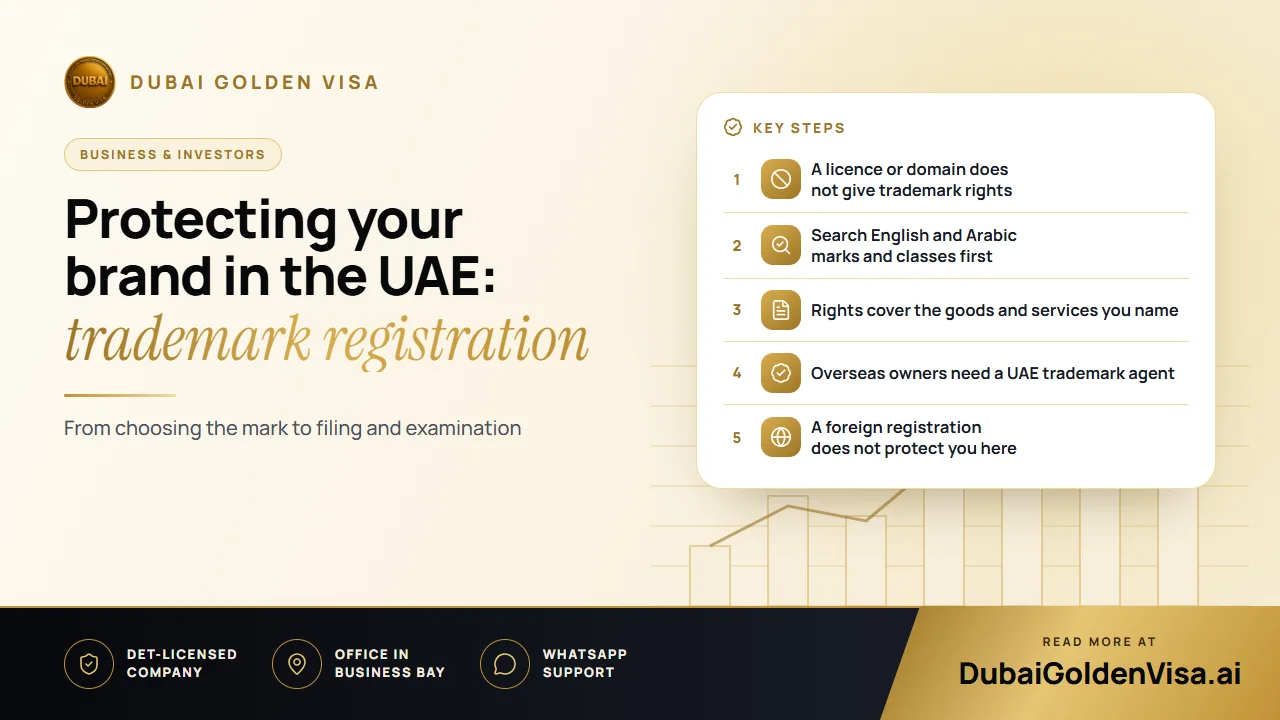
A trade licence records your business. A company name identifies it for licensing. A domain gives it a web address. Only trademark registration gives you legal rights in the brand itself, and only for the goods and services you list.
02Who can apply
The UAE runs a federal system administered by the Ministry of Economy and Tourism. Individuals and companies, whether mainland or free zone, can apply if the mark and the application meet the requirements. The applicant should be the true owner, so settle that before filing, particularly if the brand began with a founder before the company existed or several people helped create it.
Owners based abroad can apply too. For a direct national filing they must go through a registered trademark agent in the UAE and supply a power of attorney and supporting documents in the form the Ministry requires. Ask the agent what is needed before you sign or notarise anything overseas.
03Word, logo or both?
Think about what people notice first. If customers ask for you by name, protecting the wording matters most. If the symbol is what they remember, protect the logo. A combined mark covers the full design as one identity, but it may give less freedom than protecting the name and the logo separately. If you use the name alone on signs, packaging or online, one combined filing might not match how you really trade.
04Search before you file
Looking only for an identical name gives false comfort. A registered mark may be spelled differently yet sound the same, and two logos can feel alike even when the words differ. Imagine a customer choosing between two products: would they mix these up when speaking, or when seeing them side by side?
- Start with the precise wording and with the logo in the form you use it.
- Try spelling variations, abbreviations and similar-sounding names.
- Check the Arabic version, the transliteration and how it is pronounced.
- Look in the classes that match your goods or services, and in nearby classes customers might expect you to cover.
A search can reveal possible conflicts, but only the Ministry decides whether an application can proceed.
05The filing process
- 1
Confirm ownership
Check whether the brand belongs to you personally or to the company, and file in the right name.
- 2
Fix the version of the mark
Use a clear image or the exact spelling that matches what you use in the market.
- 3
Choose classes with care
Goods and services are grouped under an international classification. Pick the ones that fit what you really do, without leaving gaps or listing everything.
- 4
Gather documents
Typical items are the owner's full legal name, a clear copy of the mark, a description of goods and services, company records and a power of attorney if an agent files for you. Foreign documents may need legalisation and Arabic translation.
- 5
Submit online
Check the application against your source documents before sending it.
- 6
Respond to examination
The Ministry may accept, question or refuse the filing. Answer the specific point it raises.
- 7
Publication and objections
An accepted mark is published so that owners of earlier rights can object.
- 8
Registration
If nothing blocks it, you complete the formalities and receive the certificate. Check the name and mark details on it.
06If your brand is registered overseas
Trademark rights are territorial. A certificate from your home country does not, on its own, stop someone using a similar mark in the UAE. You have two broad routes. One is a direct UAE application through a local agent, which suits a business focused on this market. The other is the Madrid System, an international application filed through your home office and sent to the World Intellectual Property Organization, with the UAE named as a destination. You must have a qualifying connection to a member country and a basic home application or registration, and the UAE still examines the designation under its own rules.
07After registration
File the certificate, the application and every Ministry letter together in the company records. Save photos of labels, packaging, web pages and adverts as evidence of use. If the business is sold or renamed, check whether the register must be updated, and put renewal dates on the same list as your other key deadlines. Long periods of non-use can weaken rights, so take advice if you stop using a mark.
Common slips include assuming the company name protects the brand, skipping the Arabic search, naming a founder as owner when the company controls the brand, and ignoring a letter from the Ministry. Be wary of anyone who promises guaranteed approval, because the decision always rests with the authority.
Preparing a filing means certified documents, translations and powers of attorney, and that is where we can help. Message us on WhatsApp for a free chat about what your documents need before you apply.
Questions about this topic
Yes. A direct filing has to go through a registered UAE trademark agent, with a power of attorney and documents in the form the Ministry requires.
Questions about your own case?
Send us a message and an advisor will tell you which route fits and what you'll need.