

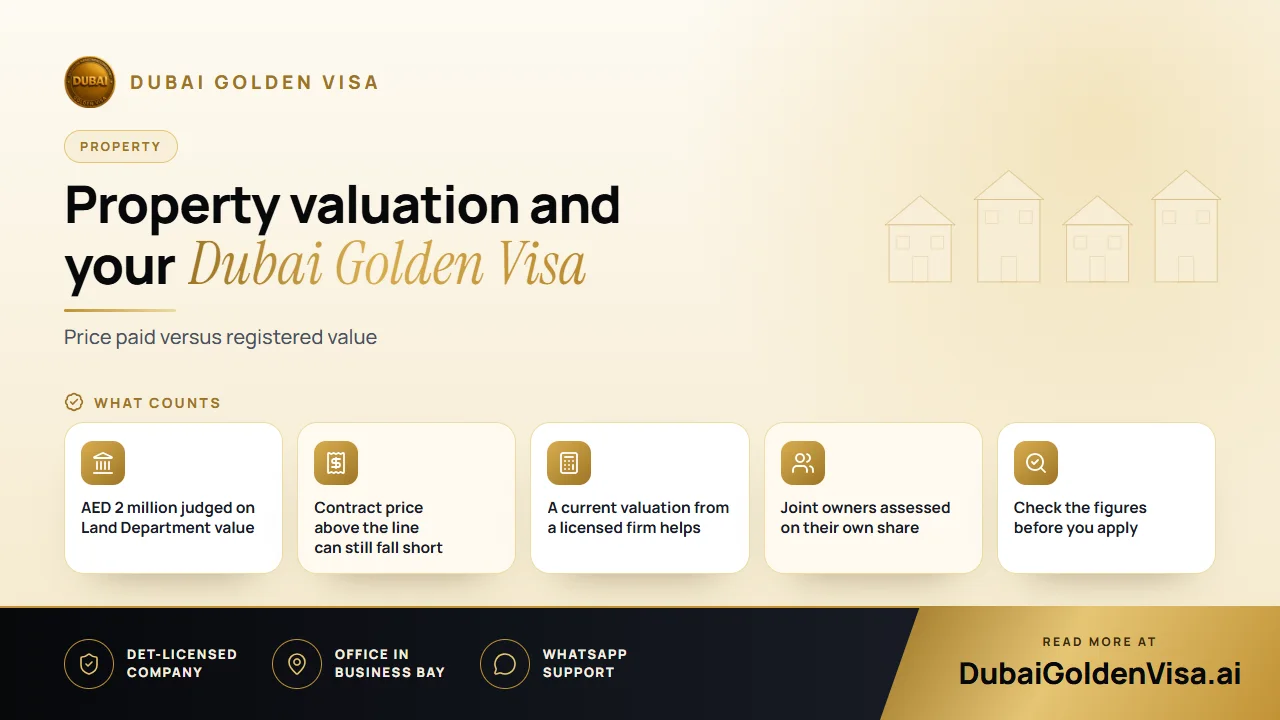
Ask a room full of Dubai property owners whether they qualify for a Golden Visa and most will answer by quoting what they paid. It is a natural instinct, but it is not the number the immigration side works from. What matters is the value attached to your property in the land department's records on the day your application is reviewed.
That gap between price and value is where applications wobble. This guide explains how the two differ, where the official figure comes from and what you can do if yours is lower than you expected.
01Why the contract price is not the test
A contract price reflects a negotiation on one day. It can be lifted by developer incentives, a launch premium or simple enthusiasm. It can also be dragged down by a quick sale. The authorities want something more neutral, so they rely on the value that the Dubai Land Department recognises for the unit.
Picture an apartment bought for AED 2.1 million whose recorded value is AED 1.85 million. On paper the buyer cleared the bar. In practice the file falls short, because the recorded figure is the one that is measured. The reverse happens too: a flat bought a few years ago for less can now sit comfortably above the line after the market moved.
Agent estimates, online listings and developer brochures carry no weight on their own. They are useful for planning, but they are not evidence.
02Where the official figure comes from
For a completed home, the starting point is the title deed. For an off-plan unit, it is the Oqood registration. Beyond those records, the land department can recognise a valuation produced by a licensed valuation firm, which is how an older deed price gets refreshed to reflect today's market.
- The type of property: apartment, villa or commercial unit
- Its location and the zone it sits in
- Whether it is complete or still being built
- Its size, layout, age and condition
- Recent comparable sales nearby
A private report that nobody at the land department recognises will not help you. If you commission a valuation, make sure it comes from a firm the department accepts, and make sure it is registered in a way that the immigration side can see.
Tip
A quick self-check
Put three figures side by side: the price on your contract, the value on your deed or Oqood, and any recent valuation. The lowest one that the authorities will accept is the one to worry about. If it is under AED 2 million, talk to us before applying.
03Mortgages, joint ownership and off-plan homes
A mortgage does not disqualify a property. A mortgaged home counts on its full value, and the bank will normally need to issue a no-objection letter to support the residence application. The amount you still owe does not shrink the figure that is measured.
With joint ownership, think in terms of each person's share. Two buyers holding equal halves of a AED 4 million home each hold AED 2 million and can each be considered. Two holding halves of a AED 2.5 million home cannot both reach the line. Where a couple owns together, how the deed is split can change the best way to file.
Off-plan property can count when the developer is approved and the unit has an Oqood. What you have paid so far does not change the value being measured, but it helps to keep payment records handy. Promised future appreciation counts for nothing: the figure is today's, not tomorrow's.
04What to do if your value falls short
- 1
Read your documents
Check the owner's name, your share and the registered value on the deed or Oqood.
- 2
Compare with the market
If you bought a while ago, ask whether similar homes in your building now sell for much more.
- 3
Arrange a current valuation
A licensed firm recognised by the land department can produce one. A higher current figure can replace an older deed price.
- 4
Consider adding a property
Several properties can be added together, as long as each is registered in your own name.
- 5
File once the numbers are solid
Apply when the figure you hold clearly clears the threshold, rather than hoping a borderline case passes.
One last reminder: the visa depends on keeping a qualifying property. If you later sell, speak to us before you sign anything, because the order in which you sell and buy can decide whether your residence continues without a break.
Unsure what your property is actually worth for visa purposes? Message us on WhatsApp for a free check. Send a photo of your deed and we will tell you plainly whether you are ready to apply.
Questions about this topic
Yes, but only once it is reflected in a value the land department recognises. A fresh valuation from a licensed firm is the usual way to capture it.
Questions about your own case?
Send us a message and an advisor will tell you which route fits and what you'll need.