
Plenty of people in Dubai work without a conventional office: consultants who meet clients, remote employees, founders in their first year and small teams that need a room together now and then. A flexible workspace can give you a proper desk, meeting rooms and a place to concentrate without the lease and fit-out of your own premises.
But workspaces differ a lot behind the photographs. The best choice is the one that matches your week, not the one with the longest facilities list. Here is a practical way to think it through.
01The main kinds of flexible workspace
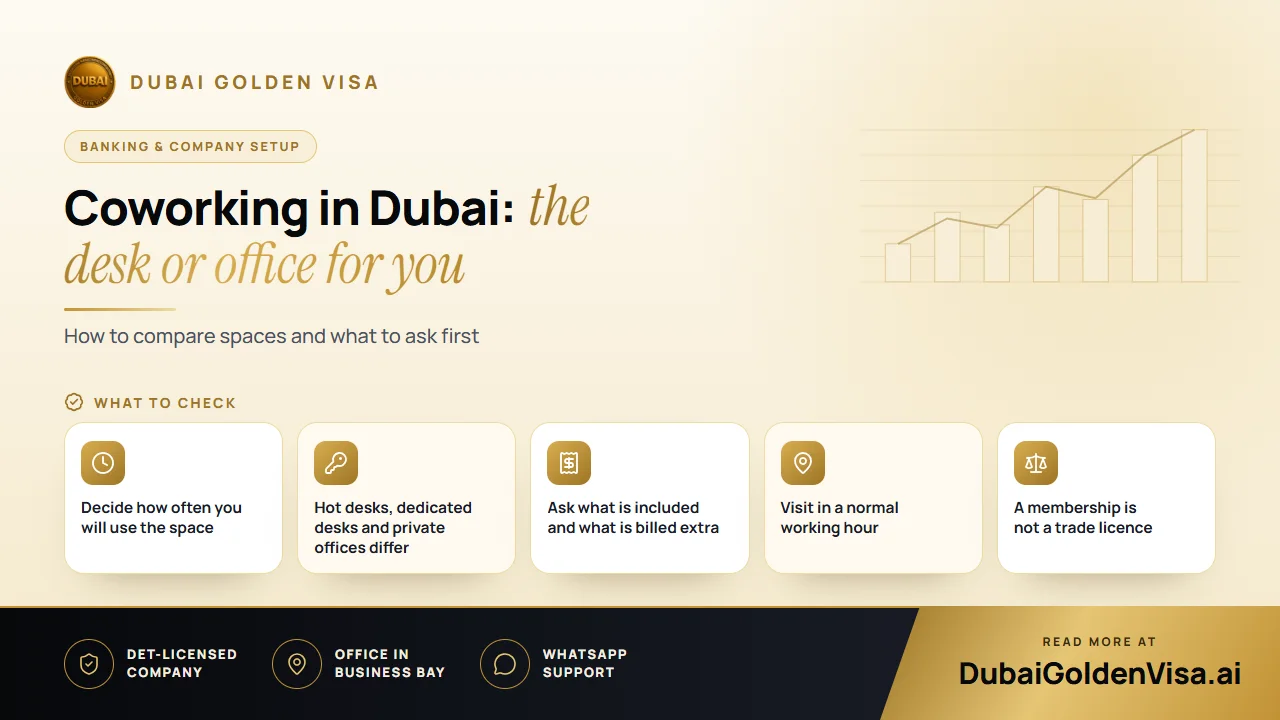
Start with how you will use it. An occasional desk and a daily team base are very different needs, and they are priced and arranged differently.
- Hot desk: you take any free seat when you visit. Good for people who move between client sites or only want an office setting on certain days. Ask whether you must reserve and what the access hours are.
- Dedicated desk: your own spot in a shared room, available whenever you come in. Useful if you visit often. Check whether you can leave equipment and whether storage is included.
- Shared office: a common area used by several businesses. Some people thrive on the buzz while others find it distracting, so judge it while it is busy.
- Private office: an enclosed room for you or your team inside a shared building, usually with access to common lounges and meeting rooms.
- Serviced office: a ready-furnished office with services such as internet and reception arranged by the operator. It suits a business that wants its own space without sorting every detail.
Terms overlap between providers, so read what a plan includes rather than relying on its label. A business centre may offer all of the above, while a pure coworking brand may concentrate on shared desks.
02Facilities worth checking
A long list of amenities is easy to be impressed by. Ask yourself which ones you would use in a normal week.
- Internet: essential if your day is video calls and cloud files. Ask about speed and what happens if it drops.
- Desk and chair comfort, plus power sockets, if you plan to sit there for hours.
- Reception: some sites welcome your visitors and tell you when they arrive, which makes client meetings feel organised. Find out whether it is part of your plan.
- Meeting rooms: check capacity, screens or video equipment, how booking works, and whether members get an allowance or pay each time.
- Printing and scanning: confirm whether it is included or limited.
Tip
Quiet matters more than people expect
If you take calls all day or handle sensitive client information, look for phone booths, quiet zones or an enclosed office. An open floor can be lively, but it is not ideal for every job.
03Why people choose it
Flexibility is the big one. You might begin with a hot desk and move to a dedicated desk or small office as a team grows. Some operators offer several types under one roof, which can make that shift easier, though availability and conditions still apply, so ask rather than assume.
It can also draw a line between work and home. Many remote workers find that a regular place to go helps them focus and finish the day properly. And sitting among people from other industries sometimes leads to a useful conversation or introduction. Events and workshops run by the operator can add to that, so ask what has actually been held recently and whether all members are welcome.
04A simple way to choose
- 1
Choose a place you can reach easily
Think about your usual route, parking, the metro and where clients are based. A lovely office that is a struggle to reach soon loses its charm.
- 2
List what you truly need
Quiet area, phone booth, meeting rooms, storage, reception. Compare providers against your own list.
- 3
Be honest about privacy
Open plan suits some people and drains others. Match the space to the kind of work you do.
- 4
Read the membership terms
Check access hours, guest rules, booking limits, cancellation and extra charges, and have important points confirmed in writing.
- 5
Visit in working hours
Notice the noise, cleanliness and how full the shared areas are, and speak to staff as you would on a normal day.
05Dubai or Abu Dhabi?
Both cities have flexible workspaces. The sensible choice follows your clients and meetings. If most of your work is in Dubai, base yourself there; if it is in the capital, look at what Abu Dhabi offers.
06Startups, small firms and licensing
A new business does not need a large permanent office. Founders can begin on shared desks and move to a private room when the team needs space. One caution: a coworking membership does not in itself give you a trade licence, register your company or allow you to run a regulated activity. Should the space need to serve as your official company address, or back a licence application, ask both the licensing authority and the operator what they will accept before paying.
If you are weighing up a workspace as part of setting up a company or sorting residence, message us on WhatsApp for a free check and we will point you to the right next step.
Questions about this topic
It varies by provider and plan. Desk access, internet and shared areas are common, while meeting rooms, printing, lockers and reception may be extra, so ask for a written breakdown.
Questions about your own case?
Send us a message and an advisor will tell you which route fits and what you'll need.