
Not many buyers pay for a home in a single transfer. Mortgages and developer payment schedules are how most Dubai property is bought, and it is reasonable to ask whether they get in the way of a Golden Visa. In short, they don't, provided the property is registered correctly and you can show the right documents.
This guide walks through the two main ways of paying over time, what the authorities look for in each, and how to prepare your file.
01Mortgaged property
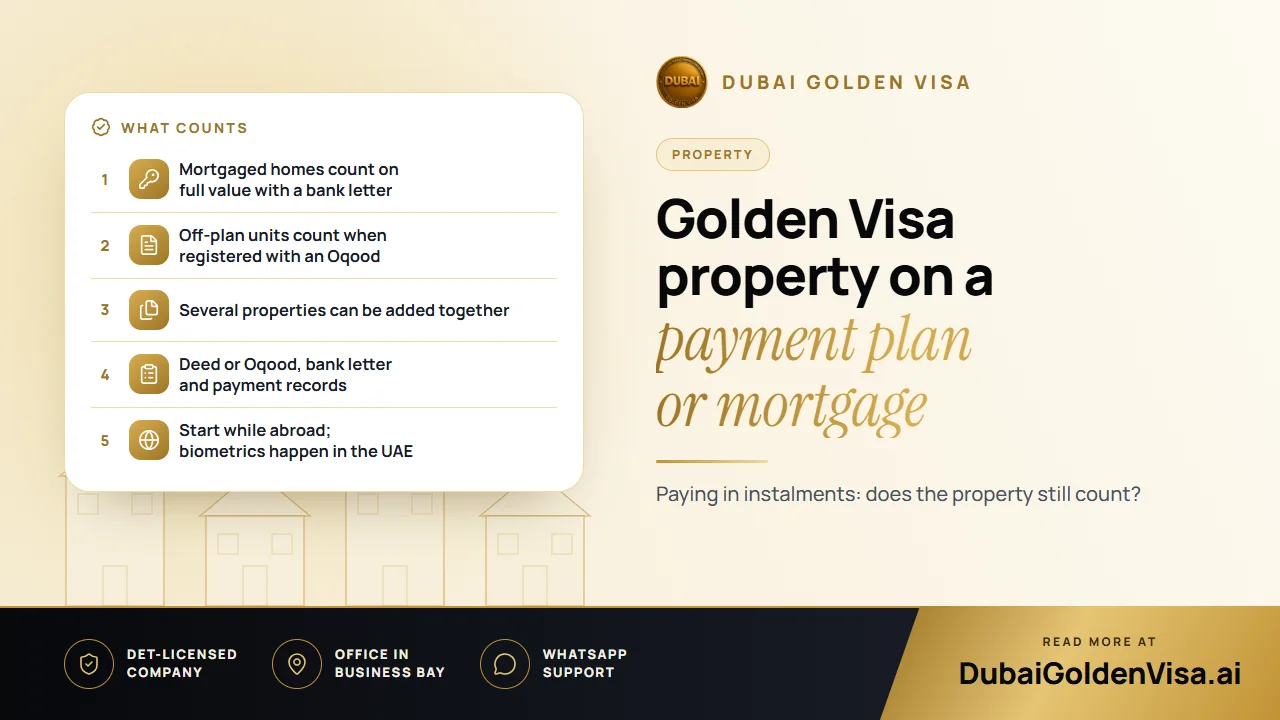
If your home is financed by a UAE bank, it still counts toward the AED 2 million. The value that matters is the full registered or valued figure of the property, not only the part you have repaid. What the authorities ask for is the bank's confirmation that it has no objection to your residence application.
That no-objection letter should identify the property, state its value and show your outstanding balance. Ask your bank for it early, as it can take some days to issue.
02Developer payment plans and off-plan homes
Buying from a developer on a schedule is common, especially in newer communities. An off-plan unit can support a Golden Visa when it is registered with an Oqood and the developer is approved by the local authorities. The amount you have paid to date doesn't change that, though we always check how the developer documents your payments.
What you cannot rely on is a reservation form or a sales agreement alone. Until the unit is registered, it is not a property the visa system recognises.
Tip
Reserved, not registered
Before you sign a payment plan for visa purposes, ask the developer when the Oqood will be issued and confirm they are approved. If the registration is delayed, your visa application will be too.
03Combining several properties
If one property doesn't reach AED 2 million, several can be added together. Each must be registered in your name, and the combined value must meet the threshold. Mixed portfolios, such as one ready unit with a mortgage and one off-plan unit on a payment plan, are workable when each has its own paperwork in order.
04Documents to gather
- Passport and recent photo.
- Title deed, or Oqood for off-plan property.
- Bank no-objection letter for any mortgaged home.
- Payment records or developer statements showing what you have paid.
- Current valuation, if the deed shows an older, lower price.
- Emirates ID and current visa, if you already live in the UAE.
- Health insurance valid in the UAE.
05The application route
- 1
Check your property
We compare value, registration and ownership share against current rules.
- 2
Collect the letters
Request the bank letter or developer statement and a valuation where needed.
- 3
File the application
The file goes to the immigration authority for your emirate. If you are abroad, an entry permit brings you in to finish the process.
- 4
Medical and biometrics
After initial approval you complete the medical test and Emirates ID biometrics, and the visa is issued.
Once your documents are complete, property files usually take five to seven working days. Government costs for the main applicant are about AED 9,459, with family members costing about AED 2,710 each plus their Emirates ID.
06Habits that help
- Keep payment receipts and statements together in one folder.
- Avoid undervalued registrations; the registered value has to support the visa.
- Apply as soon as your documents are ready rather than waiting.
- Talk to us before a sale or a restructure, since the visa depends on the property.
If you are choosing a payment plan or mortgage right now, message us on WhatsApp before you sign. We'll give you a free check on how it fits the Golden Visa rules.
Questions about this topic
A mortgaged home counts on its full value with the bank's letter, and registered off-plan units count whatever you have paid. We still review your payment records before filing.
Questions about your own case?
Send us a message and an advisor will tell you which route fits and what you'll need.