
A large share of Dubai's new homes are sold before they are built. If you are one of those buyers and you hope to turn your purchase into a ten-year Golden Visa, one document will come up in nearly every conversation: the Oqood certificate.
Many buyers assume it is the same as a title deed, or that it is somehow a visa document in itself. It is neither. Here is what it really is and how to use it.
01What an Oqood certificate is
The name Oqood comes from the Arabic for contracts. It also labels the Dubai Land Department register where off-plan sales are logged. Once you sign a sale and purchase agreement for a unit that is still under construction, the developer registers it on that system and an electronic certificate is issued in your name.
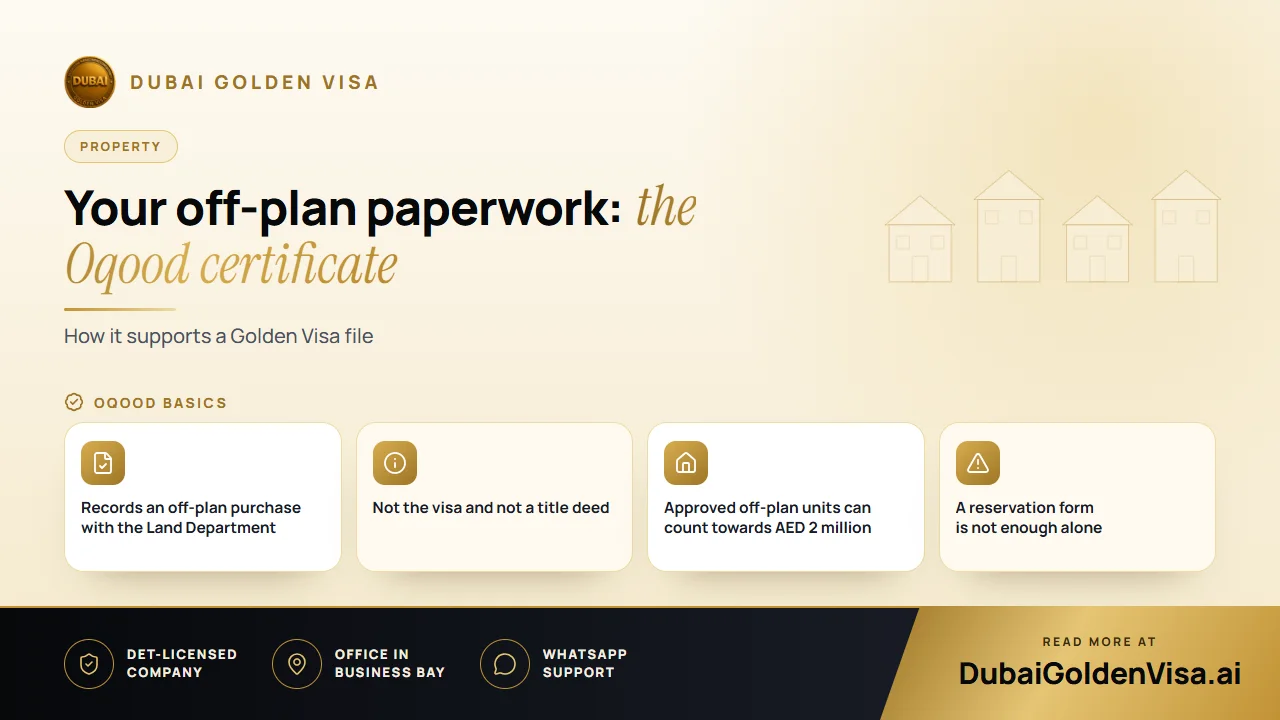
Think of it as a temporary title for the property. It protects your purchase while the building is completed, and when the unit is handed over it is replaced by a proper title deed.
02Oqood certificate and title deed side by side
- Stage: Oqood covers a unit under construction; a title deed covers a completed, handed-over property.
- Register: Oqood sits in the provisional register; the title deed sits in the final real estate register.
- Registration fee: the 4% transfer charge is paid when the off-plan sale is registered, and it is not charged again when the title deed is issued.
- Visa use: Oqood supports the off-plan route; a title deed supports the standard route for ready homes.
03How you get one
- 1
Sign the sale agreement
You sign with the developer and pay the initial deposit set out in your payment plan.
- 2
Pay the registration fee
The 4% Dubai Land Department fee and small admin charges are settled, usually alongside your early payments.
- 3
Developer registers the sale
The developer files the contract on the Oqood system within the time the land department allows.
- 4
Certificate is issued
If it drags on, chase the developer in writing and keep copies of every message.
- 5
Check it yourself
Look for your name, the unit, the registered price and the Oqood number in the Dubai REST app.
04Does an Oqood work for a Golden Visa?
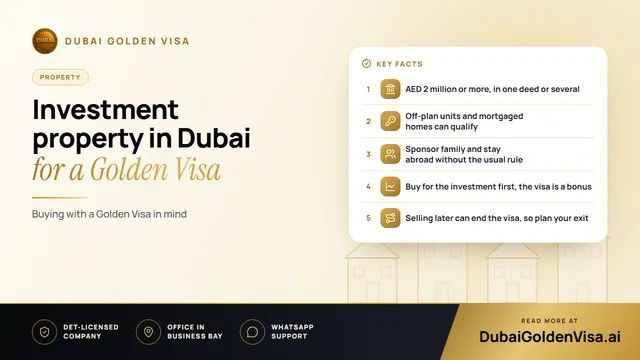
Yes. Off-plan property can support the property Golden Visa as long as three things line up. The registered value is AED 2 million or more, from one unit or several added together. The unit is in an approved project from an approved developer. And the sale is actually registered, because a reservation form or a signed agreement that has not been entered on the system gives the authorities nothing to verify.
The part that surprises many buyers is the money. What counts is the registered price, not the instalments you have made so far. Someone who has paid a modest percentage of a AED 2.3 million apartment can still apply once the Oqood exists. The land department confirms the property, and the residency application then goes through GDRFA.
Tip
Three quick examples
One unit registered at AED 2.4 million with a fifth paid: most likely fine. Two units registered at AED 1.2 million and AED 950,000 in your own name: they add up to over AED 2 million, so likely fine. One unit worth AED 2.5 million with only a reservation form: not yet, because nothing is registered.
05Documents to keep together
- Passport and a recent photo.
- The registered Oqood certificate.
- A recent statement of account from the developer.
- A developer no-objection letter, where requested.
- A bank no-objection letter if the unit is mortgaged.
- Your Emirates ID and current visa, if you already live in the UAE.
06Mistakes to avoid
The most common slip is treating the Oqood as the visa, or as a title deed. It is proof of purchase and nothing more; the residency file has its own rules.
Others are buying from a developer or project that is not approved, skipping the check in the Dubai REST app, and losing payment evidence. Keep bank receipts and developer statements, because the authorities can ask for them. Finally, rules in this area have moved more than once, so confirm today's position before you commit to a purchase for visa reasons.
Holding an Oqood and wondering if it is enough? Send us a photo of it on WhatsApp and we will tell you for free whether your unit can support a Golden Visa.
Questions about this topic
Usually yes. Once the Oqood is registered and the value reaches AED 2 million, you do not need to wait for handover.
Questions about your own case?
Send us a message and an advisor will tell you which route fits and what you'll need.