
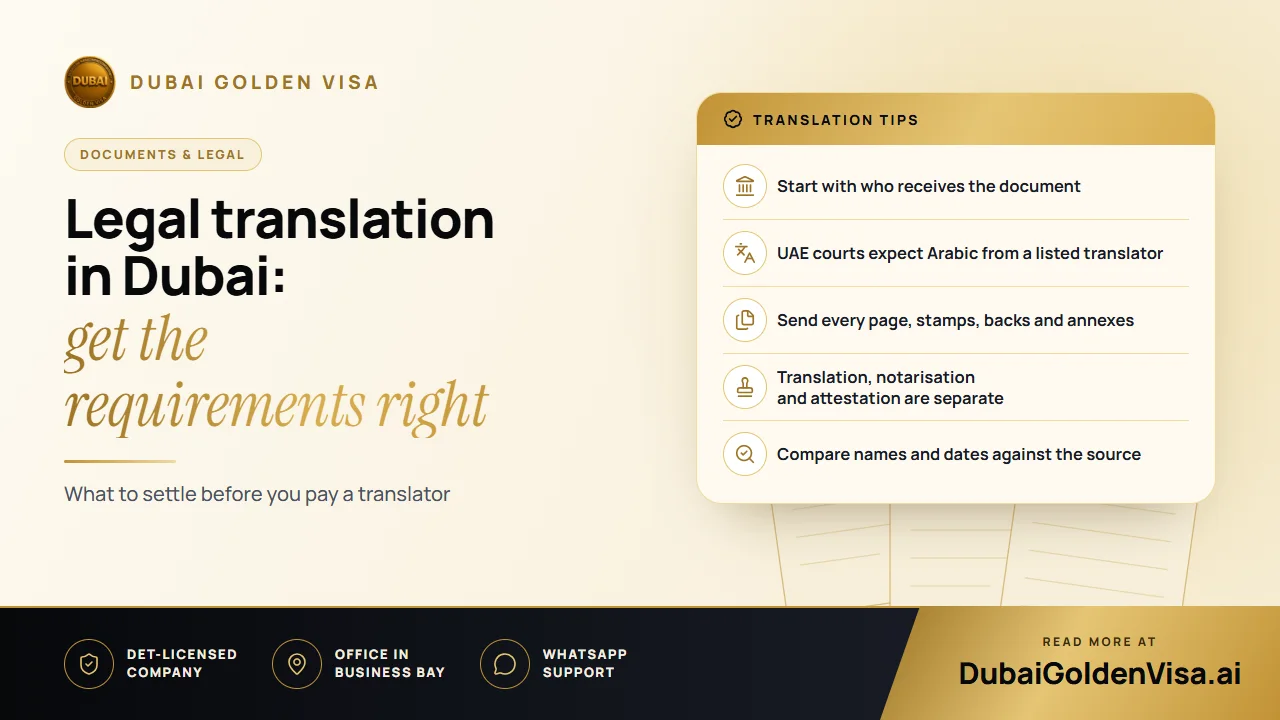
One wrong detail can undo a good translation. A company name spelt differently from the trade licence, a missing seal on the scan, a clause rendered loosely: any of these can make an authority send the file back. When the paper will be used in the UAE, the first question should be what it is for, not what it costs.
This guide walks through what to settle before you contact a translator, how to prepare your documents, and how translation relates to notarisation and attestation, which people often confuse.
01Start with the receiving authority
Work out who will read the document: a court, a government department, a notary, an employer, a bank or a business partner. If that body has given written instructions, keep them close, since they tell the translator whether an ordinary translation will do or a particular certification is expected.
A translation that satisfies one reader may not satisfy another. A company might use an English version of a contract for internal review, while the same contract filed with a court faces stricter language and translator rules. If the instructions are unclear, ask the receiving body directly.
02Who is allowed to translate
Courts are the strictest case. Official guidance says Arabic is the language of filing, so a foreign-language paper has to be rendered into Arabic by a translator on the Ministry of Justice's approved list. Terms such as professional or certified are used loosely in advertising, so ask the provider how the requirement will actually be met in your case. Where a specific court or authority applies, confirm with it or a qualified lawyer.
03Questions to put to a provider
- Who will translate or certify my document, and if an approved legal translator is required, how will that be met?
- Do you handle this language pair and this kind of document? Contract experience is not the same as court papers or personal certificates.
- What gets verified before you receive the work, whether that is names, dates, case numbers, seals, signatures or attachments?
- How are my files transferred, stored and shared, given the personal or commercial details inside?
- What exactly is delivered, in what format, by when, and which steps must I arrange myself?
Confident sales language is no substitute for clear answers. Judge the way they work rather than proximity, review scores or a quick advertised turnaround. This applies equally if you search for an Arabic legal translator near you.
04Documents that may need translation
The need depends on the intended use, not the document alone. Typical examples include:
- Court claims, judgments and notices.
- Commercial contracts and partnership deals.
- Powers of attorney and papers prepared for a notary.
- Company incorporation records and trade licences.
- Civil certificates, such as birth, marriage and death records, used for official applications.
- Immigration, job and school records.
- Property or banking paperwork that a local institution has asked to see.
Treat that as a set of examples rather than a full list. Ask the organisation which language it needs and whether it requires a specific format or certification.
05Preparing the source file
- 1
Gather every page
Include the reverse of each page, as it may carry a stamp, signature or reference number, plus all schedules, annexes and appendices.
- 2
Make it readable
Use a scan or photo where small print, seals and handwritten notes can be read clearly.
- 3
Fix the spelling of names
If an official spelling already appears on a passport, licence or company record, tell the translator so the versions match.
- 4
Explain the purpose
Say where the translation will be submitted and pass on any instructions you were given.
- 5
Never fill gaps yourself
If something is hard to read, say so instead of guessing, and never edit the original to make it easier. Flag missing pages and ask how to continue.
06Translation is not attestation
Translation carries meaning from one language to another. Notarisation is a formal act by a notary or other authorised official. Attestation or legalisation confirms that a paper, or the official stamp on it, can be relied on for a given purpose. A file may need only one of these, or all of them, and the sequence hinges on the country of issue and the body that will read it.
Guidance from the Dubai Courts notes that papers issued abroad may have to be certified at home, then by the UAE embassy in that country, then by the UAE Ministry of Foreign Affairs. This is not true of every document, so check your own.
Tip
Last check before you submit
Read the translation next to the original and compare names, dates, numbers and company particulars. Keep copies of both versions. Translation alone never guarantees that an authority will accept the underlying document.
If your papers are heading to a court, notary or government counter and you are unsure what is required, message us on WhatsApp for a free check. Tell us the document and where it is going, and we will explain the sequence and what we can handle.
Questions about this topic
Not usually. Filings need to be in Arabic, prepared by a translator the Ministry of Justice has approved. Confirm your own case with the court or a lawyer.
Questions about your own case?
Send us a message and an advisor will tell you which route fits and what you'll need.