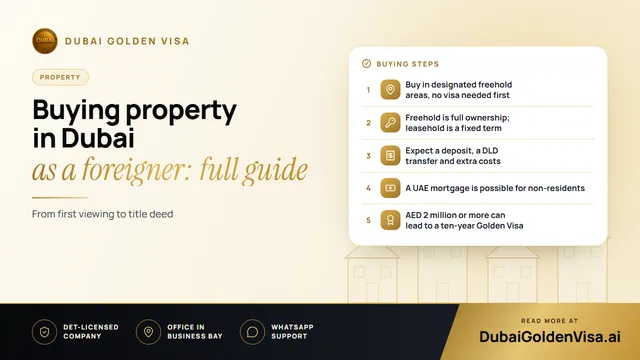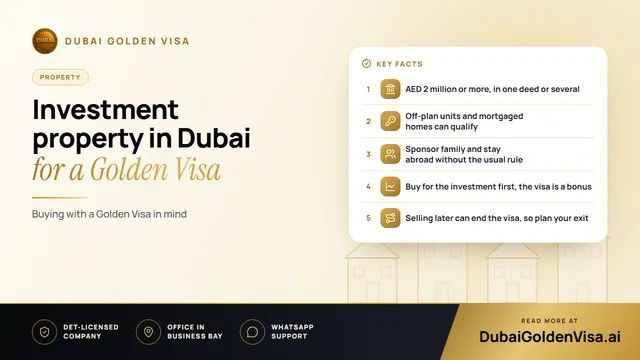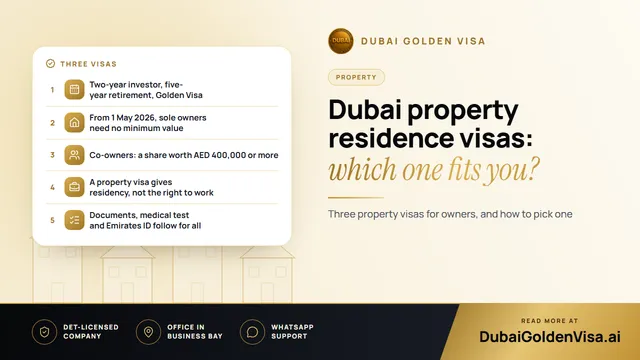

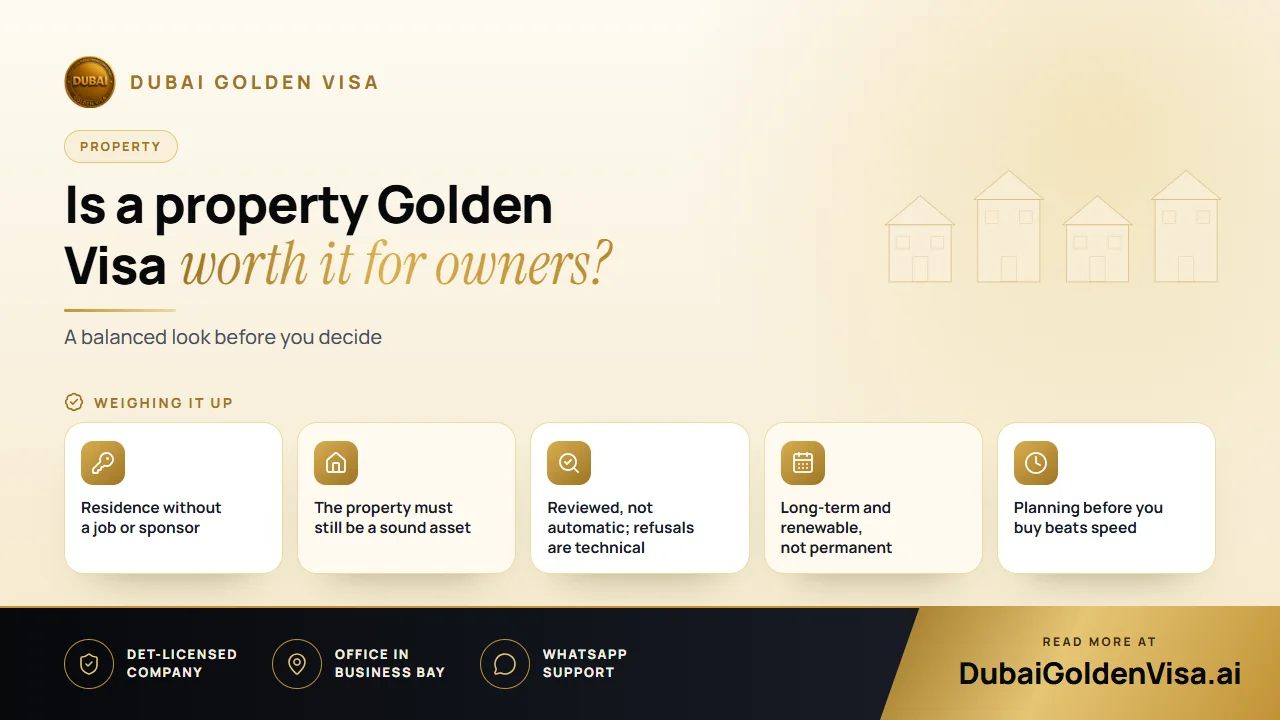
Property in Dubai has always had a financial case: rent, growth and a tax-friendly setting. A Golden Visa adds a second case, which is security of residence. Whether that is worth it depends on what you want from the purchase.
Here is a fair look at where the value sits, where it does not and how to avoid the common mistakes.
01Where the value comes from
Residence in many countries has become harder to get and easier to lose. A ten-year, renewable visa that you hold as your own sponsor is therefore a valuable thing in itself. You can change jobs, close a business or stop working, and your status holds. Time abroad does not cancel it, because Golden Visa holders are exempt from the six-month absence rule.
Family cover adds to that. Spouse, children and parents can be included, sons with no age cap and unmarried daughters at any age. For many households, that matters more than any rental yield.
There is a financial side too. Banks tend to see a long-term resident as a steadier customer, which can ease accounts, mortgages and refinancing. The final call always belongs to the bank.
02The asset still has to stand up
The strength of your visa follows the strength of the home it rests on. The property needs to hold its value, because a renewal depends on it still meeting the AED 2 million line. A poorly chosen unit, or one bought at an inflated off-plan price, can leave you with a visa problem and a financial one.
Location, build quality, the developer's record and the demand for rentals in the area all feed into how well a property holds up over ten years. None of that appears on a visa application, yet it shapes whether the same property will still clear the threshold when renewal arrives. We are happy to talk through those questions alongside the visa ones.
Tip
Judge the property first, the visa second
Ask whether you would be happy to own this home with no visa attached. If the answer is yes, the Golden Visa is a bonus. If the answer is no, it is not a good reason to buy.
03A process you can follow
The route is run through official channels. Ownership is recorded with the land department, the value is documented and the application goes to the immigration authority. Because the records are digital and traceable, there is less room for guesswork than in many schemes elsewhere.
That does not mean approval is automatic. Buying a qualifying property lets you apply, nothing more. The authorities then look at the registered value, the way the property is held and your documents.
04Mistakes that cost time and money
- Assuming any property qualifies, rather than checking registration and value
- Assuming an off-plan unit qualifies at any stage, whatever the developer or payments
- Relying on the contract price while the recorded value is lower
- Counting a joint property's full value when each owner's share is what counts
- Buying first and verifying later
Most refusals are quiet ones and come from documents, not policy. A little checking in advance avoids almost all of them.
05What it does not do
The Golden Visa is not permanent residence and it is not citizenship. It is long-term and renewable, but you must keep a qualifying property. Selling it can end the visa unless a replacement is registered first. Rental income does not enter the assessment, so you can let the unit, live in it or leave it empty.
If you want a sense of the costs, the government charges for the main applicant on the property route are about AED 9,459, with about AED 2,710 plus AED 1,180 for the Emirates ID per family member and a medical test for adults. A straightforward file is usually done in five to seven working days.
Weighing up a purchase and want an honest view of how the visa fits? Message us on WhatsApp for a free check before you buy, and we will tell you plainly what we see.
Questions about this topic
No. Buying simply lets you apply, and the authorities then review the value, registration and documents.
Questions about your own case?
Send us a message and an advisor will tell you which route fits and what you'll need.