
Sooner or later most people living in Dubai are asked for a notarised paper. A bank wants a Power of Attorney, a property office wants a signed declaration, or a company needs a formal resolution. The word notarised sounds final, yet it only means that an authorised person has carried out the formal step the law requires for that document.
Whether it satisfies the organisation on the other end is a separate question. Here is how to get it right the first time.
01What a notary does, and what they do not
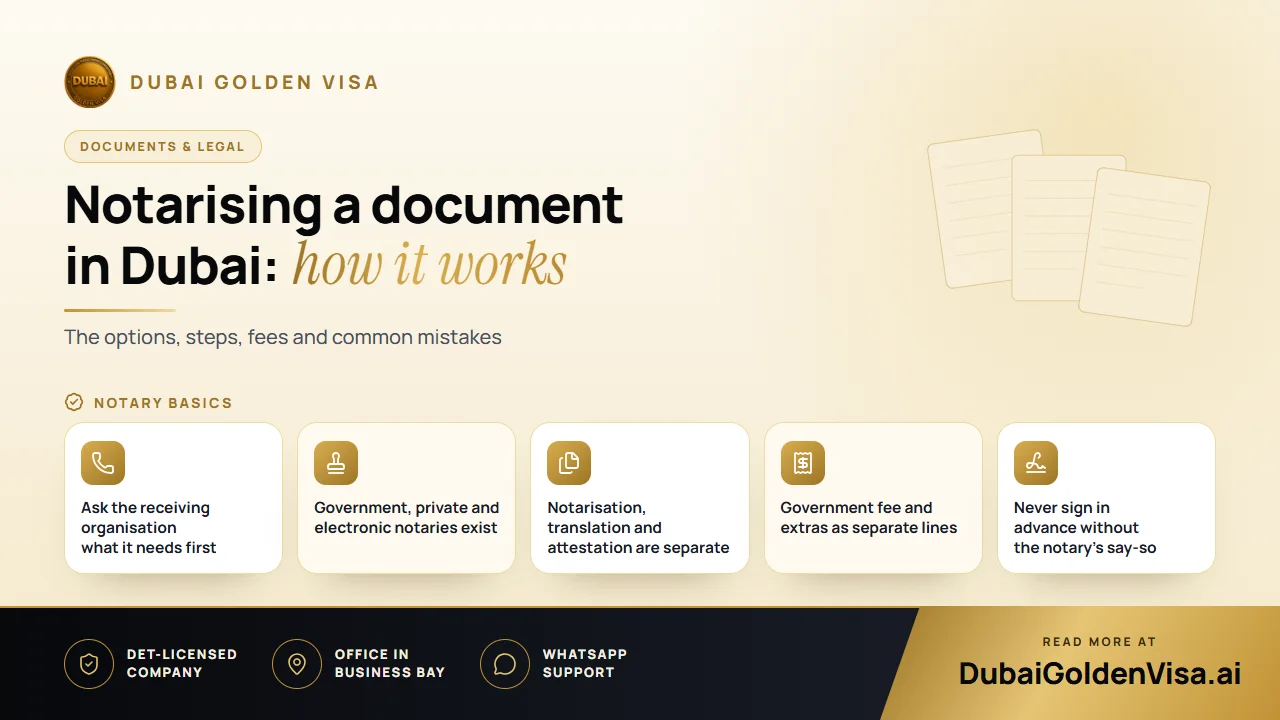
A notary checks who is signing, confirms they are doing so willingly and completes the formal process for the instrument. The exact checks depend on the document and the service. A notary is not auditing every statement inside the paper, and the seal does not oblige a bank, court or foreign authority to accept it. That decision always stays with the receiving party.
02Three ways to get it done
- Government notary: provided through official Dubai Courts channels and suited to instruments within the government notary's authority. Locations and booking methods change, so check the current service directory.
- Private notary: an authorised office that can perform specified notarial acts, often with more flexible appointments. Confirm it is authorised for your exact document.
- Electronic notary: Dubai Courts runs a digital service for eligible transactions such as Powers of Attorney and legal notices. Not every document qualifies, and some still need an identity check or attendance.
03Documents people commonly notarise
Typical requests include general and special Powers of Attorney, declarations and acknowledgements, legal notices, certain company instruments and some property or business papers. Certain wills are also handled this way where the service is authorised. Overseas documents may need extra attestation or legal translation, so a Dubai notary stamp alone is rarely the whole answer.
04The process, step by step
- 1
Ask the recipient
Find out the wording, language, number of originals and ID rules the bank, court or authority expects, ideally in writing.
- 2
Pick a channel
Decide between a government notary, a private notary or the electronic service, based on what can handle your instrument.
- 3
Prepare your papers
Bring the draft, passport or Emirates ID, and any reference numbers. For a company, add the trade licence and proof that the signatory has authority.
- 4
Arrange translation
If the document is not in an accepted language, get a legal translation and ask whether it needs its own attestation.
- 5
Submit and pay
Review the fee breakdown before paying, especially if drafting, translation or courier services are bundled in.
- 6
Verify identity and sign
Follow the notary's instructions. Signing before you are told to can force you to start again.
- 7
Check what you receive
Look over names, dates, page counts, seals and electronic verification details before you leave or close the online session.
Tip
A small step that saves money
Send the recipient's instructions to the notary and ask whether the document looks right. It does not guarantee acceptance, but it often catches missing wording before you pay.
05Power of Attorney: get the wording right
A Power of Attorney lets someone act for you, but only within what the document says. A general one gives wide authority; a special one is limited to named actions, such as signing a property transfer. Banks and land departments often insist on a special POA that spells out the exact task, and they may need property or company details in the text. An online template is rarely enough.
06Fees: what to expect
There is no single price. The government notary schedule currently lists examples such as AED 100 for each signature on a Power of Attorney, whether general or special, AED 200 for a legal notice, and higher amounts for instruments with a stated value. Private providers may add charges for drafting, translation, extra copies and delivery.
When you ask for a quote, say what the document is, how many people sign, whether it has a monetary value, which language it is written in and if you want help drafting it. Then request separate lines for the government fee and the provider's own service charge.
07Notarisation versus attestation
Notarisation is the formal act by an authorised notary. Attestation is the wider confirmation of a signature, seal or origin by an authority, and for documents used abroad it can involve embassies and the Ministry of Foreign Affairs. If your paper is going to another country, ask whether you need both.
08Mistakes we see most often
- Using a generic template that lacks the wording the recipient needs
- Signing before the notary has witnessed or verified the signature
- Assuming every branch handles every instrument
- Paying a provider who promises a document will definitely be accepted
Branch locations and opening hours change from time to time. Some counters have closed or moved in recent years, so check the current listing before you travel, rather than trusting an old map pin.
Unsure what your document needs? Message us on WhatsApp for a free check of the wording, translation and attestation steps before you pay anyone.
Questions about this topic
Some documents can, through the Dubai Courts electronic notary. Eligibility depends on the instrument and the parties, so check before you plan around it.
Questions about your own case?
Send us a message and an advisor will tell you which route fits and what you'll need.