
Plenty of buyers in Dubai never write a single cheque for the full price. They pay a deposit, follow the developer's schedule over a few years, or finance the rest through a bank. A common worry follows: does a property you are still paying for count towards a Golden Visa?
In most cases it does. The immigration side cares about what is registered in your name and what it is worth, rather than how much cash has left your account. Let's walk through how that plays out for a payment plan, a mortgage and a mix of both.
01The basic rule in one paragraph
The property route gives a ten-year, renewable residence to people who own UAE property worth AED 2 million or more. That value can sit in one home or be spread across several deeds. The holder is their own sponsor, so no employer or local partner is involved. Everything else in this article is about proving that value when the purchase is not yet fully paid.
02How a developer payment plan is treated
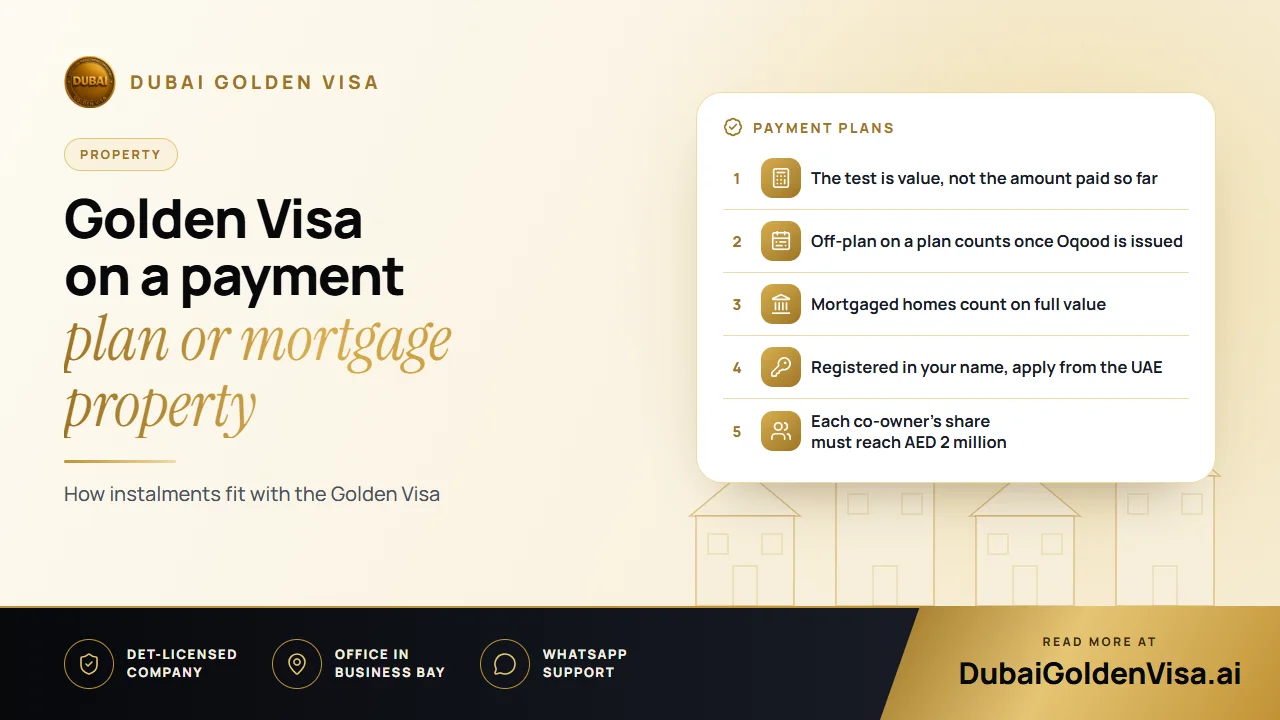
With an off-plan purchase you receive an Oqood, the registration that records your contract with an approved developer at the Dubai Land Department. Once that registration exists, the unit can be counted at its contract value, whatever stage your payments have reached.
So if you have paid only the first instalment on a AED 2.4 million apartment, the registered figure is still AED 2.4 million. You do not have to wait for handover or for the final payment. What you do need is a developer that is approved and a registration that is complete.
- The sales agreement showing the full price
- The Oqood registration for the unit
- A payment statement from the developer, listing what you have paid and what is still due
- Your passport and Emirates ID, if you already hold one
03How a mortgage is treated
A home bought with bank finance also counts on its full value, not just the share you have funded. The bank holds a charge over the property, but ownership is still yours. In our experience the bank's no-objection letter is the document that keeps this smooth, so we ask for it early rather than discover the need at the last minute.
Some applicants are told that requirements have been dropped. Practice can differ from one case to another, so we plan for the letter and are pleased if it turns out not to be requested.
Tip
Older purchase, newer value
If you bought a few years ago and the deed shows a price below AED 2 million, a current valuation recognised by the Dubai Land Department can replace the old figure. It is worth checking before you buy another unit just to close the gap.
04What does not change
- The total registered value must reach AED 2 million, whether in one unit or several.
- The property must be registered at the land department, as a title deed or an Oqood. A reservation form alone is not enough.
- You must be the registered owner. For joint ownership, your own share is what is measured, so each co-owner should check the split.
- You file while you are in the UAE. If you are overseas, an entry permit brings you in first.
05A sensible order of events
- 1
Check the registration
Make sure the deed or Oqood carries your name and the right value before anything is submitted.
- 2
Collect the finance papers
If there is a mortgage, ask the bank for its no-objection letter. If there is a payment plan, ask the developer for an up-to-date statement.
- 3
Submit the application
Your file goes through the land department and then to immigration. Property files usually take around five to seven working days once the documents are complete.
- 4
Medical test and biometrics
These follow approval. Your current visa is cancelled only after initial approval, so you are never left without status.
06Practical points before you commit to a plan
If the Golden Visa is part of your reason for buying, read the payment schedule as carefully as the brochure. Confirm that the unit's registered price, rather than a discounted launch figure, reaches AED 2 million. A unit priced just under the line can quietly miss the threshold once a discount is applied to the contract.
Think too about what happens later. The visa rests on the property, so selling it can bring the residence to an end unless you replace it with another qualifying asset. Plan your exit with that in mind, especially on a long payment plan where you may be tempted to sell before completion.
Finally, budget for the government costs. The property route is about AED 9,459 for the main applicant, and each family member is around AED 2,710 plus AED 1,180 for the Emirates ID, with a medical test of about AED 285 for adults. These are approximate figures and we confirm the current total before you pay anything.
Not sure whether your payment plan or mortgage qualifies? Send us a photo of your Oqood or title deed on WhatsApp and we will give you a free, straightforward check.
Questions about this topic
No. An off-plan unit with an Oqood from an approved developer counts at its contract value, whatever you have paid so far.
Questions about your own case?
Send us a message and an advisor will tell you which route fits and what you'll need.