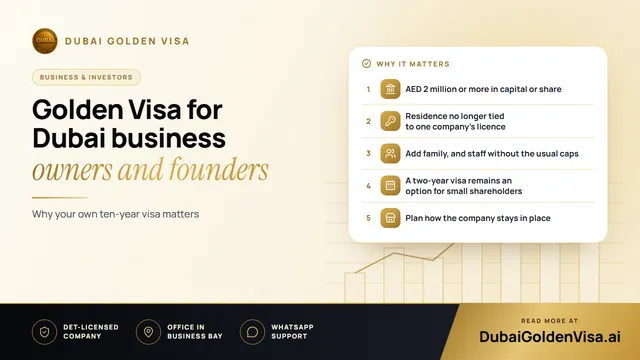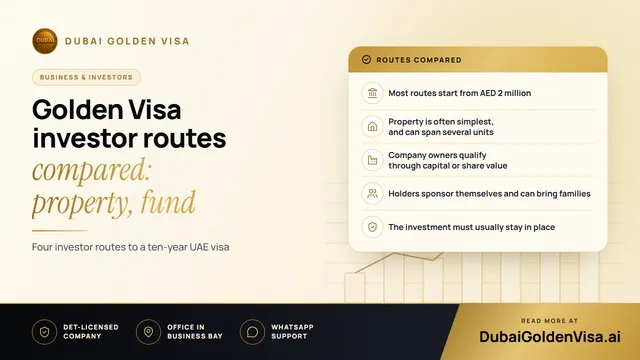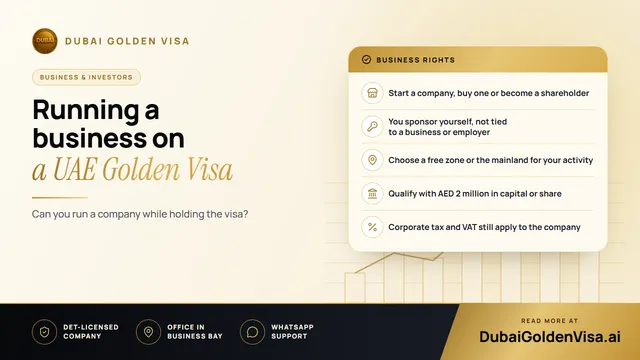
Founders are a big part of the UAE economy, and the Golden Visa has a category aimed at them. What surprises many is that the visa does not reward effort or reputation. It rewards evidence. Strong companies get turned away when the paperwork fails to show what an immigration officer needs to see.
This guide sets out how founders can prove their record, which documents carry the most weight and where files usually go wrong.
01Pick your route before you collect anything
Based on what we know today, entrepreneurs usually qualify in one of three ways, each with its own benchmark, and each approved by a recognised authority.
- Approved project: you own or co-own an innovative project valued at AED 500,000 or more, backed by an accredited incubator or a government body.
- Revenue: your registered small or medium business earns AED 1 million or more a year.
- Exit: you built one or more ventures that were sold for a combined AED 7 million or more.
Pick the route that fits your business now. A file that tries to argue all three at once tends to prove none of them properly.
Tip
Keep this in mind
Owning a company only opens the door to a route. It is the valuation, the financial record and the endorsement that actually carry you through it.
02The documents that carry weight
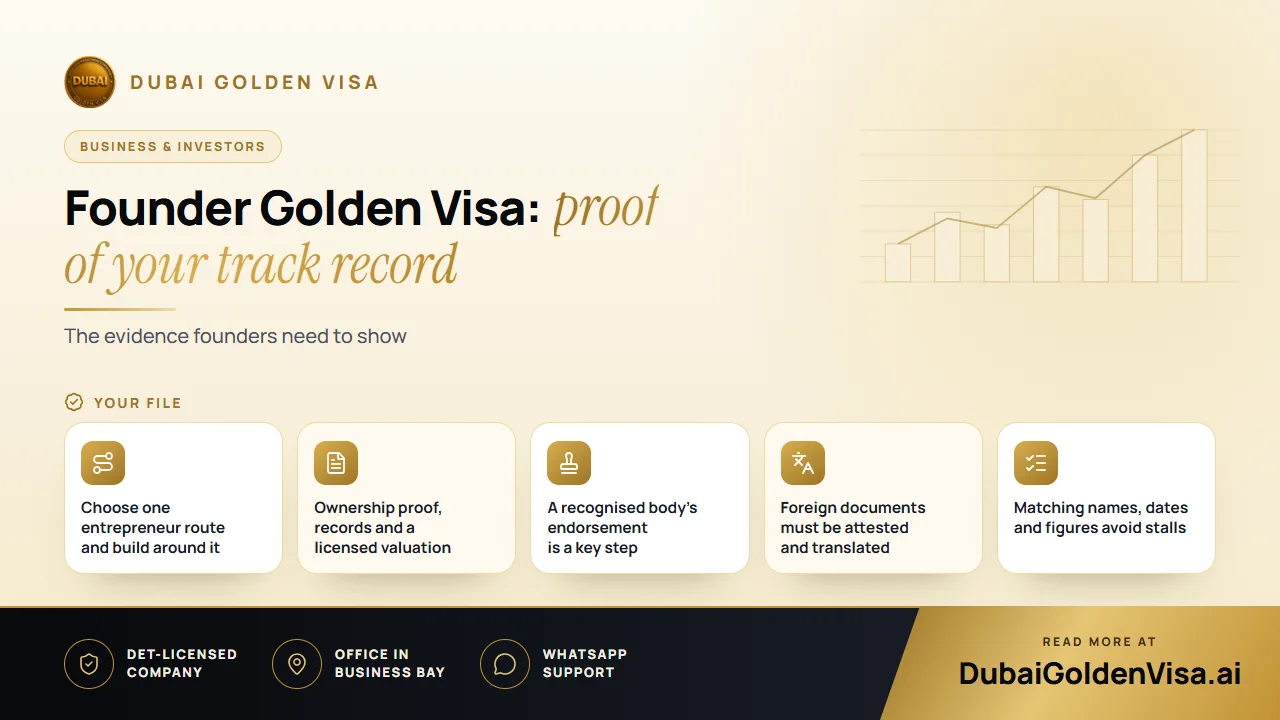
Proof of ownership comes first: a valid trade licence, the memorandum of association showing your share, shareholder agreements or share certificates, and records naming you as founder, director or partner. If a business was registered abroad or has since closed, include its historic registration papers to show your involvement at the time.
Next come financial records that show a real, running business: audited statements, income and expense reports, company bank statements, tax filings and the contracts and invoices behind your income. Keep yearly revenue, company value and personal income clearly apart. They are measured differently, and mixing them undermines your credibility quickly.
For the project route you also need a valuation letter from a UAE-licensed auditor. It should state the figure, the method used and the auditor's licence details. Self-prepared reports and foreign appraisals are generally not accepted.
An endorsement letter from an accredited incubator or the relevant ministry tells the authorities that a recognised body has reviewed your business. Before accepting one, confirm that the organisation really is accredited.
03The story behind the numbers
Officers are people, so give them context. A short business profile should explain what the company does, why it is innovative, how many jobs it supports and how it plans to grow in the UAE.
Add a founder profile too: a CV that highlights business achievements, plus a brief factual account of how you started, the problem you solve and the milestones you drove yourself, such as raising investment, building the team or entering new markets. If you sold a company, include the signed sale agreement and the transfer papers. Only completed sales count, not valuations or informal offers.
04Documents issued abroad
Certificates, contracts or company records issued outside the UAE normally need legalisation and attestation by the UAE Ministry of Foreign Affairs, and a certified Arabic translation where required. Unattested foreign documents are a quiet cause of stalled files, because nobody warns you and the application simply stops moving.
05How the process runs
- 1
Choose the route
Match your business's current position to one benchmark.
- 2
Secure the endorsement
Approach an accredited incubator or the relevant ministry.
- 3
Commission the valuation
Use a UAE-licensed auditor for the valuation letter.
- 4
Align every record
Names, dates and percentages should be identical across all documents.
- 5
Attest foreign papers
Legalise, attest and translate anything issued abroad.
- 6
File and complete
Submit through ICP or GDRFA Dubai, then do the medical test, biometrics and Emirates ID. Company files usually take two to four weeks.
06Mistakes that sink applications
- Working from an outdated investor-visa threshold that does not apply here
- Relying on a CV alone when every claim needs a document behind it
- Revenue figures that differ between statements, bank records and the application
- Valuations from anyone other than a UAE-licensed auditor
- Endorsements from organisations that are not accredited
- Foreign documents without attestation or translation
Not sure which route fits your company? Message us on WhatsApp for a free check and we will tell you which one to aim for, and what is missing from your file.
Questions about this topic
It can support your application, but you will still need a UAE-recognised endorsement and valuation, and foreign documents must be attested.
Questions about your own case?
Send us a message and an advisor will tell you which route fits and what you'll need.