
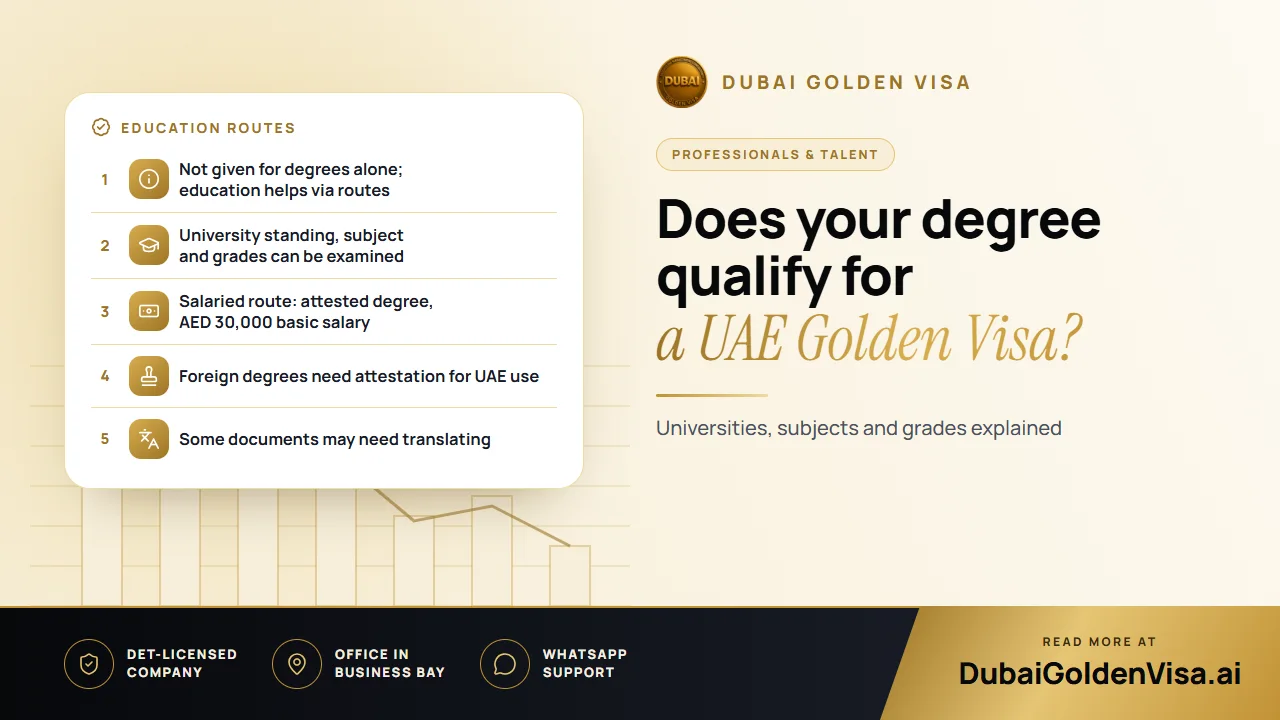
If you have just graduated, or built a few years of experience since, you may wonder whether your degree is enough for ten-year residence in the UAE. It can help a great deal, but it does not do the job alone. The Golden Visa looks for people with something to contribute, and education is one way of showing it.
This guide walks through where your degree matters, which parts of it get checked and what to prepare.
01The three ways education comes into it
There is no single route called the degree visa. Instead, your studies can support one of several categories, each with its own conditions.
- Outstanding students and graduates: high-achieving students and recent graduates can qualify, normally on top academic results and, for graduates, a degree from a well-rated university.
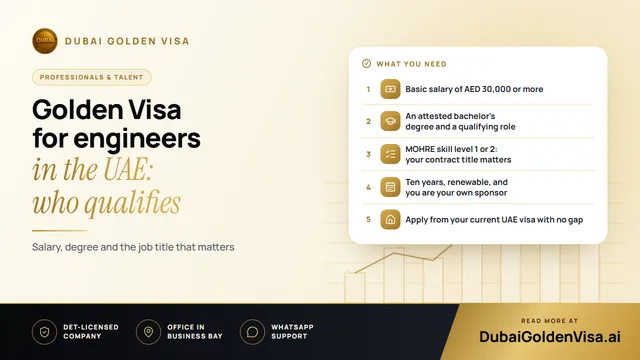
- Skilled professionals: an attested bachelor's degree is one of the core requirements, alongside a basic salary of AED 30,000 or more and a job in MOHRE skill level 1 or 2.
- Scientists, researchers and specialists: advanced degrees and published work often back an application, along with a recommendation from the relevant authority.
02University and subject: what gets looked at
For the graduate route, the standing of your university is part of the picture. Applicants have generally been expected to come from a highly ranked international university or a well-rated UAE institution. Official recognition counts for more than a famous name, so a university's rating in the relevant ranking or education ministry listing is what gets checked, not its reputation.
The subject matters too. The UAE has been keen on fields linked to its national strategies, such as artificial intelligence, engineering, data science, life sciences, medicine, public health, renewable energy and financial technology. If your degree sits close to one of these, your case is stronger, though other fields can still succeed through the professional or talent routes.
03Grades and timing
For graduates, a strong grade point average has usually been part of the test, with a higher bar for UAE universities than for the top international ones. The rules for recent graduates are also time-limited, and applicants have generally needed to apply within a couple of years of finishing the degree. Because these thresholds are adjusted from time to time, we check the latest figures before you apply rather than rely on old numbers.
Tip
Still studying?
If you are in your final semester, you can start collecting transcripts and certificates but may need to wait for your final result and certificate before filing. Ask us about your timing.
04Documents to prepare
- Degree certificate and academic transcripts
- Proof of your university's ranking or rating, where it applies
- Attestation of your degree for UAE use if you studied abroad
- Passport and passport-style photos
- Police clearance certificate
- Valid health insurance in the UAE
- Arabic translations of documents where required
Attestation takes the longest, since it passes through several offices in your home country and in the UAE. Start it first and everything else will flow more smoothly.
05If your university or grades fall short
Do not give up if you narrowly miss the graduate route. If you are working, your degree can still support the skilled professional route. If you have a postgraduate degree or research output, a talent or researcher category may fit better. A fresh graduate who does not yet earn AED 30,000 can come back to the question once their pay and role reach the level.
You can apply while you are abroad. If you are outside the country, an entry permit brings you in to finish the medical test and Emirates ID biometrics.
- 1
Identify the route
Graduate, skilled professional or specialist. We help you choose.
- 2
Check your university and grades
Against the current official criteria for that route.
- 3
Attest and translate
Start document attestation early.
- 4
File and complete
Submit, then finish the medical test and biometrics.
Send us your degree and transcripts on WhatsApp and we will give you a free eligibility check, including which route is the best fit and what is missing.
Questions about this topic
Only for some routes. The graduate route looks at university standing, while the skilled professional route needs an attested degree, the right salary and a qualifying role.
Questions about your own case?
Send us a message and an advisor will tell you which route fits and what you'll need.