

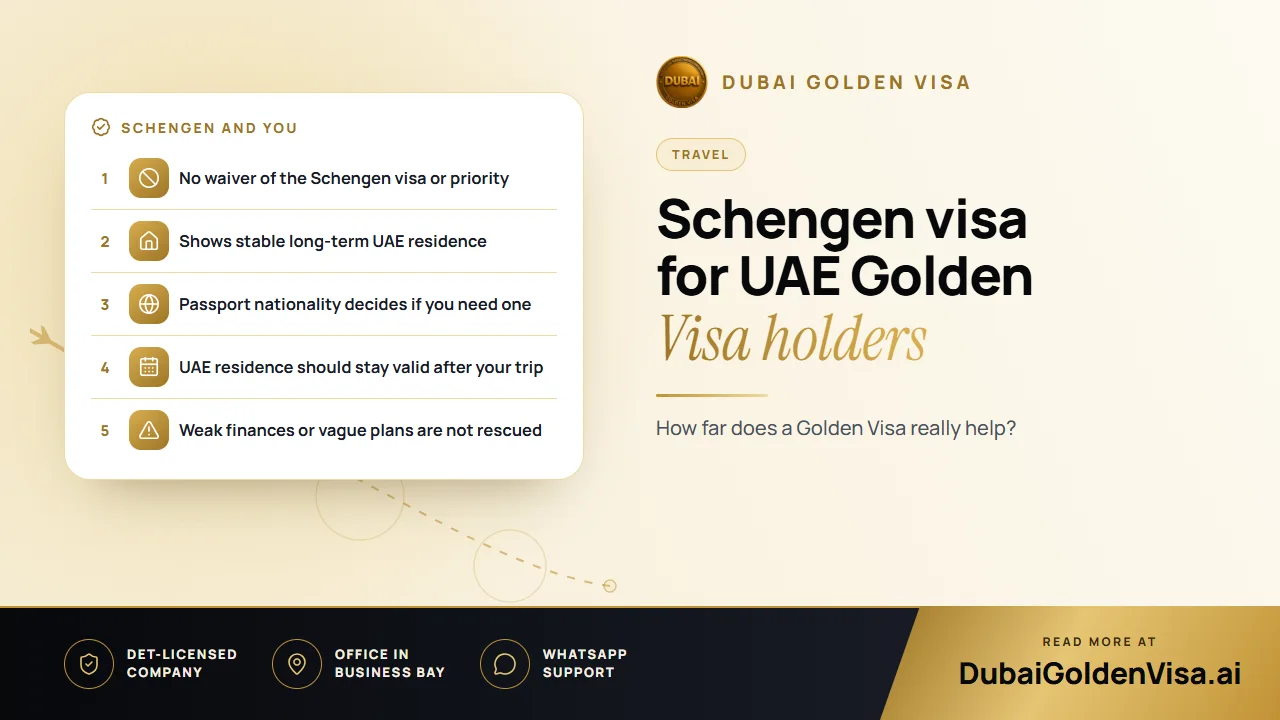
It is natural to assume that a ten-year UAE residence permit carries weight in Europe. In one sense it does: consulates like to see applicants who are settled and have good reasons to return home. In another sense it does not, because the rules for a Schengen visa depend on your passport, not on where you live.
So think of the Golden Visa as a strong supporting document, not a shortcut. Below is how it fits in, and how to prepare an application that stands on its own.
01What the Golden Visa tells a consulate
It shows that you are a long-term legal resident of the UAE. Consulates look for that, because it supports the claim that you will return after your trip. A ten-year permit, linked to property, a business or a skilled career, usually reads as more settled than a short residence visa tied to one employer.
It also helps you present your case cleanly. Your residence permit, Emirates ID and supporting proof such as property or business ties give the officer a clear picture. In borderline cases, a well-documented residence can add reassurance, though it will not outweigh obvious gaps.
02What it does not do
- It does not make you visa-exempt. If your nationality needs a Schengen visa, you still need to apply.
- It does not guarantee approval or faster processing.
- It does not remove the need for biometrics or an interview where they are required.
- It does not replace proof of funds, accommodation, insurance and a sensible itinerary.
03The documents consulates usually ask for
Each embassy publishes its own checklist, so always follow the one for the country you will spend the most time in. In general, expect to provide:
- A passport with enough validity beyond your planned departure and blank pages.
- A UAE residence permit and Emirates ID, which usually must remain valid for a few months after you return.
- A completed application form and recent photographs.
- Travel medical insurance that meets the Schengen minimum cover.
- Proof of accommodation and flight reservations or an itinerary.
- Recent bank statements and proof of income or investments.
- A short cover letter explaining the purpose of your trip and your ties to the UAE.
04How an application usually runs
- 1
Choose the right country
Apply to the country where you will spend the most nights, or the first country you enter if the stay is split evenly.
- 2
Check your timing
Applications can usually be lodged months ahead but not too close to departure. Allow for a decision time of a couple of weeks, and longer in busy seasons.
- 3
Prepare the file
Collect documents and make sure names and dates match across all of them.
- 4
Book and attend the appointment
Most applications go through an authorised visa centre where you give fingerprints and submit documents.
- 5
Wait for the decision
Do not book non-refundable flights until the visa is in your passport.
05Why applications get refused
The most common problems have nothing to do with residency: a thin bank history, an itinerary that does not add up, missing insurance, or a residence permit that expires too soon after the trip. A Golden Visa will not fix those, so give them as much attention as the visa itself.
Tip
Check your own passport first
Some nationalities can travel to the Schengen area without a visa, and some will need an electronic travel authorisation in the future. Whether that applies to you depends on your passport and the current rules, so check with the official sources for your nationality.
Our team cannot apply for a Schengen visa on your behalf, but we can make sure your UAE documents, such as your residence permit and Emirates ID, are valid and ready before you book. Message us on WhatsApp for a free check of your residency documents.
Questions about this topic
No. You meet the same requirements as any other applicant, and the decision depends on your whole file.
Questions about your own case?
Send us a message and an advisor will tell you which route fits and what you'll need.