
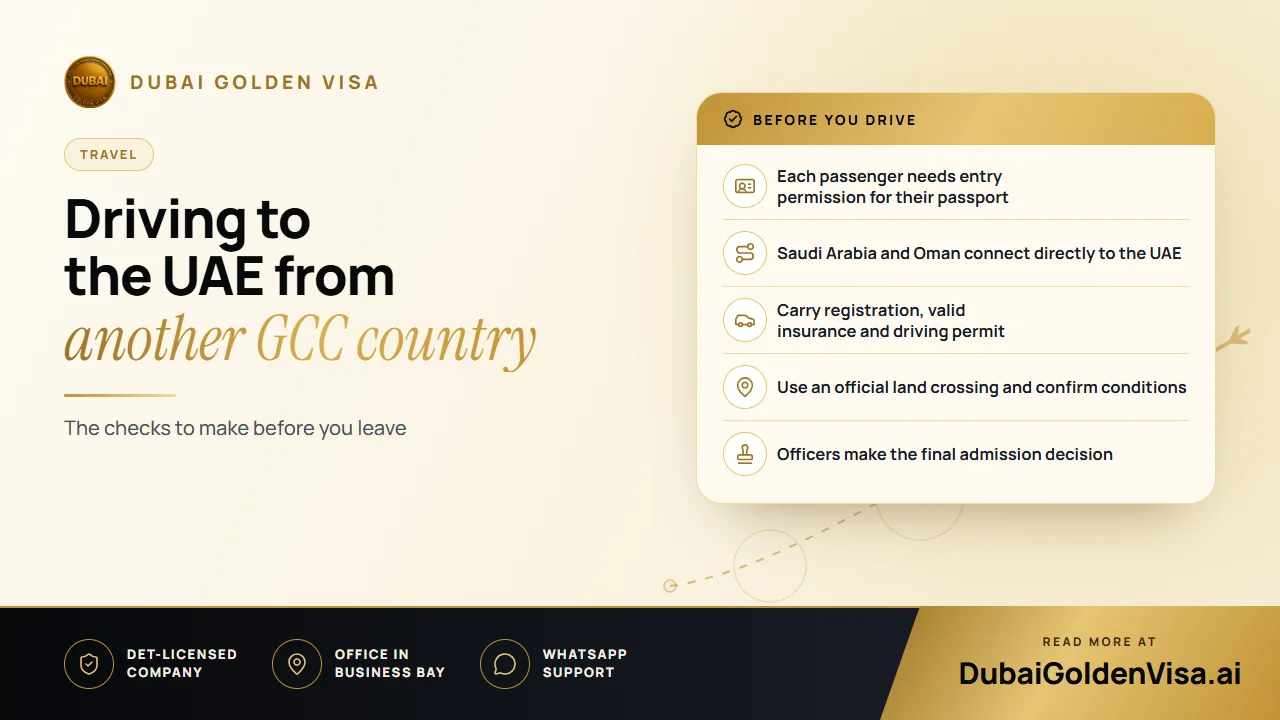
Every year, families and friends living elsewhere in the Gulf load up the car and head for the UAE. It is a lovely way to arrive, but the border does not care how you travelled. Each person in the vehicle must be allowed to enter on their own passport and residence status, and the car itself has to be properly insured, registered and authorised for the trip.
This guide is for people living in Saudi Arabia, Oman, Qatar, Kuwait or Bahrain and planning to drive across into the Emirates. It covers the visa question first, because that is where most problems start, and then the vehicle and the border itself.
01Start with the visa, not the car
Citizens of the Gulf states generally do not need a UAE visa, though they still carry accepted travel documents and pass through border control like everyone else. Things are less simple for foreign nationals who live in a Gulf country. Holding a residence card in, say, Riyadh or Muscat does not on its own open the door to the UAE. What counts is the passport you travel on.
- If your passport already allows visa-free entry or a visa on arrival, you may not need to arrange anything in advance. Check the current rule for the exact passport you are carrying.
- If your passport needs a visa, apply and wait for it to be issued before you set off. An application receipt is not permission to enter.
- Some foreign residents of Gulf countries can use a dedicated visit entry route, usually for a stay of up to 30 days, depending on passport, residence validity and profession. Conditions apply, so confirm them first.
- A tourist visa for the country you live in is not the same as residence there. Visitors should check UAE entry using their actual passport and status.
02Which road do you take?
Saudi Arabia and Oman both share a land border with the UAE, so drivers from those countries can reach an official UAE crossing without passing through a third state. Drivers starting in Qatar, Kuwait or Bahrain are in a different position. The usual road runs through Saudi Arabia, which means you must satisfy Saudi entry or transit rules as well as the UAE's.
Saudi permission is personal, so one passenger's approval does not cover the others in the car. Work out what each person needs, and do it well before departure. Border operations and permitted crossings can change, so please do not rely on a route a friend used two years ago.
03Paperwork for the car
Visitors who drive into the UAE are expected to hold valid motor insurance and an international driving permit alongside their home licence. The car's ownership should also be beyond question. Our advice is to prepare the following before you leave home rather than hoping to sort it out at the crossing.
- The vehicle registration, with details that are easy to read
- Written authorisation if you are not the registered owner
- Motor insurance that really covers the UAE and any country you cross on the way; domestic-only cover is not enough
- Your driving licence and the international permit
- Written permission from the rental company or the finance provider if the car is rented or financed, because cross-border use is often restricted
Tip
Carry paper and digital copies
Phone signal can be patchy near remote crossings. Keep printed copies of visas, residence cards, insurance and vehicle papers in the glove box, and save digital copies as well.
04A pre-departure routine that works
- 1
Check every passport
Confirm whether each traveller needs a visa, can enter visa-free or can get a visa on arrival. Children need their own documents, plus any parental evidence the family situation requires.
- 2
Check your residence cards
Make sure each resident document is current. An expired or cancelled card can undermine the route you chose.
- 3
Secure the UAE visa if needed
Do not leave until the visa or permit has actually been issued.
- 4
Sort transit permission
If your route crosses Saudi Arabia, confirm what each passenger needs there.
- 5
Prepare the vehicle
Registration, authorisation, licence, permit and insurance should all be in order.
- 6
Confirm the crossing
Pick an official land port that suits your route and vehicle, and check its conditions shortly before travelling.
05At the UAE border
Expect your passports and any residence or supporting documents to be examined, your entry permission to be checked, and the vehicle and belongings to go through customs procedures. The order can differ from one port to another. Even with an approved visa, the final decision on admission rests with the border and immigration officers, so be polite, patient and organised.
The most common causes of delay are simple ones: assuming Gulf residence alone gives entry, an expired residence card, no Saudi transit permission, a driver who is not the owner and has no authorisation, an insurance gap, or an out-of-date idea of which crossing is open. All of them can be avoided with an hour of checking at home.
Not sure which entry route fits your passport and residence? Message us on WhatsApp for a free check before you book the trip, and we will tell you what to prepare.
Questions about this topic
No. For foreign nationals, the passport and the chosen UAE entry route still decide whether you can enter, and officers make the final call at the border.
Questions about your own case?
Send us a message and an advisor will tell you which route fits and what you'll need.