
Every route to a Golden Visa asks you to prove something. A professional proves a salary and a degree. A founder proves a company. A property owner proves an asset. The question of which is most predictable comes down to how many things can change underneath you.
In our experience, property has the fewest. Here is why, and where its own risks sit.
01Three questions instead of many
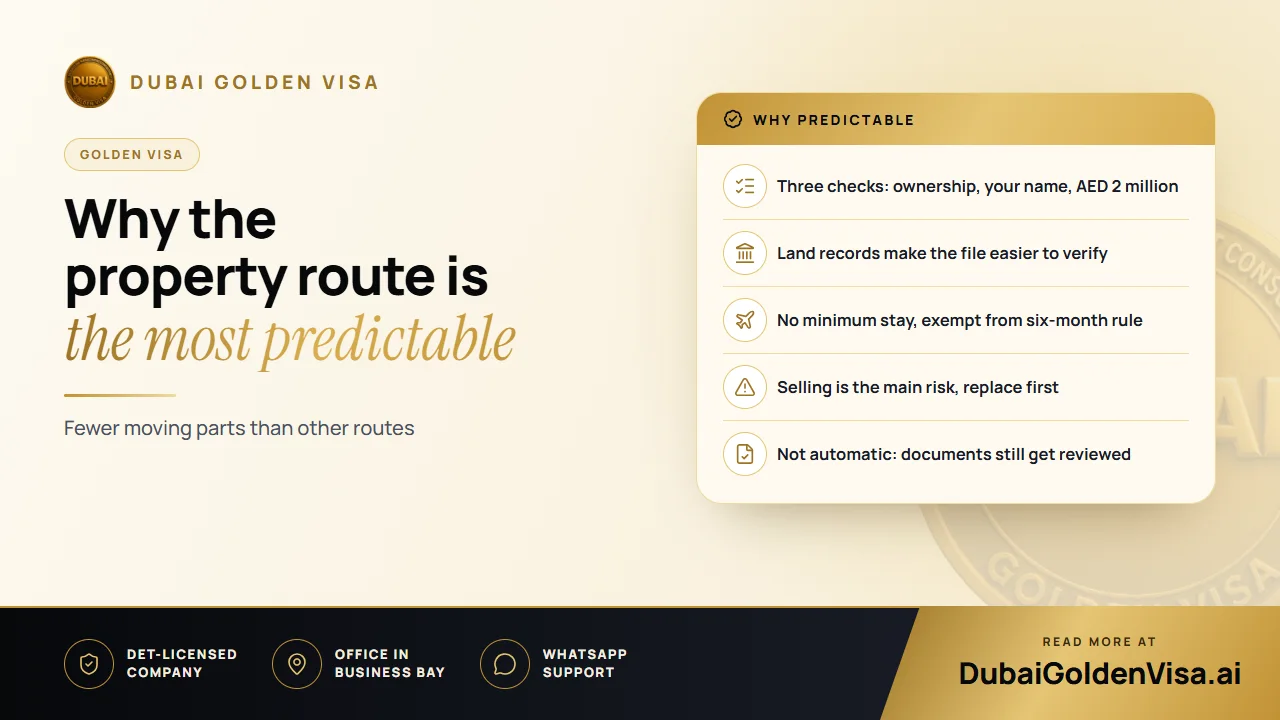
The eligibility test is short. Do you own qualifying property? Is it registered in your name? Does its value reach AED 2 million, whether in one deed or several? If the answer to all three is yes and the paperwork matches, the file is strong.
Compare that with a salary route, where the figure has to be a basic salary of AED 30,000 or more, not allowances, with a qualifying role and an attested degree. A job change, a restructured contract or a missing certificate can each break the file. With property, ownership and value are recorded in official systems and can be checked on the spot.
02A visa backed by a registered asset
UAE property sits within a structured system of freehold rules, registration, licensed developers and escrow protection. Title deeds and transactions are digitally logged, which leaves less room for judgment calls. When your visa is tied to something that already exists in the land department's records, there is less to dispute.
Tip
Predictable still means reviewed
A strong asset does not guarantee approval. The authorities still check the value they recognise, how the property is held and your documents. Many problems come from preparation, not from the rules.
03Which properties count
- Completed homes with a title deed, in one or several units
- Off-plan homes from an approved developer, backed by an Oqood
- Mortgaged homes, on their full value, with the bank's no-objection letter
- Properties registered in your own name, not held by someone else for you
What does not count is a promise: assumed future value, an informal agreement or an unregistered holding. If a salesperson says a unit qualifies, ask to see the registration.
04Freedom from the six-month rule
Standard residence visas can be cancelled after six months outside the country. Golden Visa holders are exempt, so there is no hidden clock running while you travel. That removes one of the commonest sources of surprise for owners who live between countries.
05The one rule to watch: selling
The main risk to a property visa is selling the property behind it. If you sell without first buying and registering a replacement that meets the threshold, the visa may end straight away. Keep the order in mind: replace first, then sell.
- 1
Check your property
Confirm the deed or Oqood, your name, your share and the recorded value.
- 2
Gather documents
Passport, photo, title deed or Oqood, a current valuation if needed, and bank papers for a mortgage.
- 3
Apply from inside the UAE
If you are abroad, an entry permit brings you in to finish the process.
- 4
Complete medical and biometrics
These follow the initial approval, and your current visa is cancelled only after that approval, so there is no gap.
Property files usually take five to seven working days once documents are complete, which is quicker than salary and company files that tend to take two to four weeks. Government costs for the main applicant are about AED 9,459.
A note on location: most property files go through Dubai, but if your property is in another emirate we check how it handles Golden Visas first.
Want to know whether your property gives you the most predictable route? Message us on WhatsApp for a free check and we will look at your documents with you.
Questions about this topic
Usually a passport, a photo, the title deed or Oqood, a valuation where needed and bank papers if the home is mortgaged.
Questions about your own case?
Send us a message and an advisor will tell you which route fits and what you'll need.