
A Golden Visa is a ten-year decision, and the authorities treat the file accordingly. They check who you are, what you own or earn, and whether your papers agree with each other. When an application stalls, the reason is rarely mysterious. It is usually something that could have been spotted in an afternoon of preparation.
Below are the problems we see most often, grouped by where they arise, with a plain explanation of what to do about each.
01Problems with the category you choose
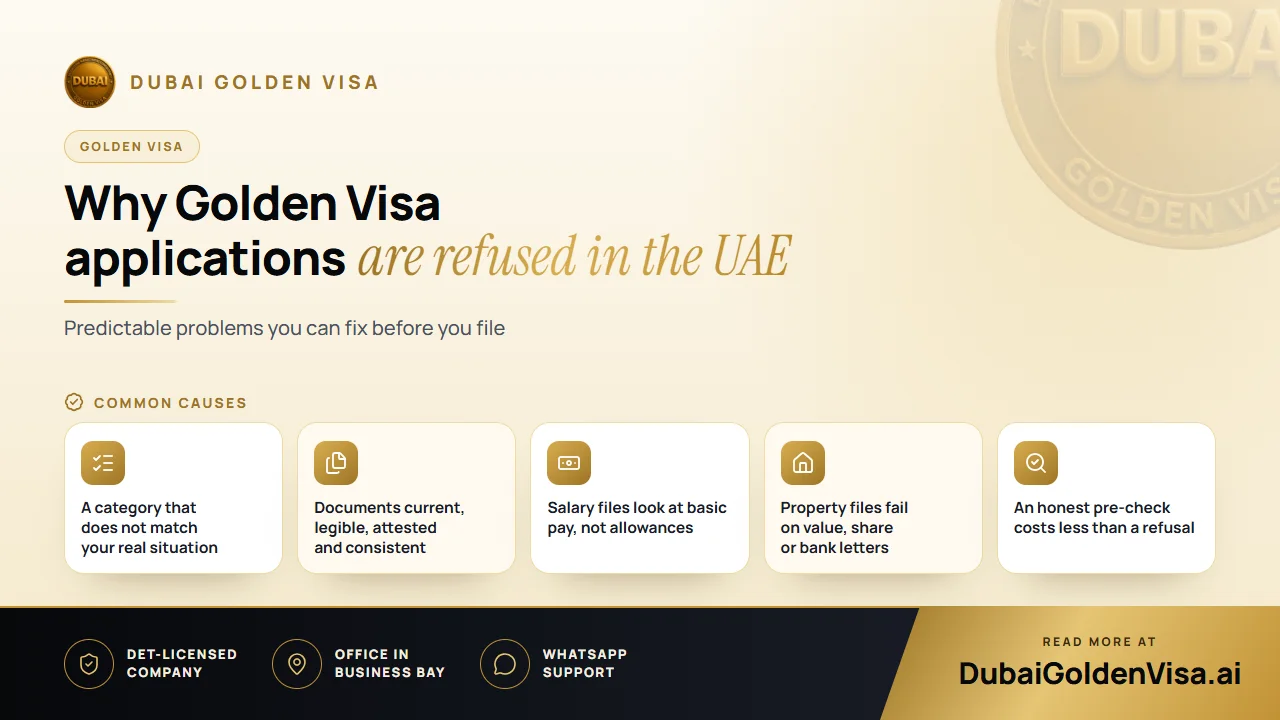
The single most common mistake is applying under a route that does not quite fit. Someone with a good salary applies as an investor, a company director with a small stake applies as a business owner, or a creative professional applies as an exceptional talent without any endorsement. Each route has its own definition, and the reviewer will test you against that definition, not against the one you had in mind.
Work out your route from the facts. Property worth AED 2 million or more, a company stake or capital of AED 2 million or more, a basic salary of AED 30,000 or more, or AED 2 million placed with an approved UAE fund or bank are the main routes. The other categories, such as exceptional talent, researchers and outstanding students, each depend on recognition or nomination rather than money.
02Problems with proof and paperwork
- Expired passports, blurry scans, cropped pages or the wrong visa page uploaded.
- Names spelled differently across the passport, degree, contract and bank letter.
- Certificates that have not been attested for UAE use when they needed to be.
- Trade licences, share certificates or contracts that are out of date or do not show your name clearly.
- Typing slips such as a wrong passport number or date of birth, which can trigger a system rejection that takes time to unpick.
None of these is a judgement on you. They are simply the kind of detail an automated and manual check will catch. A second pair of eyes before submission is the cheapest insurance there is.
Tip
Never submit anything you cannot stand behind
Edited bank statements, inflated salary letters or borrowed paperwork are treated very seriously. Beyond a refusal, they can leave a lasting mark on your record. If a document is weak, we would rather help you find a genuine alternative route.
03Problems specific to each route
Property files usually trip on value and ownership. The registered value has to reach AED 2 million, your own share has to count if you co-own, and a mortgaged home needs the bank's no-objection letter. A title deed showing an older, lower price can often be supported with a current valuation, but only if you provide it.
Salary files look at basic salary, not allowances, so a package that totals AED 30,000 but has a lower basic figure will not do. The role should sit at MOHRE skill level 1 or 2, and you need a bachelor's degree attested for UAE use. A job title that sounds senior but does not match the contract is another reason for questions.
Business owner files need clear proof of the stake and capital, and the company details must match the licence. Talent and creative routes depend on an endorsement from the relevant authority, so applying without it usually goes nowhere.
04Background and history checks
Every applicant goes through security screening. A pending case, a travel ban or an unresolved fine linked to your name can hold a file up. So can a record of immigration problems, such as long overstays. If you know of anything like this, it is far better to raise it early and resolve it than to hope it goes unnoticed.
05A short checklist before you file
- 1
Confirm the route
Match your situation to one definition, and check the exact numbers against your documents.
- 2
Check every document
Validity dates, legibility, attestation and name spelling, side by side.
- 3
Clear any blockers
Outstanding fines, old cases, or gaps in your current visa status.
- 4
Plan the family file
Marriage and birth certificates, attested where needed, ready at the same time.
- 5
Keep your current visa valid
Your existing visa is cancelled only after initial approval, so do not cancel early.
06What to do if you have already been refused
A refusal is not always the end. Find out the stated reason, fix the specific gap, and decide whether the same route still suits you or a different one does. Sometimes the answer is simply a corrected document. Sometimes it is a better-fitting category. Either way, do not resubmit the same file unchanged.
Message us on WhatsApp and we will review your situation for free, tell you honestly which route fits, and point out anything that could cause trouble before you apply.
Questions about this topic
Usually yes, once you have understood the reason and corrected it. Resubmitting an unchanged file rarely helps.
Questions about your own case?
Send us a message and an advisor will tell you which route fits and what you'll need.