
Planning a trip from Wallis or Futuna to Dubai involves one of the longest journeys in the world, with several flights and plenty of connections. Before you worry about any of that, there is a simpler question: which passport will you be carrying? That answer, not your island of residence, decides how you enter the UAE.
Wallis and Futuna is a French overseas territory. There is no separate Wallis and Futuna passport, so your route is the same as that of the passport actually in your hand.
01Three situations, three routes
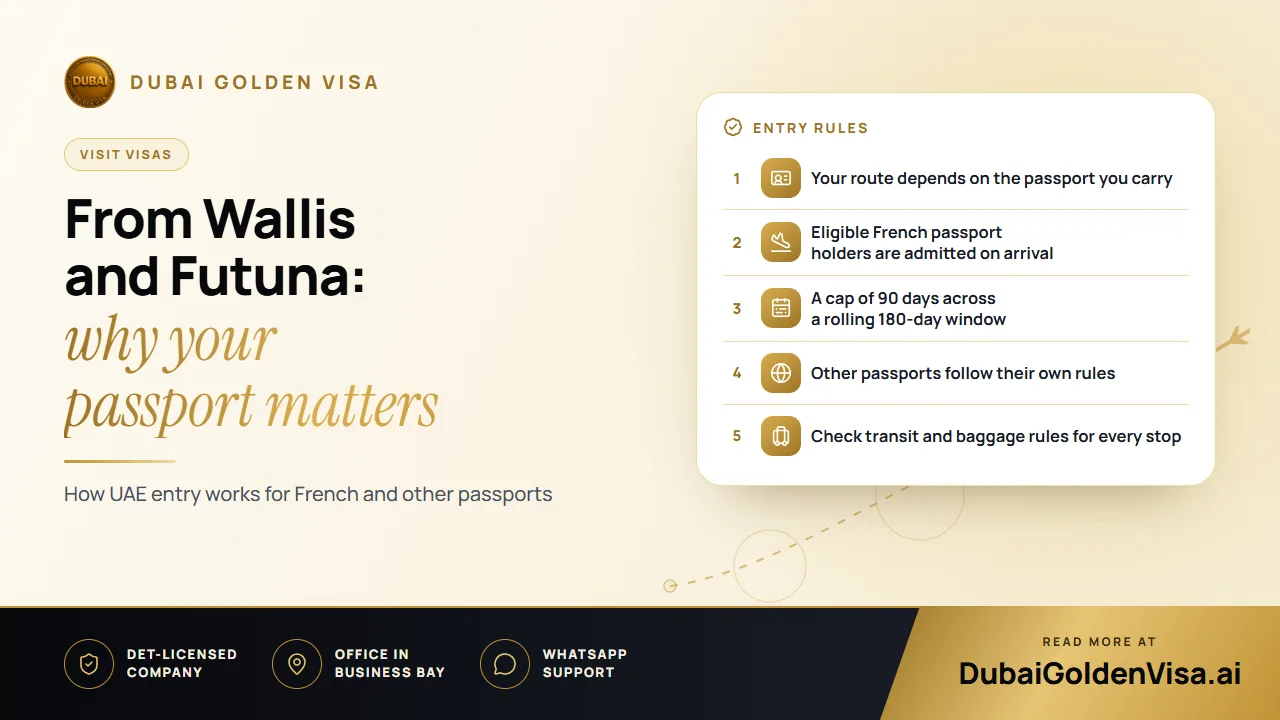
If you travel on an ordinary French passport, you are normally admitted to the UAE on arrival for a short visit, without buying a visit visa in advance. You can stay for a maximum of 90 days in any rolling 180 days, and the passport generally needs at least six months of validity from your entry date.
If you live on the islands but hold a different nationality, your passport's rules apply. Some nationalities are admitted on arrival, while others need approval before they fly. If you use an emergency or other non-standard travel document, check that it is accepted before you pay for flights.
Tip
Do not enter a nationality that is not on your passport
When filling in any visa form, use the nationality printed on the passport you will travel with. Listing a territory or an island of residence as a nationality can invalidate an application.
02How the 90-in-180 rule works
The 90 days are counted across a rolling 180-day window. Leaving the UAE and coming back does not wipe the slate clean. A 20-day trip followed by a 25-day visit inside the same window has used 45 days in total, so what matters is the dates of your earlier trips rather than your latest arrival.
This short-visit arrangement is for tourism and visiting. It does not allow you to work or take up residence. If your plans go beyond a short visit, talk to us before you travel about the right route.
03Documents to check before you leave
- The physical passport you will use at check-in and at UAE immigration
- Passport validity of at least six months from your entry date
- Names and dates on your tickets that match the passport exactly
- Your return or onward itinerary, and your hotel or host address
- For each child, an appropriate travel document and any consent papers needed for your route
04Planning the flights
Allow generous time between flights, especially on the sectors out of the islands, where schedules can be limited. A missed early flight can unravel everything booked after it, so check operating dates before you commit to hotels or events in Dubai.
Before paying, find out whether your bags are transferred through to Dubai or must be collected and checked in again. If a connection needs you to leave the transit area, or you are on separate tickets, you may have to clear immigration in that country. Transit rules are separate from UAE entry rules, so check each stop against your own passport.
If your family travels on mixed passports, check each person individually. A French passport holder's arrangement does not automatically extend to a companion on another passport.
05If your passport needs a visa
For passports that need advance permission, visit visas come in 14, 30 and 60-day versions, with single or multiple entry. Standard processing usually takes two to three working days and express about 12 to 24 hours.
- 1
Identify the passport
Check the nationality and document type printed on it.
- 2
Pick the visa
Choose the length and entry type that cover your trip.
- 3
Submit exact details
Type your name and passport number exactly as printed, and upload clear files.
- 4
Check the approved visa
Confirm the name, number, entry window and permitted stay before you fly.
If your passport does not need a visa, you can skip this step. Remember that visit visas carry no grace period, so the last permitted day is the day you must leave.
Not sure which route applies? Message us on WhatsApp with the passport you will use, and we will give you a free check and tell you plainly what to arrange before you go.
Questions about this topic
No separate rule exists. The passport you carry determines the route, and an ordinary French passport follows the French arrangement.
Questions about your own case?
Send us a message and an advisor will tell you which route fits and what you'll need.