

Most visitors arrive in Dubai with their return flight neatly booked. Trouble starts when plans shift: a delayed meeting, a family event, a flight that gets cancelled. Suddenly the expiry date printed on the e-visa is behind you, and the question is what it will cost.
This guide walks through how overstay penalties work for visit and tourist visas in 2026, what to do if you're already past your date, and the habits that keep you from ending up there in the first place.
01How the daily fine works
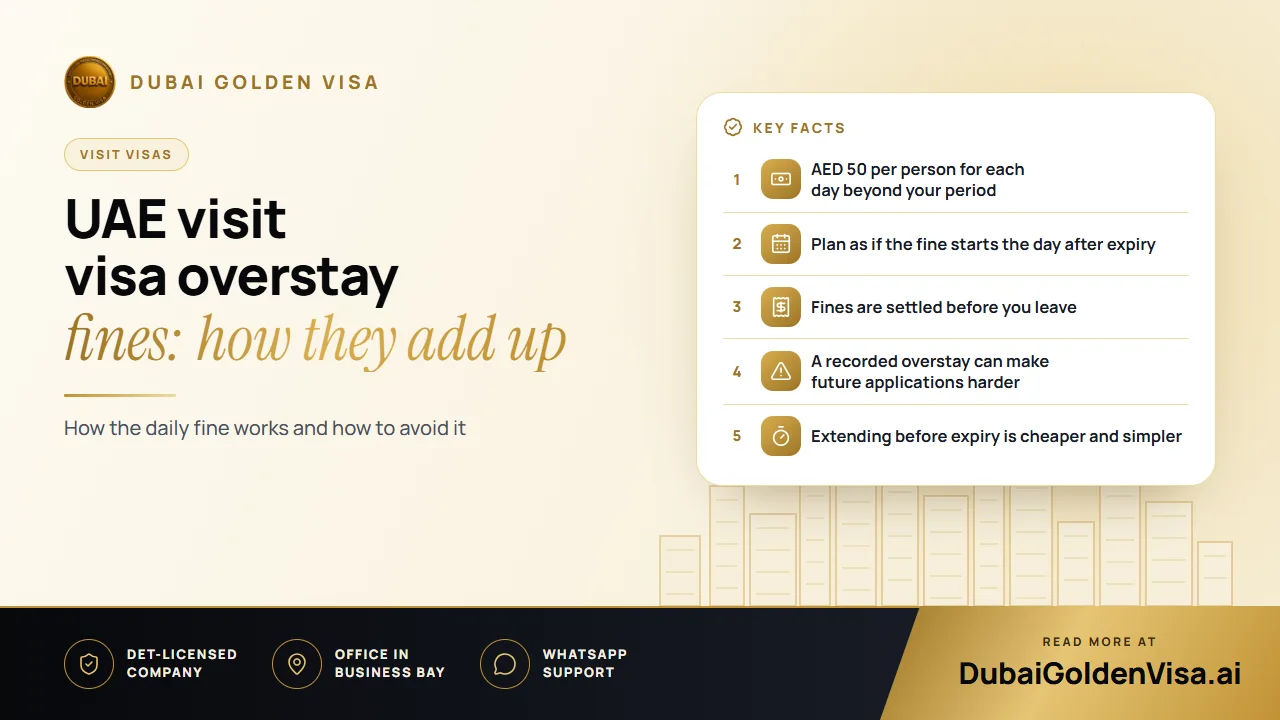
UAE immigration charges AED 50 for each day a person remains in the country after their permission to stay has ended. The charge is per traveller, so a family of four who overstay by a week is looking at four separate totals, not one.
The sums grow quickly but predictably. Five days comes to AED 250, ten days to AED 500, and twenty days to AED 1,000. Because the rate is a flat daily figure, you can work out your exposure with simple multiplication.
On top of the fine, you may be asked to complete exit formalities before you can board. The exact steps depend on how long you've overstayed and the channel you use, which is one reason we suggest checking your file before heading to the airport rather than discovering the requirement at the check-in desk.
02What the grace period does and doesn't do
Residence visas usually come with a grace period of around 30 days after they expire or are cancelled, so that people can renew, change status or leave in an orderly way. Visit visas are different: treat the expiry date on your visa as the last day you can stay without a fine. Many travellers hear about grace periods and assume they mean free extra time for everyone. They don't.
Fines are still tracked by the system, immigration records are updated electronically, and the practical effect depends on your specific file. If you're relying on the grace period at all, you're already in a situation where a quick check with us will save money.
Tip
Never plan a trip around the buffer
Treat your expiry date as the last day you are comfortably allowed to be in the UAE. Anything after it is a risk, even if the rules in your case turn out to be forgiving.
03Are there cases where fines are waived?
Sometimes, but only under specific, officially announced conditions. In 2026, for example, the authorities set up a temporary arrangement for people who could not leave because flights were suspended during regional disruption. That relief was limited to eligible travellers and had a defined end date, so it was never a general amnesty.
Other cases, such as a documented medical emergency, may support a request for a reduction, but nothing is automatic. If you think you qualify for any exception, keep every piece of evidence: airline cancellation messages, hospital letters, booking changes and receipts.
04What can happen if you overstay
- Daily fines keep accumulating until you leave or fix your status.
- You may need to complete exit steps and clear the balance before departure.
- A recorded overstay can complicate future UAE visa applications.
- Long or repeated overstays can bring bigger consequences, including entry restrictions.
- If someone reports you as having left a sponsor or host without notice, separate penalties can follow.
05How to extend before it's too late
If your visa is still valid, an extension is the cleanest solution. Many visit visas can be extended from inside the UAE without leaving, subject to the type of visa, your stay history and the authorities' decision. A pending application does not always stop the clock, so don't leave it to the final afternoon.
- 1
Find your exact expiry date
Read it from the visa document itself, not from memory or the date you landed.
- 2
Apply early
Aim to start a week or so before the visa ends, which leaves room for questions or a request for another document.
- 3
Send clear documents
A sharp passport copy, the current visa and a recent photo are normally the basics.
- 4
Keep checking the status
Watch for approval, and if the date is close, tell us at once so we can advise on the safest route.
06Simple habits that avoid fines
- Set two phone reminders, one a week before expiry and one two days before.
- Save airline messages if a flight is moved or cancelled.
- Keep copies of receipts for any fine or fee you pay.
- If your plans change, decide about an extension straight away rather than waiting to see how things go.
If you've already gone past your date, don't wait for it to sort itself out. The options narrow with every day, and the earlier we see your file the more choices you tend to have.
Not sure where you stand? Message us on WhatsApp with a photo of your visa and we'll give you a free check of your dates and your options.
Questions about this topic
It is charged per person, so each traveller on the visa, including children, carries their own daily amount.
Questions about your own case?
Send us a message and an advisor will tell you which route fits and what you'll need.