
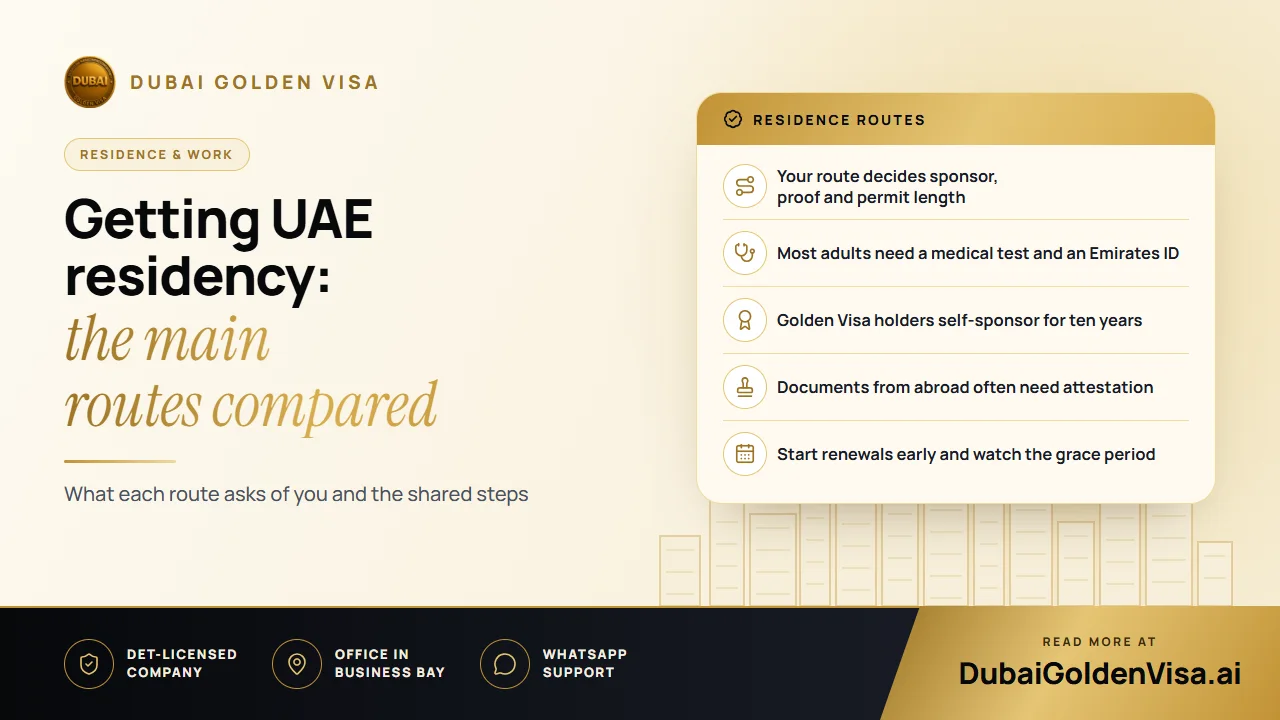
People talk about "getting residency" as if it were one product. In the UAE it is closer to a set of doors. You might come in through an employer, a spouse, a university, a company you own, a property you hold or the Golden Visa, which is a long-stay programme in its own right. Each door has its own sponsor, paperwork and validity.
Here is how the routes compare, what nearly every applicant has to prepare, and where people tend to lose time.
01Permit, visa and entry permit: the vocabulary
In everyday speech, residence permit and residence visa mean the same thing: permission to live in the UAE under an approved category. An entry permit is different. It lets you come into the country, or complete the process, before your residence is finalised. Whether you need one depends on where you are when you apply and which route you use.
02The main routes
- Employment: your employer starts the work permit and residence process, and the permit follows once the requirements are met.
- Family: a resident who meets the income and housing rules sponsors a spouse and children, and in some cases parents.
- Investor or business owner: residence is tied to a company, a share or an investment, and owning a company does not by itself guarantee a visa.
- Student: through a parent or through an accredited institution, with proof of enrolment.
- Property owner: certain owners qualify, with conditions on the property and the owner that vary by emirate and route.
- Golden Visa: ten years, renewable, self-sponsored, for qualifying investors, skilled professionals, exceptional talents and other categories.
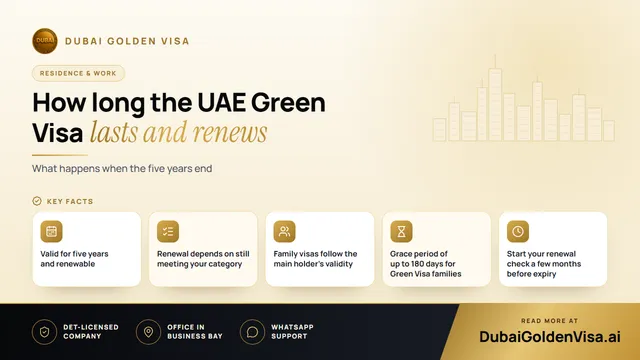
- Green Visa: a five-year self-sponsored option for skilled employees, freelancers and investors.
With a Golden Visa you are your own sponsor, and you are not caught by the six-month absence rule that can cancel a standard residence visa. That freedom is a large part of why people choose it, but eligibility is specific: for example, a property worth AED 2 million or more, or a salaried role with a basic salary of AED 30,000 or more.
03What almost everyone needs to prepare
- A passport with sufficient validity and a recent photograph
- An entry permit or your current visa details, where relevant
- A medical fitness test for applicants aged 18 and over (about AED 285, with a result usually within a day)
- Emirates ID registration and biometrics (AED 1,180 for a ten-year card, AED 675 for five years)
- Health insurance where your emirate or category requires it
- Route-specific evidence: a work contract, trade licence, title deed, enrolment letter or marriage and birth certificates
Certificates issued abroad commonly need attestation or a certified Arabic translation. Names, dates of birth and passport numbers must be identical across every document. A single spelling difference can stall a file for days.
Tip
Check the order before you start
Some routes need the medical test before the visa is stamped, others after approval. The sequence changes with the category and with whether you are inside or outside the UAE, so confirm it for your case rather than copying a friend's experience.
04The process in steps
- 1
Choose your route
Match your situation to the right category: job, family, business, study, property or a long-term programme.
- 2
Identify the authority
In Dubai the file normally goes through GDRFA Dubai; elsewhere it is usually ICP. Employers, free zones and universities often handle parts of it.
- 3
Prepare and verify documents
Gather your list, and arrange attestation or translation for anything issued overseas.
- 4
Entry permit or status change
If you are abroad, you enter on a permit; if you are already here, your status may be changed in-country.
- 5
Medical test and Emirates ID
Complete the test and biometrics at the appointments you are given.
- 6
Submit and pay
File through the correct channel, check every detail, then pay the fees.
- 7
Respond to requests
Reply quickly if the authority asks for another document. Slow replies are the usual cause of delay.
05Cost and timing
The total depends on the route, the length of the visa and the emirate. Typical parts are application and issuance fees, the Emirates ID, the medical test, insurance and any attestation or typing charges. For a Golden Visa through property, the government costs are about AED 9,459 for the main applicant; other Golden Visa routes are about AED 4,175. Family members are roughly AED 2,710 each plus the Emirates ID.
Timing is just as variable. Straightforward Golden Visa property files usually take 5-7 working days once documents are complete, while company and salaried files take two to four weeks. Appointments and missing papers are what stretch the timeline.
06Family, renewal and what happens at the end
Family permits depend on the sponsor staying valid. A commonly quoted minimum for sponsoring a spouse and children is a monthly salary of AED 4,000, or AED 3,000 with accommodation, but the exact test depends on the emirate and the latest rules. If the sponsor's visa ends, dependants must renew, transfer or cancel within the allowed period.
Begin renewals well before expiry. After a standard visa expires or is cancelled, you usually have 30 days to leave or change status. Overstaying after that costs AED 50 per person per day.
Not sure which route fits you? Send us your situation on WhatsApp and we will give you a free check of the options, the documents and the likely timeline.
Questions about this topic
In daily use, yes. Both mean official permission to live in the UAE under a particular category, whereas an entry permit only allows you to arrive or complete the process.
Questions about your own case?
Send us a message and an advisor will tell you which route fits and what you'll need.