

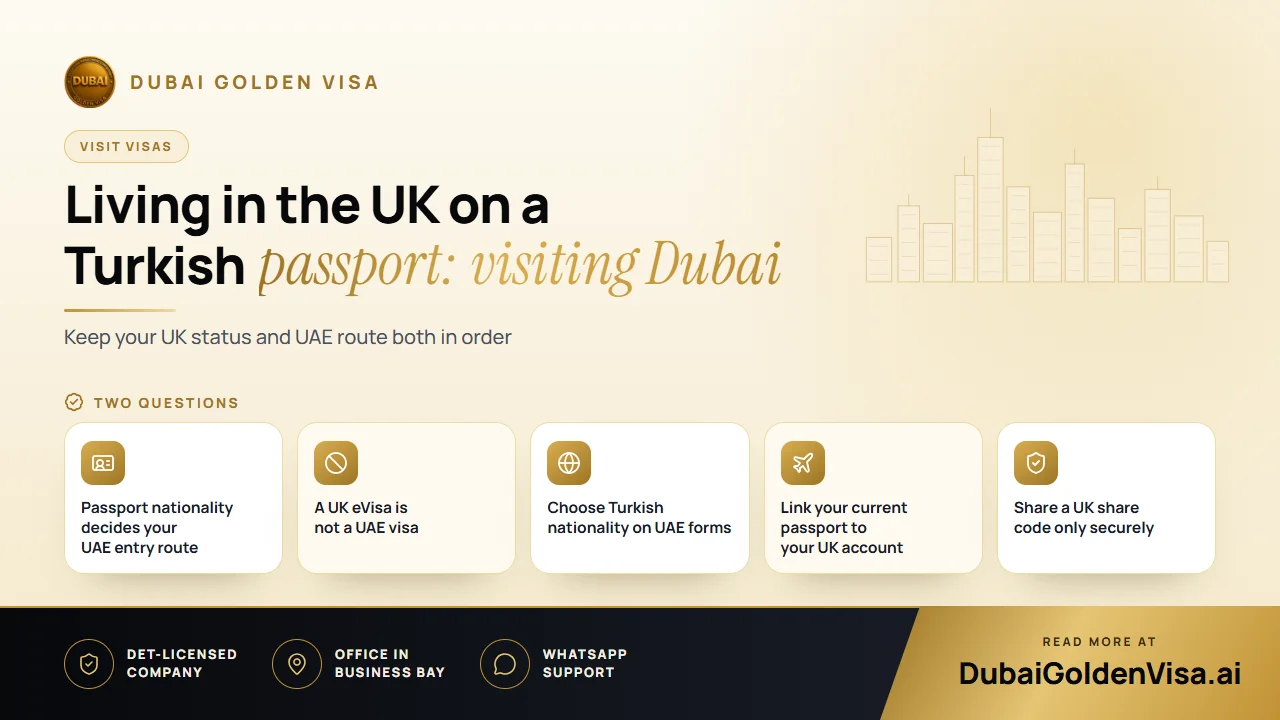
Many Turkish citizens who work, study or live in the UK plan trips to Dubai, and one question comes up again and again: does my UK status help? In short, it does not change the rules for your passport. A UK residence record proves where you may live. It says nothing about whether the UAE will admit you.
Two checks therefore run side by side. One is about getting into the UAE. The other is about getting back into the UK. Handling them separately saves a lot of stress at the airport.
01Why the passport decides the route
Someone carrying an ordinary Turkish passport generally has to arrange a UAE visa ahead of the journey, wherever home happens to be. Living in Britain does not turn you into a British national and does not alter your nationality on a UAE application. So when a form asks for nationality, select Turkish, and copy your name, passport number and dates exactly as printed in the travel document.
Physical UK residence cards have been phased out and replaced by digital eVisas. People still search for the old term, but what matters today is your online record. Check your status through your UK immigration account before you book.
02Getting the UK side ready
- Make sure the Turkish passport you will fly with is the one linked to your UK account, especially if it was recently renewed
- Review your name, date of birth and status in your eVisa record and compare them with what you gave the airline
- Know how to generate a share code, which the UK government currently says is valid for 90 days when used for travel
- Do not rely on an expired plastic card as proof of status
Tip
Renewed your passport recently?
Update your UK account with the new passport details and use the new number on the UAE application too. An old number in one system and a new one in another is a classic cause of corrections and check-in questions.
03Documents for the UAE application
- A valid ordinary Turkish passport, with a clear colour scan of the photo page and normally at least six months of validity
- A recent photo that follows the size and background rules
- Evidence of UK status, such as accessible eVisa details or a share code, if asked
- A return or onward ticket that shows your departure from the UAE
- Medical insurance valid in the UAE
- Extra trip evidence, such as accommodation details, if the reviewer requests it
Send any additional proof only through a secure route and only when it is actually requested. A share code gives access to personal immigration data, so treat it like a password.
04Picking the right visa length
Choose the stay and entry type from your itinerary, not from habit. A short city break fits a 14-day visa. A standard holiday or a family visit fits 30 days. A longer stay may need 60 days. Multiple-entry options suit those who will leave and re-enter the UAE, perhaps for a side trip. If you are only passing through on a connection and will leave the airport, a 48 or 96-hour transit permit can be the neat solution.
- 1
Confirm both records
Check the passport, and check that it is linked to your UK account.
- 2
Choose the UAE visa
Match the stay length and number of entries to your real plans.
- 3
Enter details exactly
Use Turkish nationality and copy information from the travel passport.
- 4
Upload clear files
Add the passport, photo, travel details and UK status evidence if requested.
- 5
Compare on approval
When the visa arrives, check the name, number and dates against your passport before departure.
Approval is never guaranteed, and the UAE immigration authority has the final say. Tell us your passport, status and dates on WhatsApp and we will check the whole route with you for free.
Questions about this topic
No. Your passport nationality sets the UAE entry route. UK residence does not change that.
Questions about your own case?
Send us a message and an advisor will tell you which route fits and what you'll need.