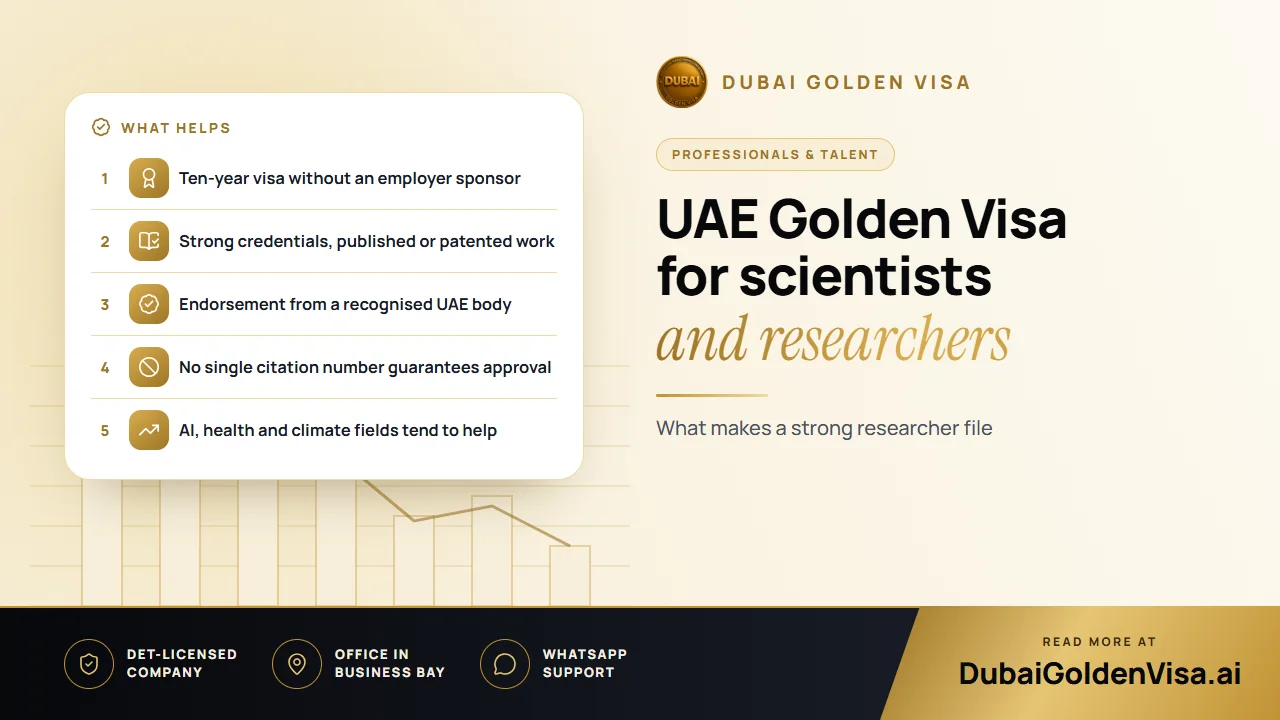
The UAE has spent years building research capacity in medicine, artificial intelligence, space, energy and climate. To keep the people who do that work, it offers scientists and researchers a ten-year Golden Visa that does not depend on a particular employer.
This is a recognition-based category, so there is no property or salary formula to follow. That makes it more flexible, and also harder to judge on your own. Here is how we usually think about it.
01Who this category suits
The category is broader than people expect. University professors, postdoctoral fellows, principal investigators, senior R&D specialists and inventors can all be relevant, whether they work in a lab, a hospital, a company or a public research centre.
What matters is not the job title but the evidence that your work is recognised and useful. A clinician-scientist with a strong publication record may be a better fit than a senior manager with no research output, and a patent holder in clean energy may be a better fit than someone with a long CV but little impact.
02What reviewers look for
- A relevant postgraduate qualification, usually a master's or a doctorate, attested for UAE use
- A record of published work: journal articles, conference papers, books, technical reports or patents
- Evidence of influence, such as citations, grants won, awards or recognised collaborations
- A link to a field the UAE is prioritising
- A recommendation or endorsement from a recognised UAE authority
Depending on your qualification, a degree equivalency may also be needed. We check this early because it can add time if it is missed.
03The endorsement matters most
For many researchers the endorsement is the deciding piece. It can come from the Emirates Scientists Council, a UAE university, a government-linked research body or an employer in a strategic sector. It tells the immigration authority that someone credible in the UAE has looked at your work and considers it valuable.
If you are already working with a UAE institution, ask about its endorsement early. If you are applying from abroad, collaborations, invitations to speak and joint projects are a good way to build the relationship.
Tip
Do you need a particular h-index?
No single number is guaranteed to qualify, and a lower score does not rule you out. Strong publications, patents, real-world impact and a solid endorsement can outweigh raw metrics. Field-adjusted measures help in smaller disciplines where citations are naturally fewer.
04Fields where interest is strongest
Work that supports the UAE's national priorities tends to be received more warmly. That includes artificial intelligence and robotics, biotechnology and genomics, health and medical technology, climate and water research, renewable energy, space science and advanced manufacturing. It does not mean other fields are excluded, only that you should explain clearly how your work contributes.
05How the process runs
- 1
Profile review
We look at your qualifications, publications and any existing UAE connections, and tell you honestly how strong the case is.
- 2
Endorsement
We help you identify the right body and prepare what it will need to see.
- 3
Documents and attestation
Degrees are attested, translations are done and your CV and research evidence are organised into one clear file.
- 4
Application
The file is submitted while you are in the UAE, or with an entry permit if you are abroad.
- 5
Medical test and Emirates ID
Once approved, you complete the medical test and biometrics.
For categories other than property, official government costs for the main applicant are around AED 4,175. Each family member is around AED 2,710 plus AED 1,180 for the Emirates ID, and adults need a medical test of about AED 285. Talent files usually take two to four weeks once the endorsement and documents are in place.
06Bringing your family
A Golden Visa holder can sponsor a spouse, children and parents, and household staff without the usual caps. Sons have no age limit, and unmarried daughters can be included at any age. For researchers who move between institutions, a family visa tied to you rather than to an employer is a real advantage.
Not sure whether your research record is strong enough, or which body to approach for an endorsement? Send us your CV and a short summary of your work on WhatsApp for a free check, and we will give you a straight answer.
Questions about this topic
A master's or doctorate in a relevant field is the usual starting point, but a recognised research career can also carry weight. We review each profile individually.
Questions about your own case?
Send us a message and an advisor will tell you which route fits and what you'll need.