
Europe is home to a huge mix of nationalities: engineers from India living in Germany, Moroccan families in France, Turkish business owners in the Netherlands, Pakistani students in the United Kingdom. All of them may want a few days in Dubai, and all will wonder the same thing: does my European residence card help?
The short answer is that it matters less than people expect. UAE entry rules are tied mainly to the passport you hold. Here is how to think it through, and how to apply when you do need a visa.
01Passport first, residence second
Many holders of European passports can enter the UAE on arrival and do not need to buy a visa beforehand. The length of stay and conditions depend on the nationality, so a French and a Portuguese traveller can have slightly different rules.
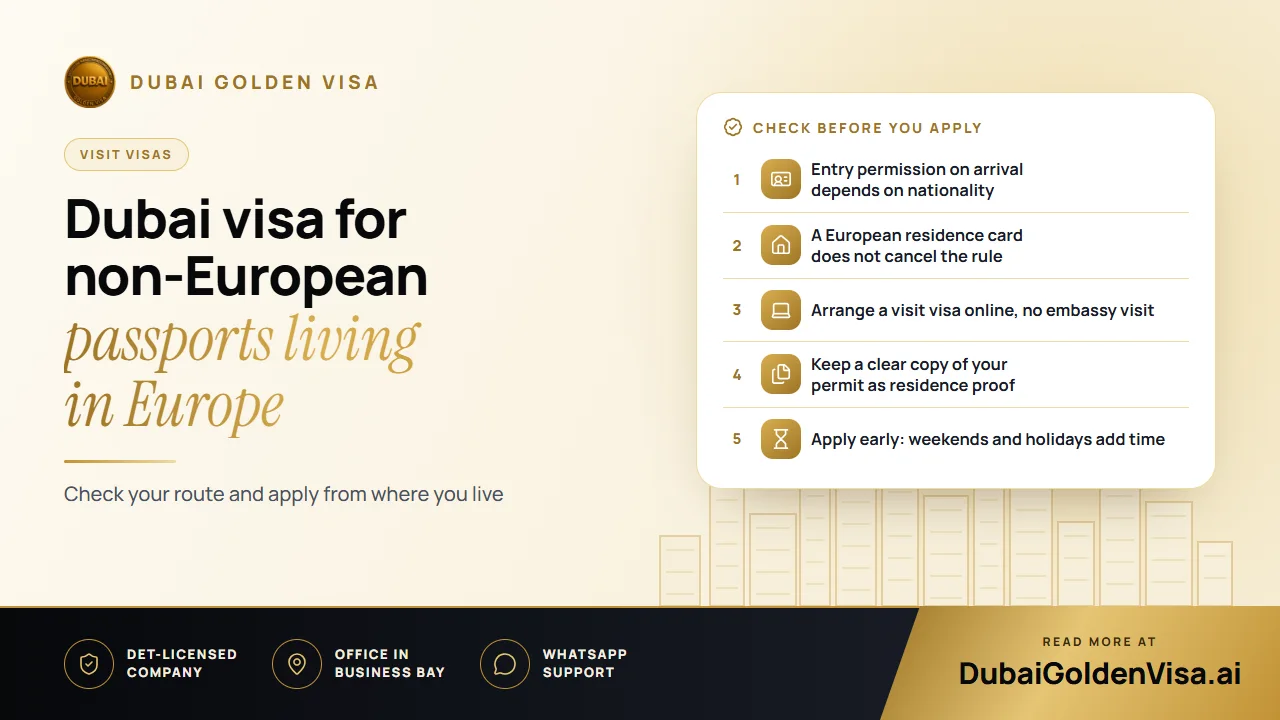
If your passport was issued outside Europe, the picture changes. A valid residence permit in Germany, Spain or Italy proves where you live, but your passport keeps the entry status it already had, so being a legal resident there does not make you visa-free for the UAE. In some cases a residence permit can support an application or open a conditional route, which is why we ask to see it.
- European passport: often arrival permission, with limits on stay that depend on nationality
- Non-European passport with European residence: often a visit visa arranged in advance
- Special or refugee travel document: reviewed individually
02Applying from Europe
You do not have to visit an embassy or travel to the UAE to start. The application can be handled online while you live in Europe, whether you are in the United Kingdom, Germany, France, Spain, Italy or elsewhere.
- 1
Choose the stay
Decide between 30 and 60 days, and between single and multiple entry.
- 2
Provide traveller details
Enter the name, passport number and trip details exactly as on your passport.
- 3
Upload documents
Add the passport page, a recent photograph and, where needed, your residence permit.
- 4
Wait for the decision
If approved, the visa is sent to you electronically; check it and keep a copy.
We file these through a partner tourism agency. Standard handling usually takes two to three working days after your documents are complete, and an express option can bring it to roughly 12 to 24 hours. Allow extra time around weekends and public holidays.
03Documents that usually matter
- A passport with enough validity, normally six months
- A recent passport-style photograph
- Travel details such as flights and accommodation
- A valid residence permit from the European country where you live, where relevant
- Any extra document that may be requested after review
Tip
Scan with care
Upload uncropped colour scans that can be read at full size. A residence card should show both sides, and the expiry date must not be hidden by glare. Poor scans are the most common reason a file is sent back.
04Things to check before you book
Look at the expiry date on your residence permit. If it is close to ending, or if you are waiting on a renewal decision, mention it up front, since it can affect which route applies.
If you are travelling with family, apply for everyone together and keep the passports in the same validity range. A child's passport that expires soon is a common reason a family trip has to be reorganised at the last minute, so check every document in the group, not just your own.
Also consider when you will be travelling. Visit visas have a fixed validity, so a 30-day visa should match flights you have realistically planned, and a stay that might stretch should use the longer option from the start.
Living in Europe and planning a Dubai trip? Message us on WhatsApp with your passport nationality and the country you live in, and we will give you a free check on the route that fits.
Questions about this topic
Not automatically. The rule attached to your passport nationality still comes first, though your permit may support your application.
Questions about your own case?
Send us a message and an advisor will tell you which route fits and what you'll need.