
The UAE has a steady need for professionals in fields like engineering, health care, technology, finance, design and education. For many of them the way in is simple: a company offers a job, and the company arranges the paperwork.
That is the starting point, not the destination. Once you are here, there are longer and more independent visas to aim for. This guide sets out the route in order, so you know what happens at each stage and what to prepare.
01Step one: the employer-sponsored visa
The standard route starts with a job offer from a licensed UAE employer. Your job is classified by MOHRE according to skill level, and the classification affects which visas you can reach later. Most employment residence visas are issued for two years and renewed while you stay in the job.
- 1
Accept a written offer
The offer should state your job title, salary and start date. Keep a copy, because later applications rely on it.
- 2
Employer files your work permit
Your employer applies to MOHRE for the permit and an entry permit if you are abroad.
- 3
Arrive and take the medical test
You complete a medical fitness test. A standard test costs about AED 285 and results usually come within a day.
- 4
Emirates ID and residence stamp
You give biometrics for your Emirates ID, which typically arrives in three to five working days, and your residence is recorded.
If your degree comes from abroad, expect to attest it and, for some roles, get an equivalency certificate. A licensed profession such as medicine or engineering may need its own approval too. Start early, as attestation can take longer than the visa itself.
02Step two: the Green Visa
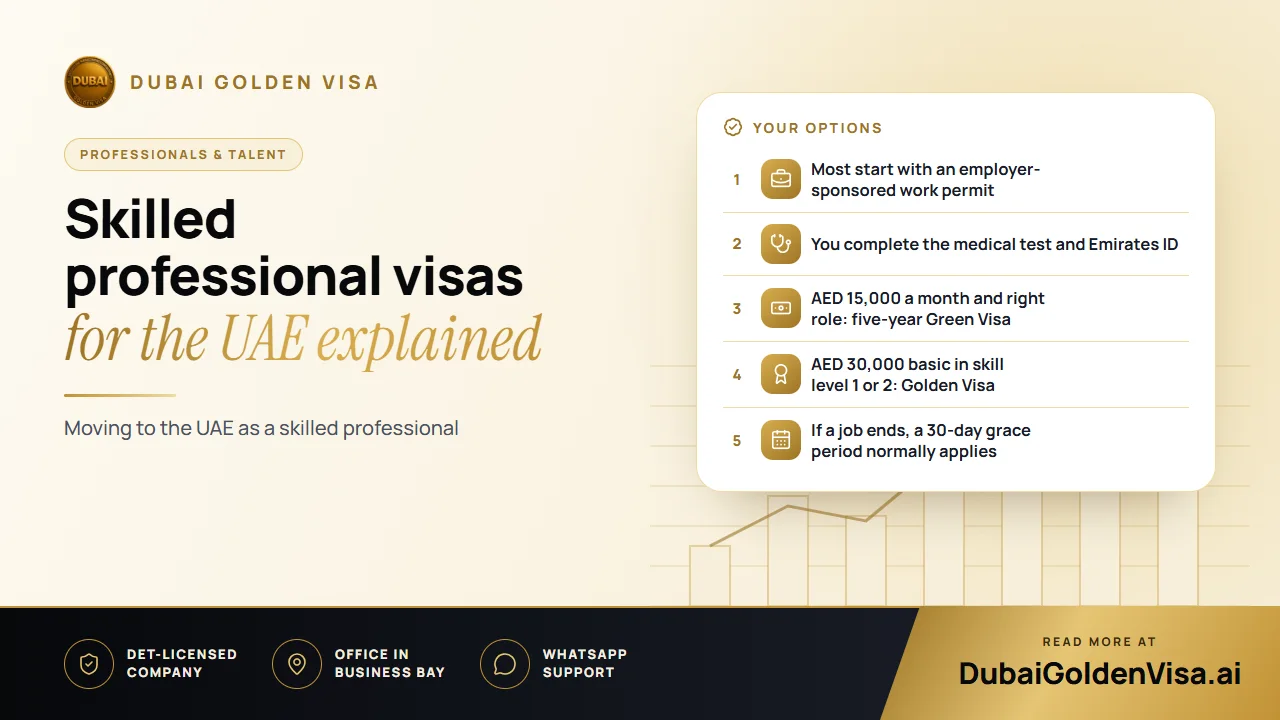
After a period in a skilled role, many people ask whether they can stop depending on a sponsor. The five-year Green Visa is the answer for those who qualify. Currently the skilled-employee route asks for a salary of AED 15,000 a month, a bachelor's degree and a role at MOHRE skill level 1, 2 or 3.
You sponsor yourself, so changing employers or going freelance does not end your residence on its own. You can also sponsor your family, including sons up to 25 and unmarried daughters of any age.
03Step three: the Golden Visa
The top of the ladder is the ten-year Golden Visa. For skilled professionals the test is a basic salary of AED 30,000 or more, a bachelor's degree attested for UAE use and a role within MOHRE skill level 1 or 2. Note the word basic: housing and transport allowances do not count towards the figure.
Company files usually take two to four weeks once the documents are complete. Your current visa is cancelled only after initial approval, so you are not left without status.
Tip
Check your contract wording
Before you apply for any long-term visa, compare your job title, basic salary and employer name across your contract, payslips and bank statements. Matching documents save weeks.
04What if the job ends?
On a standard employer-sponsored visa you usually have a 30-day grace period after the visa is cancelled or expires. In that time you can find a new employer, change to another visa type or leave. Do not let the period run out, because an overstay fine of AED 50 per person per day applies after it.
A Green or Golden Visa gives you a longer cushion, up to 180 days for families, which is one of the strongest reasons to move up the ladder.
Alongside the visa, there are everyday benefits to a skilled role here: salaries are not subject to personal income tax, UAE bank accounts and credit become available once you hold an Emirates ID, and a steady residence record helps with renting a home. These are good reasons to keep your paperwork in order from the very first day.
05Bringing your family
On a standard visa you can usually sponsor a spouse and children, subject to the income and housing rules set by the authority. Sons are generally covered up to the age of 25 and unmarried daughters with no age limit. Parents need a higher income of AED 20,000 a month, a home with at least two bedrooms, and in some emirates a refundable deposit.
Wondering where you stand on the ladder today? Message us on WhatsApp for a free check. Tell us your job title and pay and we will map out the quickest route to a longer visa.
Questions about this topic
Yes. Your new employer arranges a fresh work permit and transfers the visa, so the order of steps matters. Ask us before you resign.
Questions about your own case?
Send us a message and an advisor will tell you which route fits and what you'll need.