
Dubai's newer developments rarely stick to one use. A single tower can hold flats, serviced apartments, offices and restaurants, and entire districts are planned the same way. If you are buying in one of them with a Golden Visa in mind, a fair question follows: does it count?
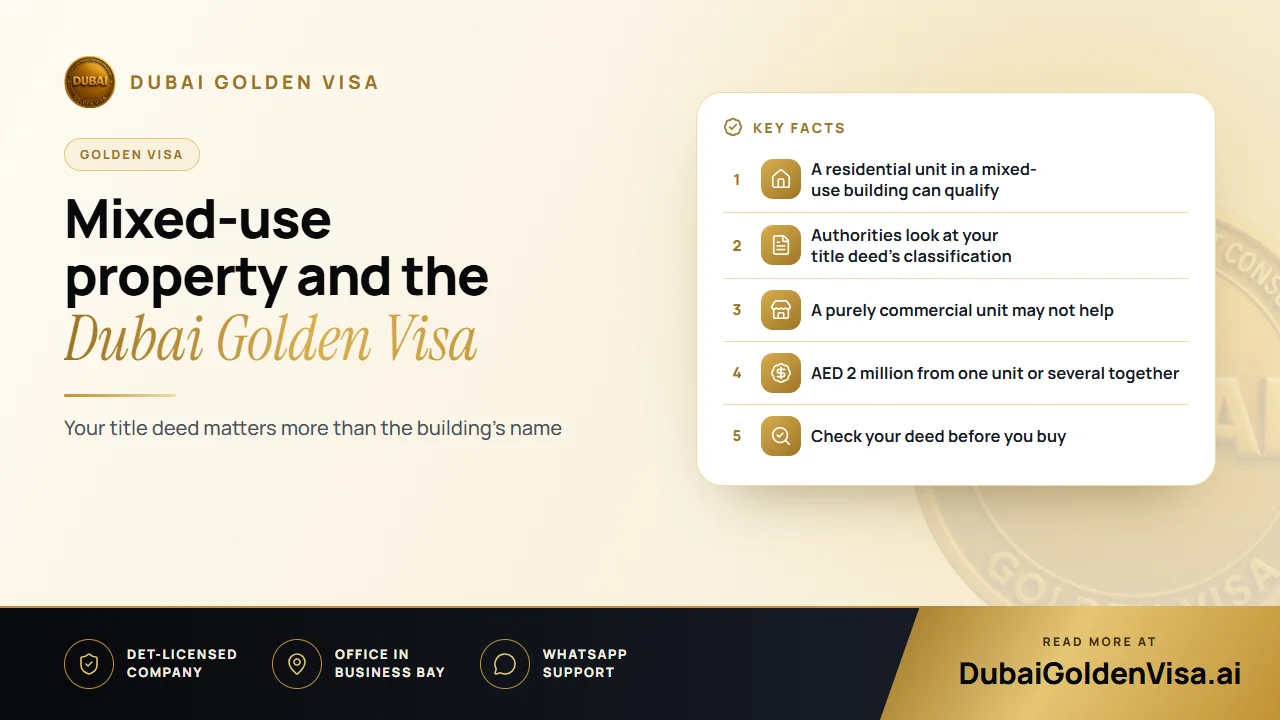
Often it does, but not because of where the building sits. What decides it is the unit you actually own and how it is registered.
01What mixed-use means in practice
A mixed-use development combines several uses on one site. Some stack them vertically, with shops at street level and homes above. Others spread homes, retail and offices across a master plan. Live-work buildings are designed for people who want a home and workspace together.
None of that is what immigration assesses. They look at your unit, and the paperwork that describes it.
02Why the title deed classification matters
A residential apartment in a mixed-use tower is generally a good sign. A unit in the same building that is registered purely for commercial use is a different matter and may not support a visa at all, although practice in this area can change and borderline units are reviewed case by case.
Tip
Read the classification first
Before you pay a deposit, check whether your deed or Oqood describes the unit as residential, commercial or something in between. That single line explains most surprises. If it is unclear, ask us before committing.
03How the AED 2 million rule applies
The financial test is the same as for any other property route: UAE property worth AED 2 million or more, from one deed or several. Value is normally taken from the registered price, and a current valuation from the Dubai Land Department can replace an older figure when the market has risen.
- Mortgaged homes count on their full value with the lender's no-objection letter.
- Off-plan units with an Oqood from an approved developer can count whatever you have paid so far.
- A unit in a mixed-use building can be combined with other homes you own, for example a flat in one tower and a studio elsewhere.
- Co-owners are judged on their own registered share.
Because many mixed-use projects are sold off-plan on payment plans, buyers sometimes assume they must have paid a large share first. That is not the case for the Golden Visa property route, but check that the developer is approved and the registration papers are in order.
04Steps to take before applying
- 1
Check the deed
Confirm the unit is classed as residential or otherwise acceptable, and that it is in an area open to foreign ownership.
- 2
Confirm eligibility early
For any unusual or borderline unit, ask for a view from the land department before you commit funds.
- 3
Arrange a valuation if needed
If you are relying on a rise in value, or adding up several properties, a current valuation helps.
- 4
Gather documents
Passport, photo, title deed or e-title, health insurance and any bank letter for a mortgaged unit.
- 5
Apply and finish the formalities
After approval come the medical test and Emirates ID biometrics.
05Timing and cost
Property-based files are usually processed in about five to seven working days once documents are complete. Government costs for the main applicant are roughly AED 9,459, with each family member costing around AED 2,710 plus AED 1,180 for the Emirates ID, and a medical test for adults.
Two things slow files down more than anything: missing health insurance and relying on market value without a valuation to back it up.
Considering a unit in a mixed-use development? Message us on WhatsApp with the deed or the unit details and we will do a free check on whether it can support a Golden Visa.
Questions about this topic
A unit with no residential element may not, although borderline cases are reviewed individually. Ask us before you buy.
Questions about your own case?
Send us a message and an advisor will tell you which route fits and what you'll need.