
Millions of people live and work in the Gulf on residence permits, and many of them hop over to Dubai for a long weekend, a family reunion or an event. If that is you, a common assumption is that residence in a neighbouring country opens the door to the UAE. It is a reasonable guess, but it is not how the rules are built.
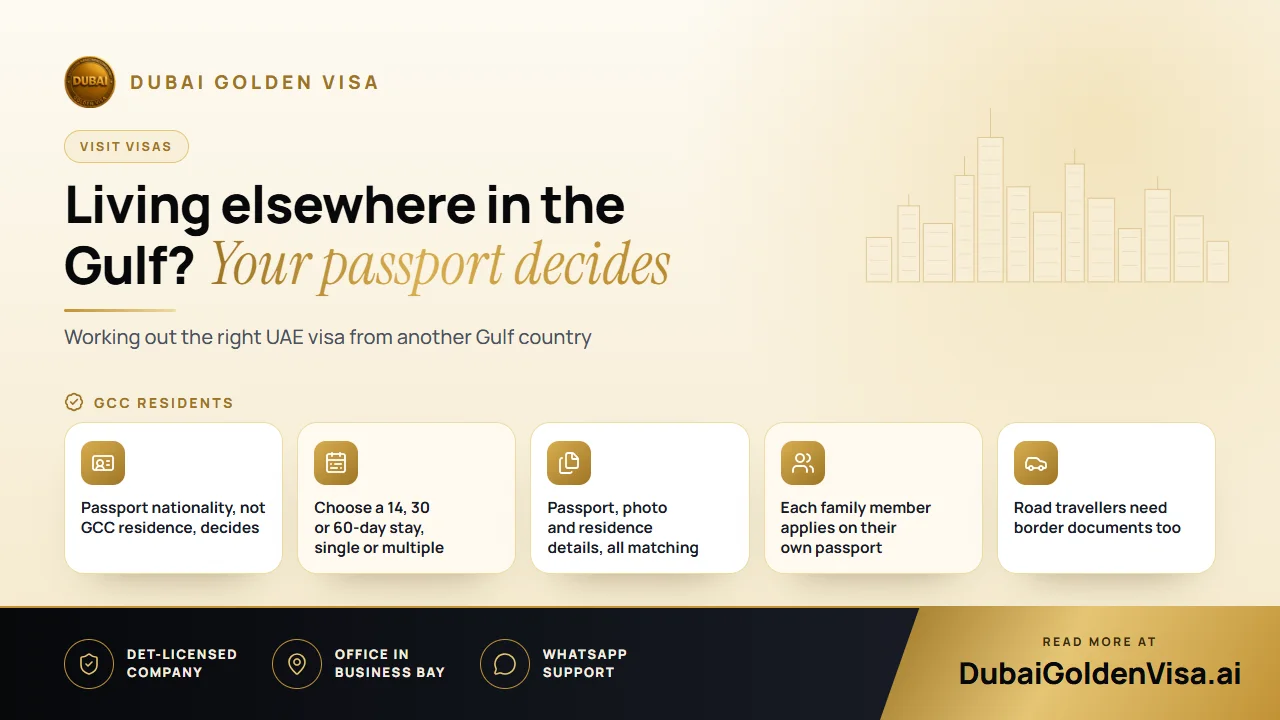
Your UAE entry conditions follow the passport you hold. Your residence permit can support your application, but it does not turn a foreign passport into a Gulf one. Two colleagues sharing the same office in Riyadh or Doha can have different requirements because they carry different passports.
01Step one: look at your passport
Start by checking the nationality printed on the passport you will travel with. Some nationalities can arrive in the UAE without a prior visa, and others must arrange one before they travel. Your living country does not change that answer.
If you do need to arrange a visa in advance, the next questions are how long you want to stay and whether you will enter once or several times.
02Step two: choose the visa shape
- A 14-day single-entry visa suits a short holiday, a business trip or a visit to relatives and friends.
- A 30-day or 60-day single-entry visa suits a longer stay in one go.
- A multiple-entry option suits an itinerary where you leave the UAE and come back, for example while visiting another country in between.
- If you are only connecting through a UAE airport, find out whether you will stay in the transit area or need to enter the country, since a transit stay is handled differently.
Availability depends on your passport and profile, so the options open to you may differ from those open to a colleague. We will confirm what applies to you and the current cost on WhatsApp.
03Documents to prepare
- A clear copy of the passport you will use, with the photo, name, number and expiry date easy to read.
- A recent photograph that follows the usual passport-photo rules.
- Your current residence details in the country where you live, such as the residence card or equivalent. Names for these documents differ by country, for example the Iqama in Saudi Arabia, the Civil ID in Kuwait or the resident card in Oman.
- Your planned travel dates and a place to stay.
- Anything extra requested for your particular profile, which is more likely if your travel history is unusual.
Tip
Match your details exactly
Type your name, passport number and dates exactly as they appear on the passport. A mismatch between the application and the document is among the most frequent causes of delay.
04Travelling with family
Every person needs an application using their own passport details, including children. A family of mixed nationalities, which is common among Gulf residents, may well need different visa types in the same booking. Check each passport on its own and apply for everyone at the same time, so that nobody is left waiting.
05If you are driving across
Many residents of Oman, Saudi Arabia and Qatar travel by road. A land crossing has its own checks, and officers may ask for your passport, visa, vehicle papers and insurance. Check the arrangements for your specific border, avoid arriving late at night with incomplete papers and make sure your car insurance covers the UAE.
06A tidy preparation routine
- 1
Confirm the passport rule
Check whether your nationality needs a visa before arrival.
- 2
Choose stay and entries
Match the visa to your dates and any side trips.
- 3
Collect the documents
Passport copy, photo and residence details, all legible.
- 4
Apply early
Standard processing usually takes two to three working days, and an express option of around 12 to 24 hours may be offered.
- 5
Check the approval
Read the visa for spelling, dates and entry type before you leave.
Do not forget that visitors do not get a grace period, so treat the last day of your visa as your last day in the UAE. If you would like a free check of your passport, residence and best route for the trip, message us on WhatsApp.
Questions about this topic
Not by itself. The rule follows your passport nationality, so check that first.
Questions about your own case?
Send us a message and an advisor will tell you which route fits and what you'll need.