
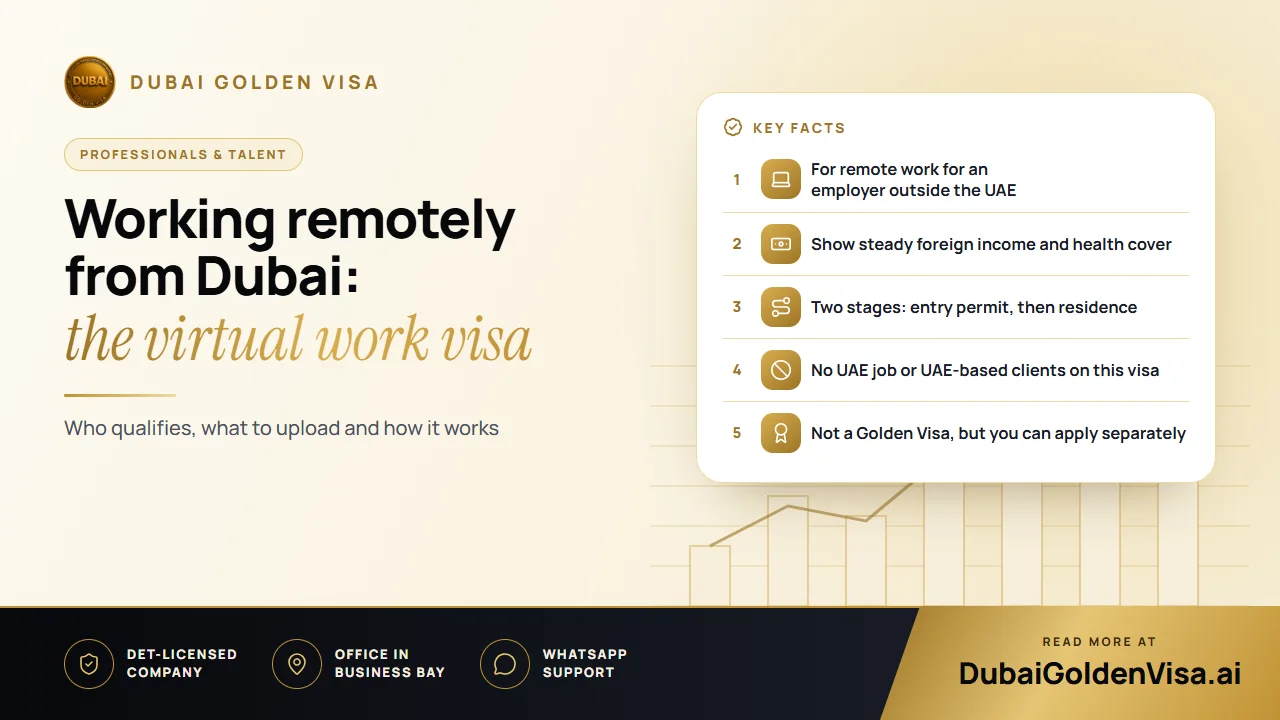
If your laptop is your office, you can base yourself in Dubai without a local employer. The virtual work visa gives remote employees, freelancers with foreign clients and owners of companies registered abroad a proper one-year residence.
It is a residence, not a long holiday, which matters in day-to-day life. This guide explains who it suits, what you need, how the process runs and where its limits are.
01What the visa is for
The core rule is that your money comes from outside the UAE. You can be a salaried employee of an overseas company, a freelancer whose clients are abroad, or a founder whose business is registered elsewhere. You cannot take a job with a UAE company or serve UAE-based clients on this visa, and doing so can put your residence at risk.
In return you receive an Emirates ID, and with it the practical things a tourist cannot do easily: open a bank account, sign a tenancy, get a local phone line and sponsor your family. The UAE also charges no personal income tax, although your home country may still have a claim, so check your own tax position.
02Who can apply
- Remote income from outside the UAE, whether as an employee, freelancer or company owner.
- A monthly income that currently needs to be about USD 3,500, shown as a steady pattern rather than one large payment.
- A passport with at least six months of validity.
- Valid health insurance that covers you in the UAE.
There is no degree requirement and no age limit. Income earned from a UAE employer or UAE-based client does not count, and this single point decides many applications.
03Documents to prepare
The first stage, the entry permit, needs a short set of documents in English or Arabic.
- A recent passport-style photo on a plain background.
- A copy of your passport.
- Proof of remote work, such as an employment contract, business licence or client agreements.
- Bank statements that show your income. Most applicants show three months, though six months looks more convincing.
- Evidence of health insurance valid in the UAE.
Later, once you have arrived, you add your medical fitness result and the Emirates ID application receipt.
Tip
Make the paperwork agree
Bank statements and employment letters are the documents most likely to cause a problem. Before you start the online form, check that names, dates and income figures match across everything you upload.
04The process from start to finish
- 1
Gather and cross-check documents
Collect everything above and make sure the details agree.
- 2
Apply online
In Dubai, you apply through the General Directorate of Residency and Foreigners Affairs, using the virtual work service and uploading each document as a PDF.
- 3
Pay and wait for the entry permit
Fees are paid online, and the entry permit is usually issued within a couple of working days.
- 4
Enter the UAE
The entry permit gives you a limited window after arrival to finish the residence steps.
- 5
Medical test and Emirates ID
Attend an approved centre for the medical test, then give your biometrics for the Emirates ID.
- 6
Receive your residence
The one-year residence is issued electronically once the previous steps are complete.
Most of it happens online. You only need to be present for the medical test and biometrics, and allowing one to three weeks overall is realistic, mostly because of appointment availability. The cost varies mainly with your health insurance, so we confirm the current government fees on WhatsApp before you start.
05Family, absences and renewal
You can usually sponsor a spouse and children on the same one-year basis. Each family member does their own medical test and Emirates ID. Avoid spending more than six months in a row outside the UAE, because standard residence visas can lapse after a long absence. At the end of the year, you renew with evidence that your income and health cover are still in place.
06How it compares with a Golden Visa
This visa is a one-year stepping stone. A Golden Visa lasts ten years, is self-sponsored and is exempt from the six-month absence rule, but it requires an investment, property or salary route, or an approved category such as exceptional talent. The remote work visa does not turn into a Golden Visa automatically.
For many people, though, it is a sensible first chapter. You settle in, decide whether the city suits you and, if you later buy a qualifying property or reach the salary route, apply for the longer visa separately.
If you are not sure whether your income setup qualifies, message us on WhatsApp for a free check before you apply.
Questions about this topic
No. It exists for remote work linked to employers, customers or companies abroad. A local job would need a different visa.
Questions about your own case?
Send us a message and an advisor will tell you which route fits and what you'll need.