
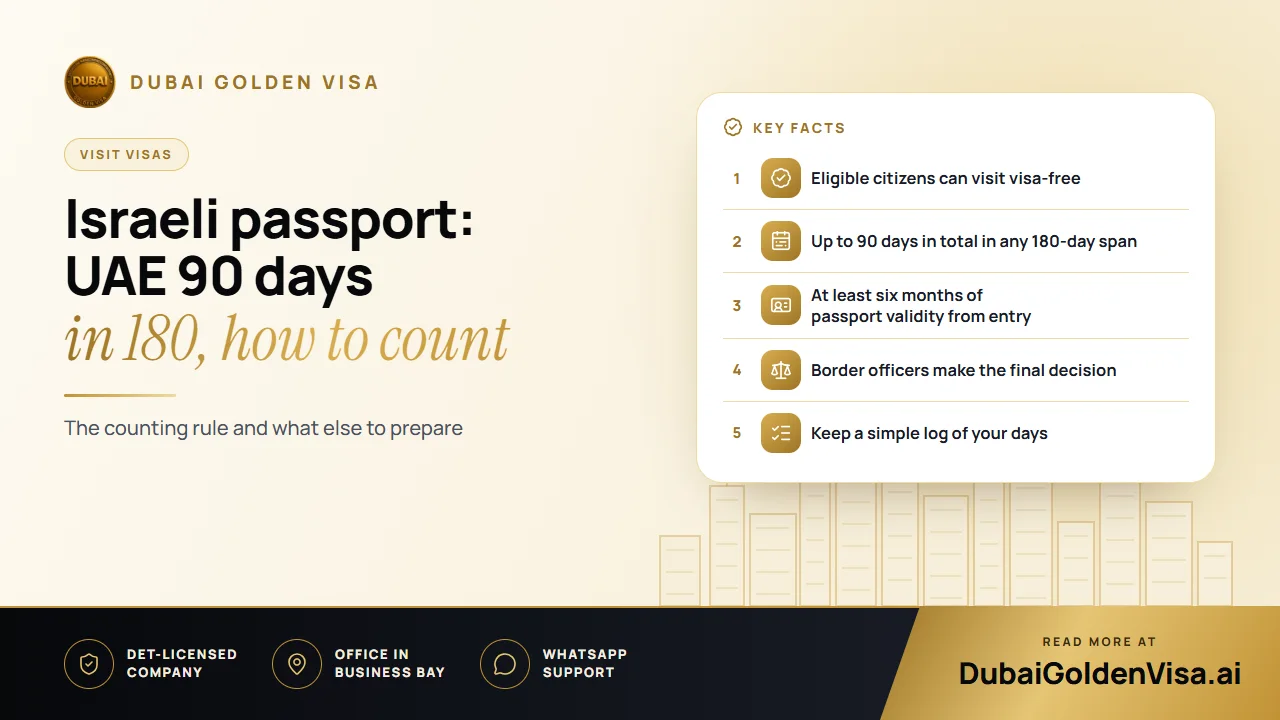
Short visits to Dubai have become a natural choice for many Israeli tourists, business people and families. For an ordinary Israeli passport, there is currently no need to apply for a tourist visa ahead of time. Instead, you are allowed to spend up to 90 days in the UAE within any period of 180 days.
That is far more generous than a standard 30- or 60-day tourist visa, but it comes with a rule that needs careful bookkeeping. Here is how the allowance works in practice and what to prepare.
01What the 90-in-180 rule means
The allowance is not 90 days per trip. It is a total across a rolling window. At any moment, look back over the previous 180 days and add up every day you spent in the UAE. That total must not pass 90.
A simple example helps. Suppose you spend 40 days in the UAE in January and February, then return in May for 30 days. By the end of that second trip you have used 70 days, so you can only add another 20 within the same 180-day window. As older days fall out of the window, your allowance builds back.
Tip
Count arrival and departure days
Count the day you arrive and the day you leave as days in the country. Keep a note on your phone with exact dates for every visit, so you are never guessing at the border.
02What to have with you
- An ordinary Israeli passport that is valid for at least six months from the date you enter.
- A confirmed flight out of the UAE, or an onward flight.
- Hotel bookings, or your host's address and phone number.
- Proof that you can fund your stay, such as a bank card.
- A printed itinerary, as a back-up to your phone.
Do not assume that a temporary passport, an emergency document or any non-passport travel document qualifies. The allowance is for ordinary passports, and anything else should be checked before you buy a ticket.
03Visa-free does not mean guaranteed
Eligibility lets you travel without an advance application, but the UAE border authorities always make the final entry decision. Officers may ask about the purpose of your visit, where you will stay and when you plan to leave. Be ready with clear answers and a tidy set of papers.
Because the rule is so generous, it is also easy to misuse. Regular back-to-back trips that look like living in the UAE can draw questions. If your real intention is to spend most of the year here, you need a proper residence route instead of repeated visits.
04Other routes for other purposes
The visa-free allowance covers ordinary tourism, family visits and short business trips. Different purposes call for different permissions:
- Working in the UAE needs an employment or freelance residence route.
- Living here long term needs a residence visa, such as through property, a company or a Golden Visa.
- Study, training or medical treatment can need a purpose-specific permit sponsored by the institution.
- A visit hosted by a resident relative can sometimes use a sponsored visit visa, although for an Israeli passport the free allowance usually makes this unnecessary.
A paid 30- or 60-day tourist visa is normally unnecessary for an eligible Israeli traveller, and so is a separate transit visa for a stopover. Do not pay for something your passport already covers.
05Keeping a clean record
- 1
Log every trip
Write the arrival and departure date of each UAE visit in a note or spreadsheet.
- 2
Check the window
Before booking a new trip, count back 180 days from your planned arrival and total the days already used.
- 3
Leave a margin
Do not plan to leave on exactly day 90. Delays and cancelled flights happen.
- 4
Check your passport
Confirm six months of validity from the planned entry date, not from today.
Overstaying a visitor permit costs AED 50 per person for every extra day, and there is no grace period. If you want a free check of your dates and the right route for your plans, message us on WhatsApp before you travel.
Questions about this topic
No. It is counted across a rolling 180-day window, so earlier visits within that window still count towards the total.
Questions about your own case?
Send us a message and an advisor will tell you which route fits and what you'll need.