
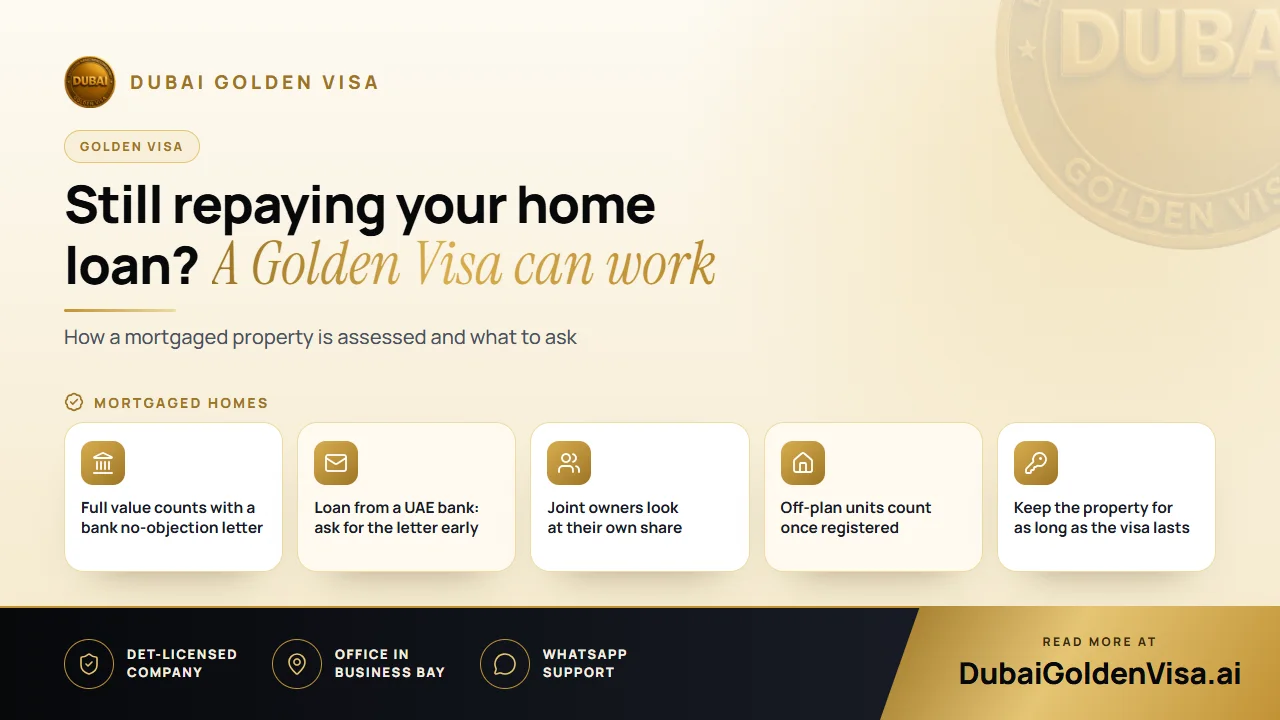
Plenty of Dubai owners hold off on a Golden Visa because they assume the bank still owns too much of their home. It is an understandable worry, but it is usually unfounded. A property with a mortgage on it can be the basis for ten-year residency, and the value that counts is the full value of the home, not just the part you have already repaid.
What makes the difference is paperwork. The authorities want to see that your lender is comfortable with a residence visa being issued against the property. This article walks through how that works, who it suits and where people stumble.
01How a financed home is assessed
For the property route, the headline test is that your UAE property is worth AED 2 million or more. A mortgage does not change that test. Your home is looked at on its full value, and the bank's involvement is dealt with through a single supporting document.
That document is a no-objection letter from the bank holding the loan. It tells the authorities your lender is content for the home to be used as the basis of your residence. It is also usual for the letter to show how much has been paid so far and how much is still owed, so the authorities can see the whole picture.
The loan itself should be with a bank operating in the UAE. A home loan taken out with a lender in your home country is a different matter, and it is not the kind of financing the process is built around. If yours is an overseas arrangement, talk to us before you start.
Tip
Ask the bank for the right letter
When you contact your relationship manager, say the letter is for a residence application based on property. Ask for a no-objection letter that shows the amount paid and the balance outstanding. A letter that leaves out either figure is the most common reason a mortgaged file comes back for correction.
02Joint owners and married couples
Joint ownership needs more thought than a mortgage does. If your name sits on a deed alongside a spouse, a sibling or a business partner, it is your own share that has to reach the threshold. Two names on one deed do not let you pool a single AED 2 million figure between you.
Take a couple who bought a AED 3 million home on a joint loan. Each of them owns half, worth AED 1.5 million, so neither reaches the line individually. The practical answer is often to restructure so that one spouse holds a qualifying share, then sponsor the other as a family member. A home worth AED 4 million or more split evenly can qualify both owners in their own right.
Since ownership structures can be rearranged before you apply but are awkward to change afterwards, this is a good moment to talk to us if you are planning a purchase.
03Off-plan and instalment purchases
A home you are buying from a developer on a payment plan is not a bank mortgage, but it can still work. An off-plan unit from an approved developer counts once it is registered with the Dubai Land Department through Oqood, and it counts regardless of how much you have paid so far. A signed sales contract on its own is not enough, because the registration is what the authorities rely on.
If you combine an off-plan unit with a completed one, the values can be added together as long as each is registered in your name.
04What to do if the value is short
A few practical options come up again and again when a property sits just under AED 2 million.
- Ask for a current valuation. If the market has moved since you bought, a Dubai Land Department valuation can replace the older price on your deed.
- Add a second property. A smaller unit registered in your name can carry the combined total over the line.
- Consider the two-year property investor visa in the meantime. Since 1 May 2026, a sole owner of a completed home needs no minimum value, while co-owners each need a registered share worth AED 400,000 or more. You stay resident while you build towards the bigger visa.
05What the process looks like
- 1
Gather your property papers
Your title deed or Oqood certificate, your mortgage contract and your passport.
- 2
Request the bank letter
Do this first, because it is the one document that depends on someone else's timetable.
- 3
Confirm the value
We check the deed value against the threshold and arrange a valuation if that helps.
- 4
File the application
Applications are made while you are inside the UAE. If you are abroad, an entry permit brings you in.
- 5
Medical test and Emirates ID
Both follow approval, and we book them for you.
Once your documents are complete, property files usually take around five to seven working days. Government costs for the main applicant are about AED 9,459, and each family member is roughly AED 2,710 plus AED 1,180 for the Emirates ID, with a medical test for adults. These figures are approximate, so we confirm the exact amount before you pay anything.
06After the visa is issued
The visa is tied to the property, so selling it, or letting a lender enforce its security, can end the basis for your residence. If you plan to refinance or sell during the ten years, speak to us first so we can map out your next step.
The good news is that Golden Visa holders are exempt from the six-month absence rule that can cancel ordinary residence visas, so you are free to travel and live abroad for long periods. You will need valid health insurance for yourself and any family you sponsor.
Not sure whether your mortgaged home qualifies? Message us on WhatsApp for a free check. Send a photo of your deed and the loan details, and we will tell you plainly where you stand.
Questions about this topic
Not at all. The lender just puts in writing that it is content for residence to be granted against the home. Approval itself is decided by the government.
Questions about your own case?
Send us a message and an advisor will tell you which route fits and what you'll need.