

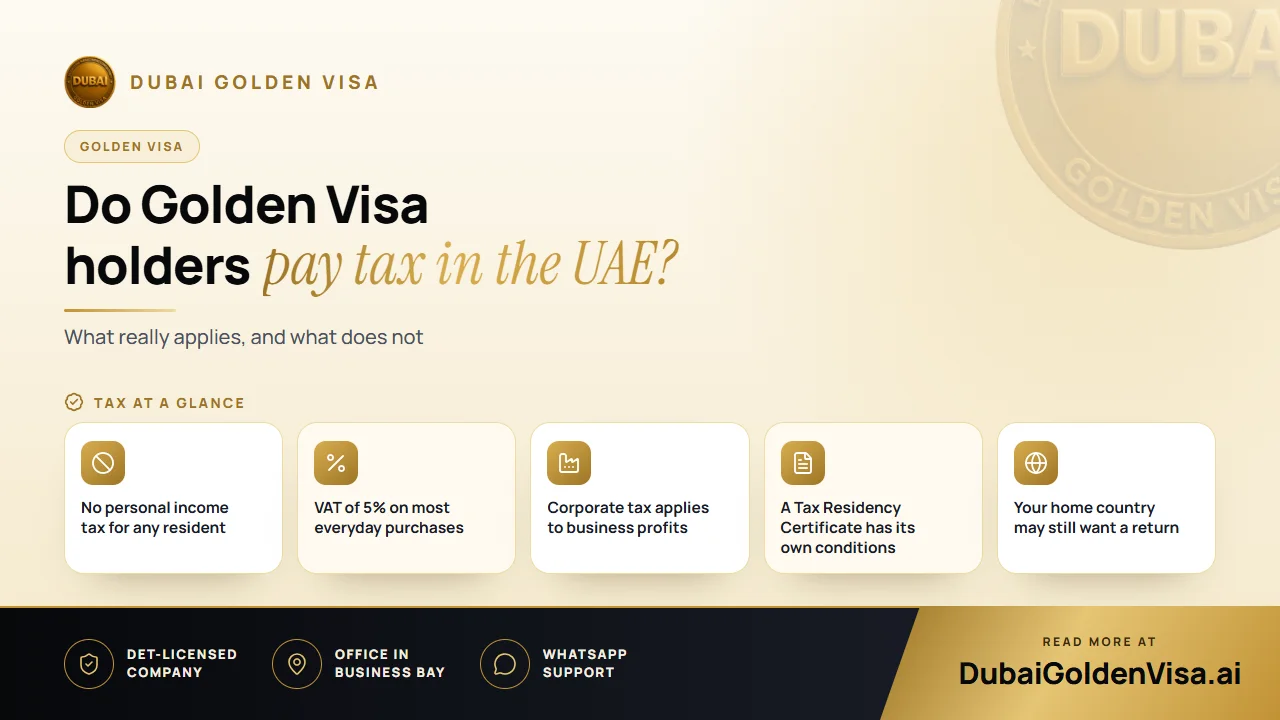
Ask ten people whether Golden Visa holders pay tax and you will probably get ten different answers. Some are certain it is all tax-free, others have heard that new charges are on the way. Neither camp is quite right, and the gap between them is where expensive mistakes happen.
The simplest way to think about it is this: your Golden Visa is an immigration document. It decides where you may live and for how long. Tax is decided by separate laws, and those laws look at what you earn, what you own and where you spend your time, not at the type of visa in your passport.
01What the UAE does not tax
At the moment the UAE has no personal income tax. Your salary, consultancy fees, dividends, bank interest and rent from a property you own personally are not taxed locally. There is also no tax on gains when you sell personal investments, no wealth tax and no federal inheritance tax.
None of this is a perk reserved for Golden Visa holders. A resident on a two-year employment visa is in exactly the same position. What the Golden Visa adds is stability: ten years of renewable residence without an employer sponsoring you, so you can plan around those rules for much longer.
02What you still pay
- VAT at 5% on most goods and services. It is a consumption tax, so you pay it when you buy, and it has nothing to do with your income.
- Corporate tax if you run a business. The federal regime that started in 2023 charges nothing on taxable profit up to AED 375,000 and 9% above that, with special treatment for qualifying free zone companies and a higher top-up tax for very large multinationals.
- One-off property costs, such as the Dubai Land Department transfer fee of 4% of the price, registration and trustee fees, plus municipality and service charges.
- VAT on certain commercial property and on some related services.
Corporate tax is the one that surprises people. It applies to a company's profit, not to the salary you take from it as an individual. But if you buy and sell property so often that it becomes a trade, or you earn through a business structure, talk to an accountant before you assume the income is outside the regime.
Tip
Visa residence is not tax residence
Holding a Golden Visa does not automatically make you a UAE tax resident. Tax residence is judged by the Federal Tax Authority, generally on days spent in the country or on a mix of a residence visa, days here and real personal or economic ties. Only a tax resident can request a Tax Residency Certificate, which is the paper foreign tax offices usually ask for under double taxation treaties.
03Your home country may still have a claim
The UAE not taxing you does not switch off the tax rules of another country. Some countries tax their citizens wherever they live. Others keep taxing you until you can show you have genuinely left, for instance by selling your home, ending local ties or spending fewer days there than their test allows.
That is why people moving here from high-tax countries usually treat the move as two projects: getting the visa, and formally ending or reducing tax duties back home. We handle the first. For the second, speak to a qualified tax adviser in the country you are leaving.
04A short checklist before you rely on tax-free status
- 1
Count your days
Keep a simple record of the days you spend in the UAE each year. You may need it to prove tax residence later.
- 2
Check your other country
Find out whether your citizenship or old residence still creates a filing duty, and what ends it.
- 3
Separate personal and business income
If you own a company, know which profits sit inside it and whether corporate tax registration applies.
- 4
Keep property records
Hold on to deeds, purchase receipts and service charge statements, particularly if you let out more than one unit.
- 5
Ask for tailored advice
Rules change. A short call with a tax professional costs far less than fixing a mistake.
Tax rules sit outside what a visa service can advise on, and we won't pretend otherwise. What we can do is make sure the residence side is correct, so that the tax planning you do rests on a visa that is secure.
Thinking about a Golden Visa and not sure which route suits you? Message us on WhatsApp for a free check and we will tell you plainly what you qualify for and what it involves.
Questions about this topic
No, the UAE does not levy personal income tax on residents of any visa type. Your obligations in another country are a separate matter.
Questions about your own case?
Send us a message and an advisor will tell you which route fits and what you'll need.