
Most residency routes ask for money, a business or a high salary. The student category is different. It is built for young people whose results stand out, and it lets them stay in the UAE because of what they have achieved in the classroom rather than what they can invest.
That makes it a valuable option for families who have lived here for years and worry about what happens when a child finishes school, and for talented graduates who want to start their career in the country. Below we explain how the category works in practice.
01Who the student category is for
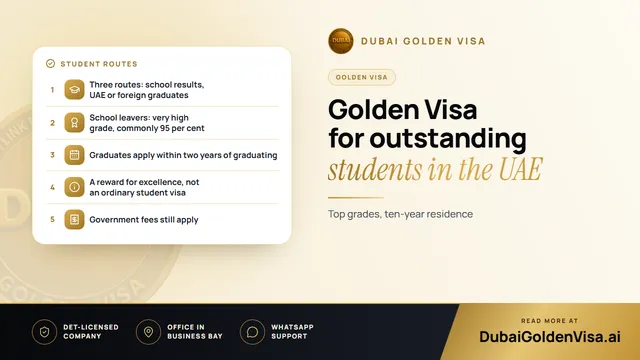
There are three broad groups. The first is pupils finishing secondary school in the UAE with exceptionally high final-year results. The second is graduates of UAE universities with a strong grade average. The third is graduates of highly ranked universities abroad, judged by well-known global rankings.
In each case the visa holder is their own sponsor. You do not need an employer, and you do not depend on a parent's residence once the visa is issued. Depending on the track, the visa runs for five or ten years and can be renewed while you continue to meet the conditions.
02The usual benchmarks
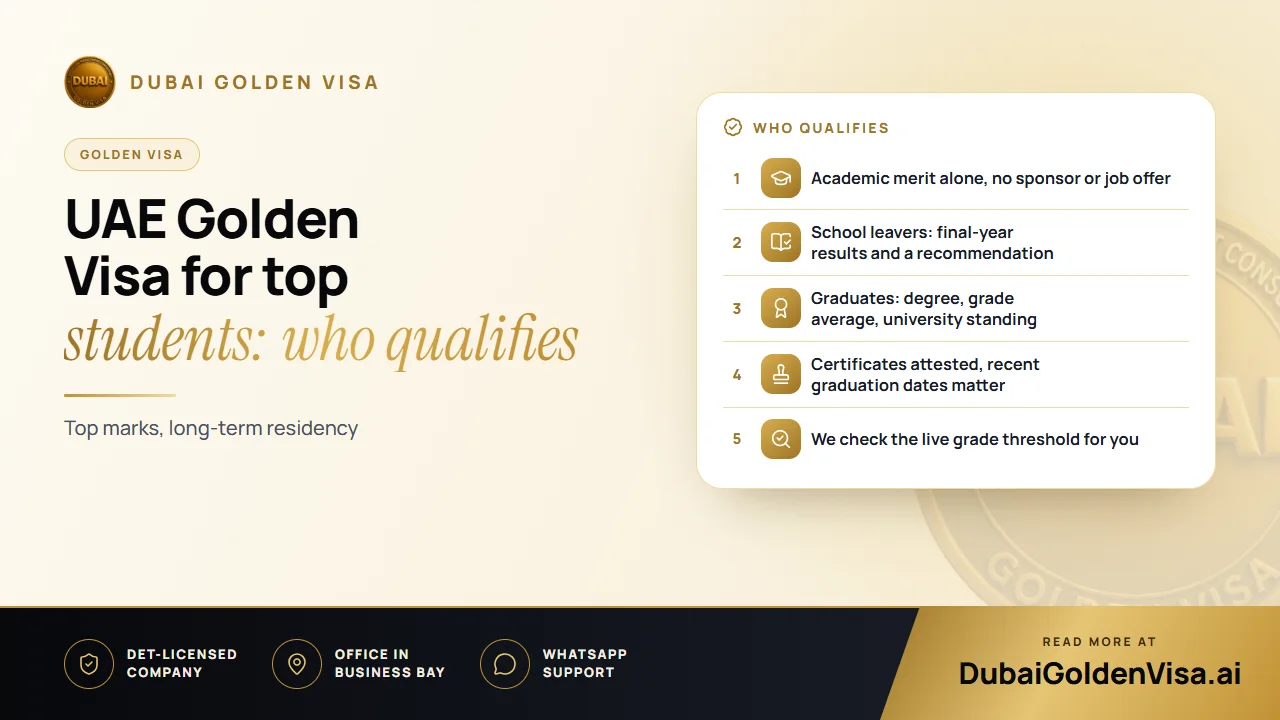
- School leavers: a final-year average of around 95 per cent or higher from a UAE public or private school, backed by a recommendation from the Ministry of Education.
- UAE university graduates: a bachelor's, master's or doctorate from an approved institution, with a grade point average that depends on how the university is rated. Higher-rated institutions face a lower bar than others.
- Overseas graduates: a degree from a university in the global top 100, a strong grade average at bachelor level, and an attested, recognised certificate.
- Timing: most graduate routes expect you to have finished your degree recently, usually within the last couple of years.
Tip
Thresholds are not the same everywhere
Different guides quote different grade averages, and the authorities adjust them. Before you spend money on attestation, send us your transcript and we will check it against the requirement in force today.
03What goes into the file
Strong marks alone do not complete an application. The paperwork has to prove them in a form the authorities accept, and this is where most delays begin.
- A passport valid for at least six months, plus a recent photo on a white background.
- Your final certificate or degree, attested for UAE use, with official transcripts showing your results.
- A recommendation or nomination letter from the Ministry of Education or the university, depending on your track.
- An equivalency certificate where the qualification came from overseas.
- Your current visa and Emirates ID if you already live here.
- A UAE medical fitness result. Some graduate tracks also ask for a police clearance.
Keep scans clear and complete. Blurred copies, expired passports and mismatched spellings of your name between documents are the most common reasons a file comes back for correction.
04How the application runs
- 1
Check the category and the numbers
Confirm which track fits you: school leaver, UAE graduate or overseas graduate. Compare your results and graduation date with the current threshold.
- 2
Attest and gather documents
Get your certificates attested and prepare the recommendation letters. This step usually takes the longest, so start early.
- 3
Request nomination where required
Some tracks need a nomination before the residency file can be opened. This is normally requested online through the federal identity authority using your UAE Pass.
- 4
File the application
The residency application is submitted through the relevant portal for your emirate, with all documents uploaded and the government fee paid.
- 5
Medical test and Emirates ID
After initial approval you complete the medical fitness test and Emirates ID biometrics. The visa is then issued electronically.
05Family and renewal
A student holder can generally bring parents, which is a big help for a young person who is otherwise tied to the family's own visa. Rules on siblings are narrower, and a brother or sister normally needs a route of their own. We confirm how it applies to your household when we review your case.
Renewal usually depends on continuing to meet the conditions of the category, so keep your academic records, insurance and a clean immigration record in order. Start the renewal a month or two before expiry rather than at the last minute.
06Mistakes worth avoiding
- Applying under the wrong track, for instance using a university route when the school route fits.
- Letting the graduation window pass before you apply.
- Skipping the attestation step, or attesting only some documents.
- Assuming a lower grade average can be balanced by a good university name. In most tracks it cannot.
- Submitting names or dates that differ between your passport and your certificates.
If you or your child is finishing school or university with top results, message us on WhatsApp for a free check. Send a photo of the certificate or transcript and we will tell you which track fits and what to prepare first.
Questions about this topic
Generally no. The category rewards completed results, so you apply once your final certificate or degree is issued.
Questions about your own case?
Send us a message and an advisor will tell you which route fits and what you'll need.