
Research and healthcare are two of the sectors the UAE most wants to grow, and its residence rules reflect that. If you spend your days in a lab, a clinic or a hospital ward, a ten-year Golden Visa may be within reach, and it can be held in your own name rather than your employer's.
The details differ between the categories, so it is worth understanding how each one is judged before you start collecting papers.
01Scientists and researchers
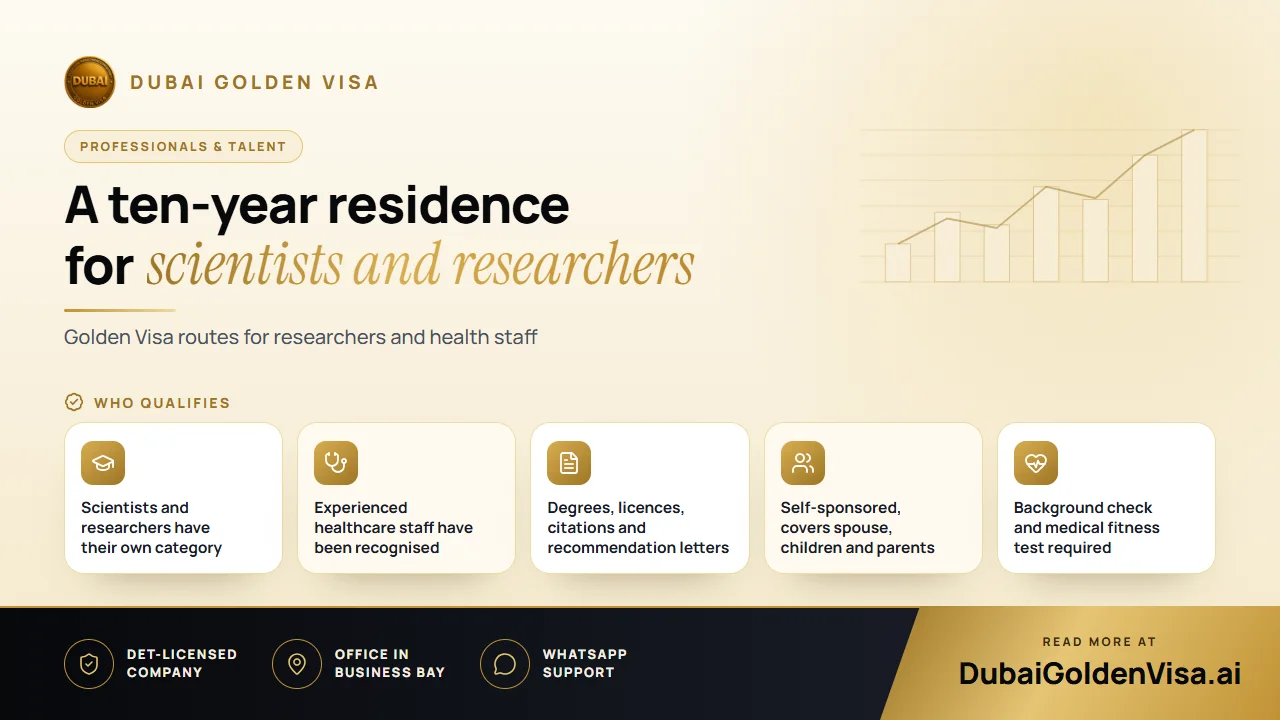
This category is for people with advanced qualifications and a track record of useful work. Abu Dhabi has published fairly measurable standards. Applicants are generally expected to hold a master's degree or doctorate in a field such as life sciences or engineering, ideally from a well-ranked university.
Research impact is then looked at in numbers. The reference points mentioned include a field-weighted citation index of at least 1.0 together with an H-index of 10 or more, or an H-index above 20 on Scopus. Researchers who have launched research and development programmes with real-world results can also make a case, even without a long publication list.
Tip
Where the numbers come from
Citation figures should be taken straight from a recognised research database and saved as they appear on the day you apply. Screenshots or exports from the platform are more convincing than figures typed into a letter.
02Nurses and other healthcare professionals
Healthcare workers have also been recognised. In 2025, a large group of nurses with more than fifteen years of service in Dubai's public health system received Golden Visas as a mark of long service.
Beyond that, professionals holding a valid UAE licence from the health regulator for their emirate are often strong candidates, especially in areas the country is prioritising, such as public health, molecular medicine and clinical innovation. A licence alone does not guarantee approval, but a licence plus a clear record of achievement gives you something to build on.
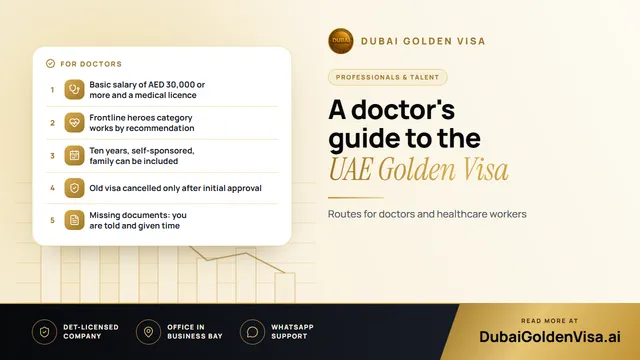
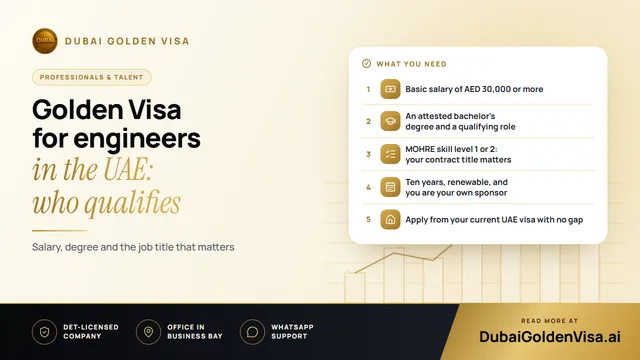
Doctors and specialists on a high salary may also be able to use the skilled professional route, which looks at a basic salary of AED 30,000 or more, an attested bachelor's degree and a role in MOHRE skill level 1 or 2.
03What the visa gives you
- Ten years of residence, renewable, with no need for an employer to sponsor you.
- The freedom to change jobs, take a sabbatical or move your research in a new direction without losing your status.
- Sponsorship for your spouse, your children (sons with no age cap, unmarried daughters at any age), your parents and household staff.
- No six-month absence rule, which suits academics who travel for conferences, fieldwork or collaborations.
- The UAE has no personal income tax, so grants, salaries and consulting fees are not reduced by it.
04How to prepare your application
- 1
Audit your evidence
List your degrees, licences, publications, grants, patents and any awards. Decide which items show your strongest impact.
- 2
Attest what needs attesting
Degrees usually need to be attested for UAE use, so start this early because it can take time.
- 3
Gather recommendations
Letters from senior colleagues, institutions or employers help explain why your work matters.
- 4
Apply through the right channel
Abu Dhabi has a dedicated residents office, and the federal platform handles applications elsewhere. Which one applies depends on your emirate and category.
- 5
Complete the final checks
A clean criminal record certificate, the medical fitness test and Emirates ID biometrics follow approval.
05Mistakes to avoid
The most common problem is submitting evidence that cannot be verified: unsigned letters, out-of-date licences or citation numbers with no source. The second is choosing the wrong category. A researcher who also earns a high salary may find the skilled professional route simpler than the talent route, and the reverse can be true for someone whose salary is modest but whose research record is excellent.
If you are not sure where you fit, message us on WhatsApp for a free check. We will look at your qualifications and tell you which route is most likely to work.
Questions about this topic
No. If you are abroad, an entry permit brings you into the country so you can finish the medical test and biometrics.
Questions about your own case?
Send us a message and an advisor will tell you which route fits and what you'll need.