

Millions of people live in the United States on very different passports and statuses, and plenty of them want a Dubai trip, whether for family, a holiday or a stopover. The question we hear most is whether being a US resident makes entry easier. Sometimes it does, but not as often as people hope.
This guide explains how the UAE usually looks at travellers coming from the US, what to prepare and how to avoid the mistakes that cause delays.
01Start with the passport in your hand
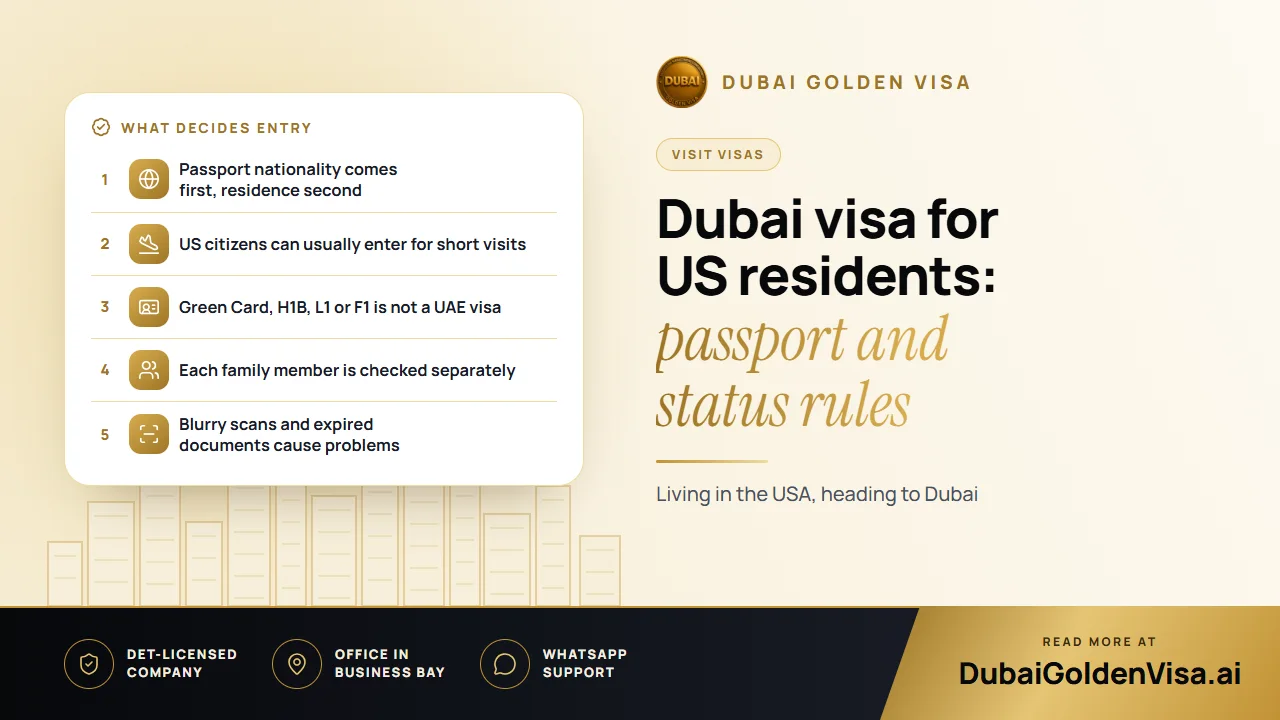
Immigration officers look at the nationality on the passport you present. If you hold a regular US passport, you can normally receive a visitor entry on arrival for a personal stay of up to 30 days, as long as the passport is valid for at least six months. Diplomatic, official and emergency documents can follow different rules.
If you live in the US but carry another country's passport, the picture changes. Your Green Card or work visa shows that you are lawfully in the US, but it does not give every nationality visa-free entry to the UAE. Many passport holders still need a pre-arranged tourist visa.
Tip
A US stamp is not a UAE visa
A Green Card, I-797, I-20 or I-94 proves your status in the United States. It is useful as supporting evidence, but never assume it replaces UAE permission to enter.
02How different US statuses fit in
- US citizens on a regular passport: usually no advance visa for a short personal visit.
- Green Card holders on another passport: a pre-arranged visa in most cases, or a residence-based route where the nationality is eligible.
- H1B and L1 workers: assessed by passport. Your US work status is supporting evidence, and a concession may apply to certain nationalities.
- F1 students: assessed by passport, and you should carry current student documents in case you are asked.
- Visitors in the US on a B1 or B2 visa: applying from the US does not make you a US resident for UAE purposes.
- Refugee or travel document holders: check your case before paying, since airlines and the UAE may treat these documents differently.
In 2026, the UAE federal authority announced a residence-based entry arrangement for holders of certain nationalities who live in the US and some other listed countries. Terms such as the permitted stay and extensions are specific, so please ask us to confirm whether your passport qualifies at the time you travel.
03Choosing the visa type
For those who do need a visa, the choices are familiar. A 14-day visa suits short holidays, 30 and 60 day visas cover longer family visits, and multiple-entry versions help if you plan several trips. If you are only passing through the UAE, a 48 or 96 hour transit visa may be enough, provided you have confirmed onward travel.
One visa covers the whole country, so Abu Dhabi and the other emirates are open to you on the same permit. No tourist or transit visa allows you to work, and doing so can create problems for any future UAE application.
04Documents to gather
- Passport bio page, valid for at least six months, plus the cover if requested.
- A recent colour photo on a plain white background.
- Evidence of US status where it applies, such as a Green Card or valid visa documents.
- Return or onward ticket, plus hotel or host details where requested.
- Travel insurance if it is required for your stay.
Names, dates and passport numbers must match across every upload. Cropped edges, glare and unreadable numbers are a frequent cause of requests for resubmission, and an expired status document can hold things up.
05Timing and common slip-ups
Standard tourist visas filed through our partner tourism agency usually take two to three working days once documents are complete. Express handling is about 12 to 24 hours. Leave extra time if you are applying for a whole family, because each person is reviewed individually.
- 1
Look at the passport
Work out the entry route for the nationality printed on it, not for where you live.
- 2
Select the visa
Choose the stay length and the number of entries.
- 3
Upload and review
Add clear documents and check every name and number twice.
- 4
Check the result
Verify validity dates and conditions on the issued e-visa before you book or fly.
Not sure how your passport and US status fit together? Message us on WhatsApp for a free check before you pay for anything, and we will confirm the correct route for you and your family.
Questions about this topic
Holders of a regular US passport can normally enter for a personal stay of up to 30 days without applying in advance. Official or emergency passports may be treated differently.
Questions about your own case?
Send us a message and an advisor will tell you which route fits and what you'll need.