
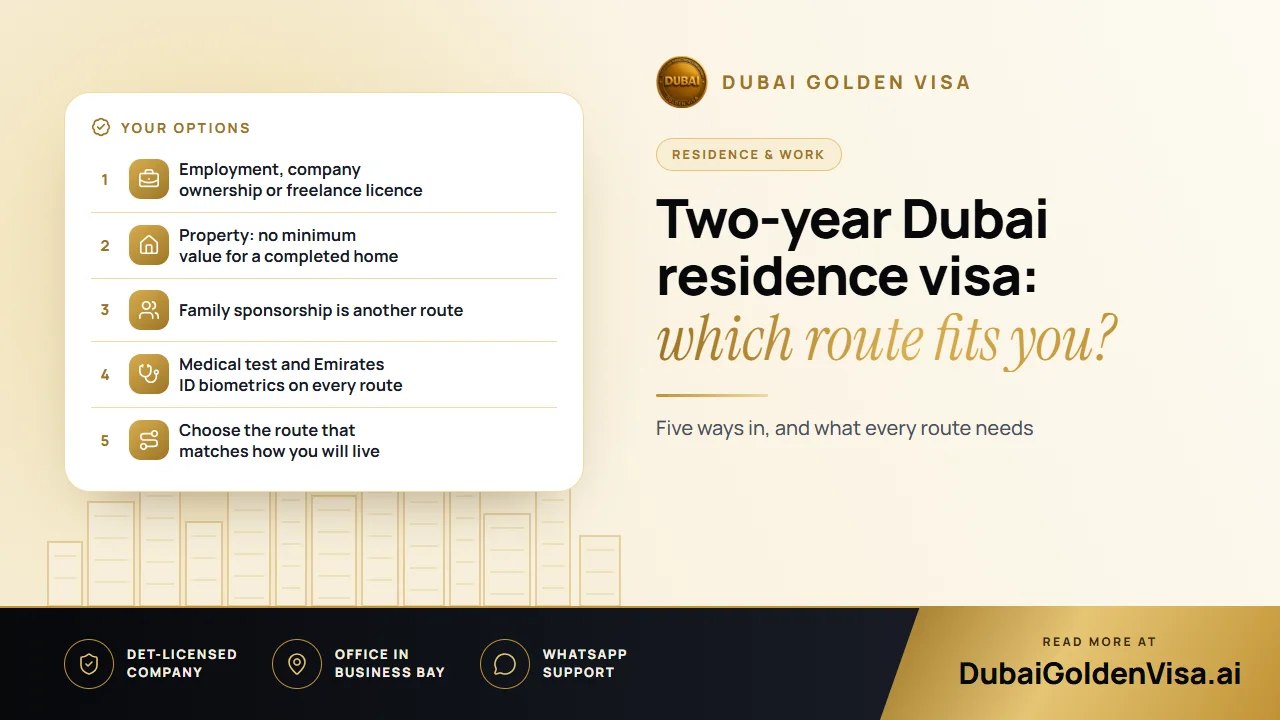
Most people who ask about a two-year Dubai visa really want to know the quickest legitimate way to become resident. The right answer depends on your circumstances, because the visa comes with a sponsor, and the sponsor can be an employer, your own company, a property you own or a family member.
This guide sets out each route so you can see which one lines up with your plans, and what the common steps are afterwards.
01The main routes
02Employment
If a UAE-licensed company hires you, it obtains your work permit and residence visa. This is the most common route for professionals moving here. The employer normally handles the paperwork through MOHRE and the immigration authority, and your sponsorship ends or transfers if you change jobs.
03Owning or partnering in a company
Shareholders of a company set up on the mainland or in a free zone can qualify for a two-year investor or partner visa. It is self-sponsored, which gives you more control over your status, and it can be renewed while the business stays licensed and active.
04Owning property
Owners of a completed home in Dubai can apply for a two-year investor visa. Since 1 May 2026, a sole owner needs no minimum property value, and co-owners each need a registered share worth AED 400,000 or more. Off-plan homes do not count for this visa. Residence stays valid while you keep the property.
05Family sponsorship
A resident who meets the income and housing requirements can sponsor a spouse and children. Sons can be sponsored up to age 25 on standard visas, and unmarried daughters have no age limit. Parents can be sponsored too, subject to a monthly income of AED 20,000 and suitable housing.
06Freelance and remote work
Freelancers and remote professionals can use freelance licences or virtual work arrangements, where available, as a basis for residence. Rules and costs vary by licensing body, so we check the current terms for your field.
Tip
Start with how you will earn
If your income comes from an employer, start with employment. If from your own business, start with company ownership. If you own a home, property may be the lightest option. Choosing the route that matches reality keeps renewals simple.
07Steps that are common to all routes
- 1
Choose your sponsor route
Employer, company, property or family.
- 2
Prepare documents
Passport with at least six months' validity, a passport-style photo, and proof of the route such as a contract or title deed.
- 3
Obtain health insurance
Cover valid in the UAE is needed before the visa is issued.
- 4
Medical test and biometrics
A medical fitness test (about AED 285) is followed by Emirates ID biometrics.
- 5
E-visa and Emirates ID
Your residence is issued electronically, and the Emirates ID follows, usually in three to five working days.
08What a residence visa lets you do
Once your visa and Emirates ID are issued, you can open a bank account, rent or buy a home, sign up for utilities and a mobile contract, enrol children in school, and in many cases apply for a UAE driving licence. The Emirates ID becomes your everyday proof of identity, so it is worth keeping it safe and renewing it on time.
Remember that residence also brings obligations. Keep your insurance active, tell the authorities if your job or address changes, and avoid long absences on a standard visa, since staying outside the UAE for more than six months can cancel it.
09Costs and renewal
Government costs vary widely between routes and between emirates, so any single figure can mislead. We confirm today's cost for your exact visa on WhatsApp. For renewal, plan ahead: apply before expiry, complete the medical, and renew your insurance and Emirates ID in step.
Not sure which route fits? Tell us about your work and plans on WhatsApp and we will suggest the best option with a free check.
Questions about this topic
Yes. Employment, company ownership, family sponsorship and freelance licences all lead to two-year residence.
Questions about your own case?
Send us a message and an advisor will tell you which route fits and what you'll need.