
Hospitals and clinics across the Emirates depend on nurses, and the immigration system has started to treat the profession accordingly. If you work in a UAE facility and hold a valid licence, ten-year residency may be more realistic than you think.
There is no single form called the nurse visa, though, and that is where confusion starts. What you actually apply under depends on your pay, your qualifications and how your role is classed. Here is how to work out which door you should knock on.
01Two ways a nurse can qualify
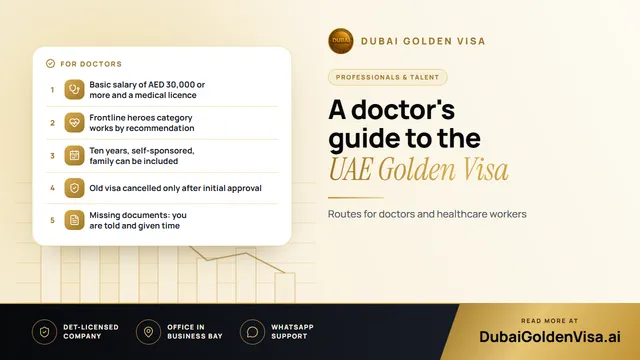
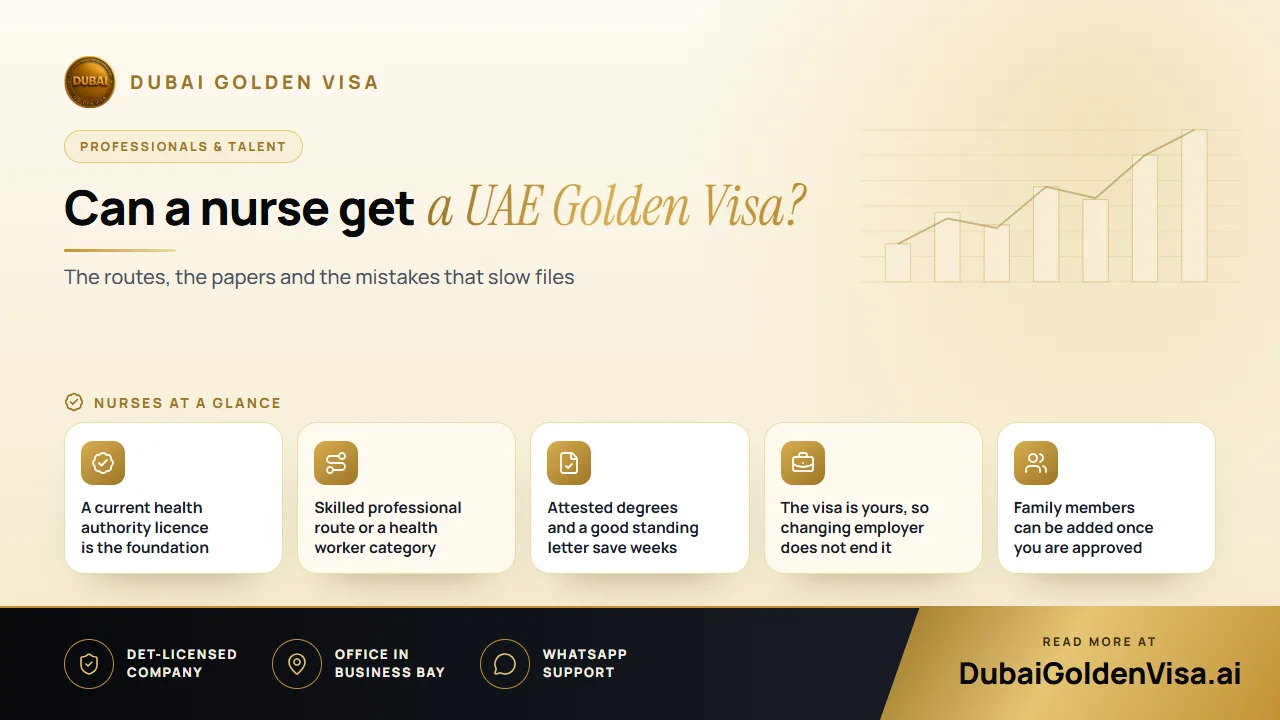
The first is the skilled professional route. It asks for a basic salary of AED 30,000 or more a month (the basic figure, not allowances), a bachelor's degree attested for UAE use and a job that sits in MOHRE skill level 1 or 2. Senior nurses, nurse managers, advanced practice nurses and specialists in intensive care or theatre are the people who most often meet this test.
The second is the recognition route for health workers and frontline professionals. Here the case rests on your record and service rather than on a salary figure, and a nomination or approval from a relevant authority may be part of the file. Because the wording and the criteria for this category can change, we always check the current position before telling a nurse that she or he qualifies.
Tip
Do not rely on years of service alone
Some guides suggest that five years in a recognised healthcare organisation is enough on its own. We would not build a plan around that. What the authorities test is the route you apply under, so work out the route first and then gather the evidence for it.
02Licence and professional standing
Whichever route you take, you need an active licence from the authority that regulates your emirate: the Ministry of Health and Prevention, the Dubai Health Authority or the Department of Health in Abu Dhabi. If your licence is close to expiry, renew it before you file. An application that rests on a lapsed licence gets stuck quickly.
A certificate of good standing from your licensing body shows that you have no disciplinary history. It is worth ordering early, since it may take a while to arrive and it often has to be attested before it can be used.
03Documents to collect
- Passport with at least six months left, plus recent passport photographs
- Current health authority licence
- Bachelor's degree or nursing diploma, attested for UAE use
- Employment contract and salary certificate showing basic pay (for the professional route)
- Letter of good standing from the licensing body
- Experience letters from past and present employers
- Police clearance from the UAE or your home country, where requested
- Current visa and Emirates ID
- Valid UAE health insurance
- A letter of no objection from your employer, if the file needs one
Foreign certificates usually need a chain of attestation, and anything not in Arabic or English needs a legal translation. Start this part first. It is the step that most often decides whether a file takes two weeks or two months.
04From application to Emirates ID
- 1
Check your route
We compare your salary, degree and job classification with the current criteria and tell you which category is strongest.
- 2
Prepare and attest
Documents are gathered, translated and attested so that nothing is rejected on a technicality.
- 3
File the application
The file goes to GDRFA in Dubai or ICP elsewhere. If you are still abroad, an entry permit brings you in to finish.
- 4
Initial approval
Your current visa is cancelled only once this approval arrives, so you are never left without status.
- 5
Medical and biometrics
You complete the medical fitness test and Emirates ID biometrics, and the ten-year visa is issued.
Salaried files usually take two to four weeks once the papers are complete. Waiting for attested documents is normally the slow part, not the government review.
05What it costs and what it gives you
For a route other than property, the government costs come to roughly AED 4,175 for the main applicant. Each family member adds about AED 2,710 plus AED 1,180 for the Emirates ID, and adults also pay about AED 285 for the medical test. Attestation, translation and insurance are separate, and we confirm today's figures on WhatsApp before you commit.
In return you get ten years of residency that you sponsor yourself. If you leave your hospital, move to another emirate or take a break from work, the visa stays valid. You are also exempt from the six-month absence rule that can cancel ordinary residence visas, which suits nurses who spend long periods with family abroad. Your spouse, children and parents can be added to your file.
06Mistakes that slow nurses down
- Filing with a licence that is about to expire
- Submitting a degree that has not been attested for UAE use
- Quoting total pay instead of basic salary on the professional route
- Forgetting the good standing letter until the last week
- Choosing a category by guesswork rather than checking it first
If you are a nurse in the UAE and wondering where you stand, message us on WhatsApp with your job title, licence and salary slip. We will give you a free, plain answer on which route fits and what to prepare.
Questions about this topic
No. The Golden Visa is tied to you, not to an employer. Changing jobs does not cancel it, though on the salary route you should check that your new role still fits the criteria at renewal.
Questions about your own case?
Send us a message and an advisor will tell you which route fits and what you'll need.